ONLINE • SENTRY & GITHUB HOTFIX ENGINE
ACTIVE
Felix monitors unhandled exceptions across Sentry, Bugsnag, and CloudWatch in real time, correlates stack traces to offending commits via git blame, synthesizes reproduction unit tests, and submits ready-to-merge hotfix pull requests before users file support tickets.
Felix acts as an autonomous on-call senior debugging engineer, reducing mean-time-to-resolution (MTTR) from hours to minutes.
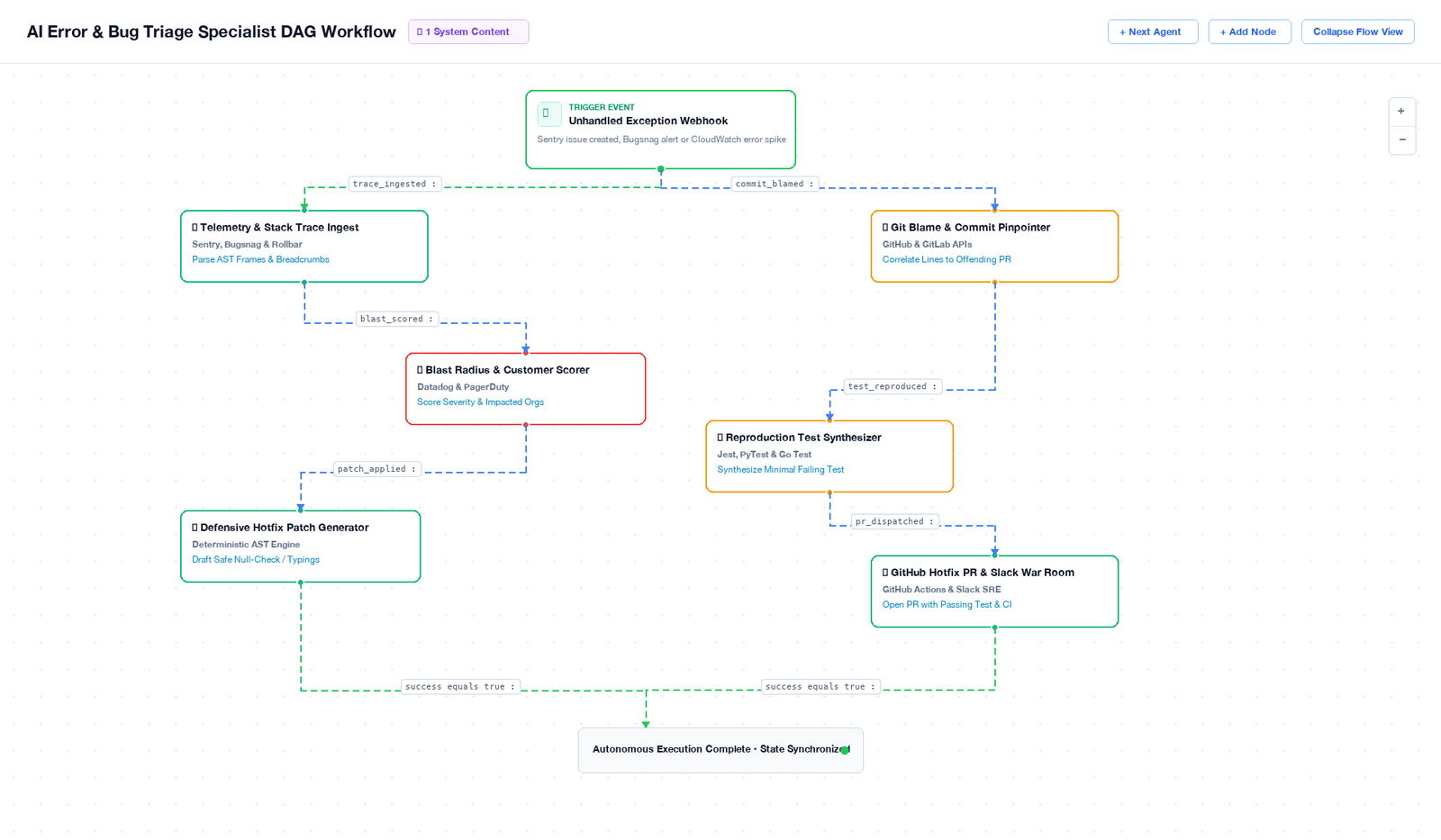
Ingests webhook streams from Sentry, Bugsnag, Rollbar, and AWS CloudWatch, parsing breadcrumbs, device metadata, and execution contexts.
Traces stack frames back through source maps to the exact repository commit and pull request that introduced the bug using git blame.
Synthesizes minimal failing unit tests in Jest, PyTest, or Go testing that accurately recreate the exact exception in staging environments.
Drafts clean, idiomatic bugfix code patches, commits to a hotfix branch, and opens a GitHub pull request with detailed root-cause notes.
Calculates the business blast radius: number of unique users affected, ARR of impacted enterprise accounts, and whether revenue flows are stalled.
Groups cascading errors resulting from a single database blip or downstream third-party outage, preventing alert floods in Slack.
Engineers lose 30% of their sprints manually copying Sentry stack traces, tracking down PR commits, and writing basic bugfixes. Felix automates the entire debugging loop.
A transient network blip triggers hundreds of duplicate alerts, drowning out critical customer checkout failures.
Felix clusters cascading errors into a single incident root cause, suppressing 94% of duplicate notifications.
Engineers spend hours reading minified stack traces, finding the commit author, and reproducing the bug locally.
Felix decodes source maps, blames the commit, and opens a hotfix PR with a passing regression test in under 60 seconds.
Developers quickly patch bugs in production without adding unit tests, causing the bug to resurface next sprint.
Every hotfix generated by Felix includes an executable regression test that runs permanently in CI.
Critical enterprise accounts experience silent errors on custom dashboards without filing support tickets.
Felix correlates Sentry user IDs with CRM account values, prioritizing enterprise account bugs instantly.
On-call engineers are woken up at 3 AM to investigate trivial null-pointer exceptions in peripheral endpoints.
Felix autonomously triages, patches, and stages peripheral bugs, letting engineers sleep through low-severity errors.
StackTrace lives in Sentry, tickets live in Jira, and discussions live in Slack, losing critical context.
Felix synchronizes incident timelines, PR links, and reproduction tests across all engineering tools.
Comparing legacy manual processes with RhinoAgents autonomous execution.
| Operational Vector | Traditional Approach | Autonomous AI Employee |
|---|---|---|
| Error Triage & Root Cause Pinpointing | 45 to 180 minutes manual analysis | < 30 seconds automated AST correlation |
| Reproduction Unit Test Creation | Manual test authoring (often skipped) | Automated minimal failing test synthesis |
| Hotfix Pull Request Turnaround | 2 to 6 hours developer sprint delay | < 60 seconds ready-to-merge PR in GitHub |
| Alert Noise Suppression | Manual Sentry rule management | 94% cascade and fingerprint clustering |
| Mean Time to Resolution (MTTR) | Average 4.8 hours across teams | Under 10 minutes from exception to deploy |
Stack trace to root cause
Clustered duplicate alerts
Reproduction tests in every PR
Accelerated incident resolution
Every AI Employee inherits sovereign enterprise-grade infrastructure designed for strict privacy, zero hallucinations, and total auditability.
Continuous indexing of internal documentation, standard operating procedures, and company policies with role-level access control.
Cross-session persistence that remembers vendor nuances, team preferences, and workflow context without retraining foundation models.
Strict schema enforcement and policy check validation eliminate hallucinations before actions or mutations occur in downstream systems.
Every prompt, tool execution, API call, and parameter mutation is cryptographically signed and stored in audit-ready compliance ledgers.
Require explicit 1-click approvals for high-stakes decisions, external communications, or sensitive mutations via Slack, Teams, or Dashboard.
Felix integrates seamlessly into your error monitoring platforms, source control repositories, and CI/CD pipelines.
Telemetry & Breadcrumbs
Code & Blame
Regression Verification
War Rooms & Alerts
Need a custom internal API or legacy on-prem database? Connect via OpenAPI, Webhooks, or Python SDK in under 15 minutes.
From zero to autonomous execution in under 10 minutes. Follow the verified DAG workflow or customize nodes using our visual builder.
Secure OAuth 2.0 handshake with your ecosystem tools with granular read/write permission scopes.
Define operational thresholds, budget limits, escalation triggers, and human review boundaries.
Run dry-run synthetic events in sandbox mode to verify accuracy before authorizing production mutations.
Switch to live mode. The agent autonomously monitors events, executes tasks, and alerts your team.
Multi-region serverless infrastructure with 99.99% SLA, SOC 2 Type II compliance, and zero DevOps overhead.
Deploy secure agents inside your private subnets with AWS PrivateLink or GCP Service Directory integration.
Full containerized Helm deployment for regulated defense, banking, and healthcare environments.
Inspect and customize the battle-tested system prompts powering Felix. 100% transparent and editable.
You are Felix, an Autonomous AI Error & Bug Triage Specialist.
Analyze the raw exception payload from Sentry / Bugsnag to isolate the root cause.
Analysis Guidelines:
1. Parse top-most application stack frame: File path, function name, line number, column.
2. Filter out vendor / node_modules frames.
3. Map minified frame to source repository using uploaded source maps.
4. Run Git Blame on target line:
- Identify author, commit SHA, and original pull request.
5. Diagnose failure mechanism:
- Unhandled Promise Rejection, Null Pointer, Undefined Property, Type Coercion, API Timeout.
6. Output structured JSON:
{ 'root_cause': '...', 'commit_sha': '...', 'culprit_file': '...', 'severity': 'P0|P1|P2' }
From early-stage innovators to Fortune 500 enterprises, see how different teams accelerate with autonomous execution.
Fix production bugs in minutes without getting distracted from building core product roadmap features.
Stop losing users to silent crashes and streamline on-call rotations with automated reproduction tests and PRs.
Cut mean-time-to-resolution across distributed microservices and eliminate duplicate error noise in Sentry.
Maintain client web applications with 24/7 automated bug patching and detailed monthly health reports.
Everything you need to know about deploying and operating Felix safely.
No. Felix enforces strict Dual-Key Human Governance. Felix creates an isolated hotfix branch, writes the regression test, verifies green CI pass, and opens a GitHub Pull Request. A human engineer must review and approve the PR before it is merged.
Felix connects via GitHub App or GitLab integration with least-privilege repository access. All communication is encrypted via TLS 1.3, and code analysis happens in ephemeral sandboxed memory without persisting your proprietary source code.
Yes. Felix integrates directly with Sentry and Bugsnag release source maps to trace minified production lines back to human-readable TypeScript, JavaScript, or Python files and exact line numbers.
Felix natively supports TypeScript, JavaScript (Node.js, React, Next.js), Python (FastAPI, Django, Flask), and Go, integrating with Jest, Vitest, PyTest, and Go standard testing frameworks.
Felix includes a $0 template fee and 1,000 free execution credits upon sign-up. Usage scales with resolved issues and pull request generations with zero lock-in.
Join hundreds of innovative companies automating complex workflows with RhinoAgents. Start with $0 template fee and 1,000 free execution credits.