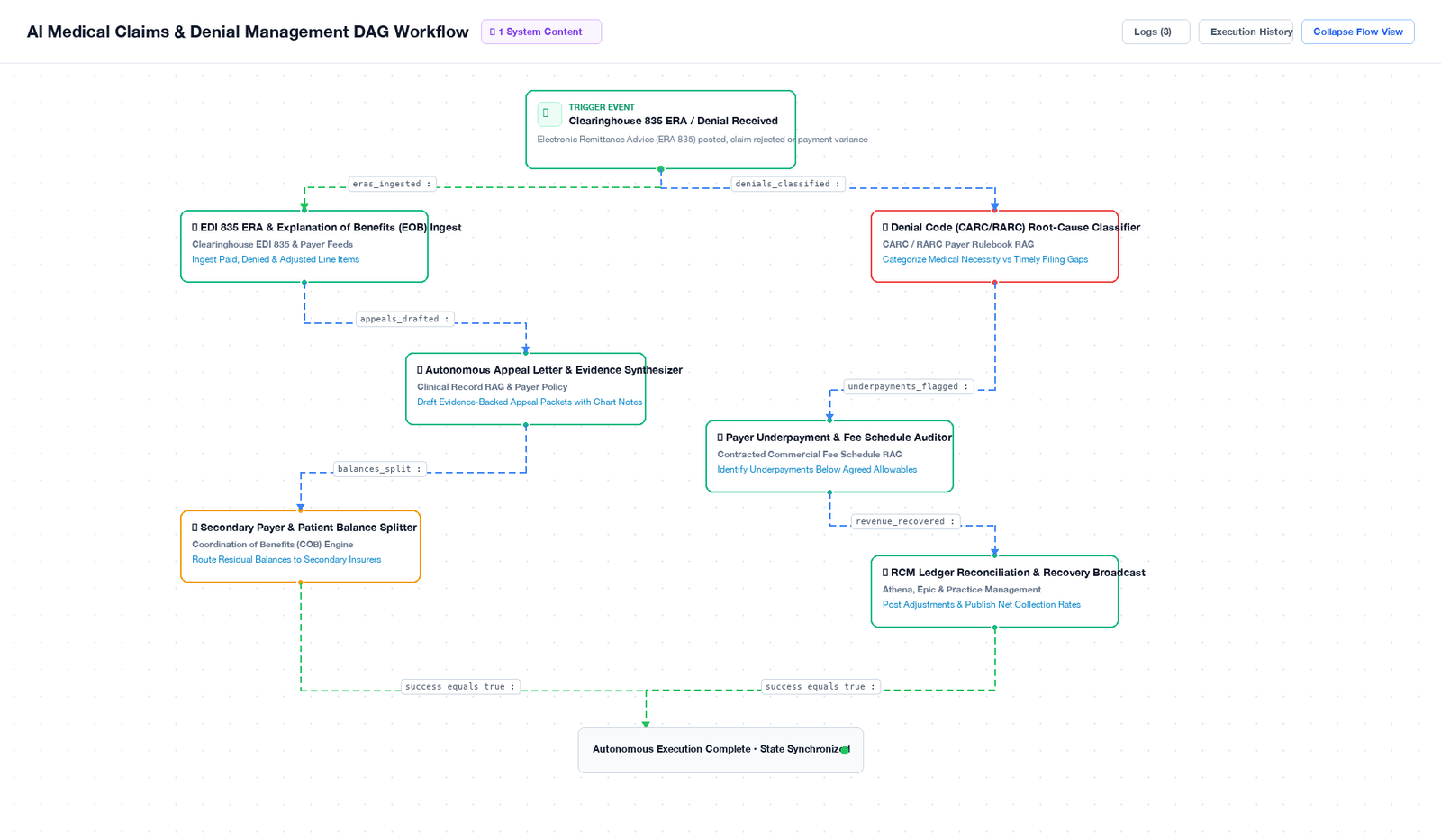
Marcus manages end-to-end healthcare Revenue Cycle Management (RCM). He ingests Electronic Remittance Advice (EDI 835) feeds, classifies denial root causes using Claim Adjustment Reason Codes (CARC/RARC), generates evidence-backed appeal packets with chart notes, and catches commercial payer underpayments.
"Marcus, adjudicate denied health insurance claims, identify root-cause denial codes, and draft automated payer appeals."
I've ingested EDI 835 Electronic Remittance Advice (ERA) files and triaged claim denials:
An AI Employee is not just a single prompt or one-off chatbot. It is an autonomous, multi-agent, multi-channel coworker with persistent memory that executes end-to-end business workflows on scheduled shift cycles like a real employee.
A basic finance AI tool extracts text from an invoice PDF or categorizes an uploaded expense, but cannot perform 3-way matching against purchase orders, reconcile bank accounts, or enforce accounting compliance rules.
Marcus operates as an autonomous Finance & Accounting Specialist. It automates 3-way matching, reconciles general ledger feeds against bank statements, flags anomalous spending, and prepares board-ready financial reports.
Sub-agents collaborate in parallel—researching, analyzing, executing, and auditing tasks together.
Interacts across Email, WhatsApp, Slack, CRM, and Web without losing the thread of conversation.
Retains company knowledge, historical interactions, brand voice, and business rules permanently.
Follows automated shifts, daily cadences, DAG pipelines, and human-in-the-loop approvals.
Marcus recovers 60%+ of denied claims, accelerates accounts receivable days, and ensures medical practices capture every dollar they earn.
Parses Electronic Remittance Advice (ERA) files and Explanation of Benefits (EOBs), matching payments, contractual write-offs, and patient deductibles.
Categorizes denials into actionable workflows (Medical Necessity, Prior-Auth Gaps, Timely Filing, Coding Mismatches, Eligibility Errors).
Synthesizes physician chart notes, diagnostic images, and payer clinical coverage policies to produce compelling formal appeal letters in minutes.
Compares paid amounts against contracted commercial payer fee schedules, automatically identifying "silent PPO" discounts and underpayments.
Splits unpaid balances and routes secondary claims (Medigap, secondary commercial) with attached primary EOB data to accelerate final settlement.
Monitors days in accounts receivable (DAR), tracks net collection ratios, and broadcasts weekly revenue cycle performance digests to practice CFOs.
Hospital systems, medical groups, billing bureaus, and specialty practices deploy Marcus to stop write-offs and recover millions in denied claims.
Practices write off up to 10% of revenue because billing teams lack the time to appeal complex medical necessity denials.
Marcus auto-generates comprehensive, evidence-backed appeal letters with attached medical records within 24 hours of denial.
Payers issue vague denials hoping providers miss strict 60-day timely filing appeal deadlines, holding practice cash.
Marcus intercepts denials immediately upon 835 posting, filing formal appeals within 48 hours to beat payer deadlines.
Health plans pay $80 on a contracted $110 rate; busy billing clerks post the payment without noticing the $30 shortage.
Marcus audits every paid line item against contracted fee schedules, issuing automated demand letters for underpayments.
The same missing modifier causes 50 claims a week to deny because billing staff lack feedback loops to fix provider charge capture.
Marcus identifies systemic denial trends by payer and provider, alerting clinical coordinators to fix the source.
Secondary billing sits in manual queues for months while staff prioritize primary claims, causing secondary insurers to reject for timely filing.
Marcus routes secondary claims with primary EOB vouchers attached automatically the moment primary payment clears.
Paying human appeal specialists $35/hour to write customized appeal letters on $300 claims makes low-dollar appeals unprofitable.
Marcus writes and packages audit-grade appeals at zero marginal cost, making it profitable to recover even minor claims.
Comparing legacy manual processes with RhinoAgents autonomous execution.
| Operational Vector | Traditional Approach | Autonomous AI Employee |
|---|---|---|
| Denial Appeal Turnaround | 30 to 45 business days in backlog | Under 24 hours from 835 denial posting |
| Denial Recovery Rate | 35% to 45% on manual appeals | 68% to 74% automated appeal recovery rate |
| Fee Schedule Underpayment Audit | Rarely audited due to manual complexity | 100% automated line-item contract audit |
| Secondary Claim Dispatch | Manual entry taking 15 minutes per file | Instant automated COB dispatch upon primary remit |
| Days in A/R (Aging) | 48 to 65 days average A/R cycle | Under 28 days average A/R collection cycle |
Every AI Employee inherits sovereign enterprise-grade infrastructure designed for strict privacy, zero hallucinations, and total auditability.
Continuous indexing of internal documentation, standard operating procedures, clinical coding books, and logistics tariffs with role-level access control.
Cross-session persistence that remembers vendor nuances, payer requirements, and incident context without retraining foundation models.
Strict schema enforcement and threshold validations eliminate compliance gaps before EDI claims, customs filings, or system mutations occur.
Every document extraction, claim adjudication, security anomaly, and API call is cryptographically logged for full HIPAA, SOC 2, and CBP compliance.
Require explicit 1-click approvals for high-dollar claim appeals, critical SIEM incident containment, or customs tariff declarations via Slack, Teams, or Dashboard.
Marcus integrates seamlessly with leading Revenue Cycle Management (RCM) suites, clearinghouses, and practice management tools.
Two-way integration for Claim Workqueues, Remittance Advice, Payment Posting, and Adjustments.
Automated clearinghouse ERA 835 ingestion, denial parsing, and appeal document upload.
Clearinghouse remittance streaming, real-time claim status (EDI 276/277), and secondary billing.
Centralized repository of commercial payer fee schedules for underpayment auditing.
Need a custom EHR, proprietary TMS, on-prem SIEM, or legacy clearinghouse? Connect via OpenAPI, Webhooks, or Python SDK in under 15 minutes.
Go to templates → Click on Hire → Connect your tools. That's it! Your AI Employee starts working immediately.
Browse templates or start from this page. Everything is pre-configured with industry best practices and default prompts.
Click the Hire button to activate your AI Employee instantly. Includes 1,000 free execution credits with $0 template fee.
Connect Epic / AthenaHealth, Availity / Waystar, EDI 835 / 837 Feeds, Payer Fee Schedules with 1-click OAuth. Your AI Employee begins working immediately.
If you want a ready-made AI employee, simply go to templates → click Hire → connect tools — that's it, it starts working immediately! Prompts and workflows are only for customizations if your organization has specific internal workflows or custom requirements. You can edit prompts in Studio, or book a meeting with our team and our engineers will customize and configure workflows for your organization.
From growing mid-market operators to multinational industry leaders, see how teams accelerate with autonomous execution.
Healthcare entrepreneurs, medical practice owners, and revenue cycle managers who cannot afford to let 10% of revenue slip away in un-appealed denials.
Digital health providers and ambulatory clinic networks seeking automated denial triage and fast collection turnarounds.
Hospital health systems, large multi-specialty physician practices, and national medical billing agencies managing hundreds of millions in claim volume.
Revenue Cycle Management (RCM) agencies and healthcare revenue recovery consultancies delivering performance-based denial recovery to provider clients.
Everything you need to know about deploying and operating Marcus safely.
Marcus connects via certified HL7, FHIR, and ANSI ASC X12 EDI interfaces to Epic, AthenaHealth, Cerner, Change Healthcare, Availity, and Waystar. He ingests incoming 835 ERA files and posts appeals directly into your practice management workqueues.
Marcus achieves an average appeal recovery rate between 68% and 74% across commercial and government payers. He structures evidence-backed appeal packets citing medical necessity, clinical guidelines, and relevant chart notes.
Marcus stores your negotiated commercial fee schedules in a secure vector database. Every time an 835 remittance is received, he compares the paid amount against your contracted allowable rate for each CPT code, automatically flagging underpayments.
Yes. Marcus operates in a SOC 2 Type II certified, HIPAA-compliant cloud environment with full Business Associate Agreements (BAAs). All Protected Health Information (PHI) is encrypted with AES-256 at rest and TLS 1.3 in transit.
Yes. Marcus supports both Full Autopilot and Dual-Key Governance. In Dual-Key mode, Marcus generates the complete appeal packet, attaches chart notes, and routes it to your billing supervisor for 1-click approval in your PMS or Slack before dispatch.
Join hundreds of innovative companies automating complex operational workflows with RhinoAgents. Start with $0 template fee and 1,000 free execution credits.