Autonomous Marketing Automation That Converts Pipeline 24/7
Static email drips and fragile if/then branching in legacy automation tools fail to convert modern buyers. Rhino deploys autonomous AI Marketing Employees that orchestrate personalized omni-channel campaigns across Email, Ads, LinkedIn, and Content—cutting CAC by 42% while accelerating lead-to-opportunity velocity by 3.2x.
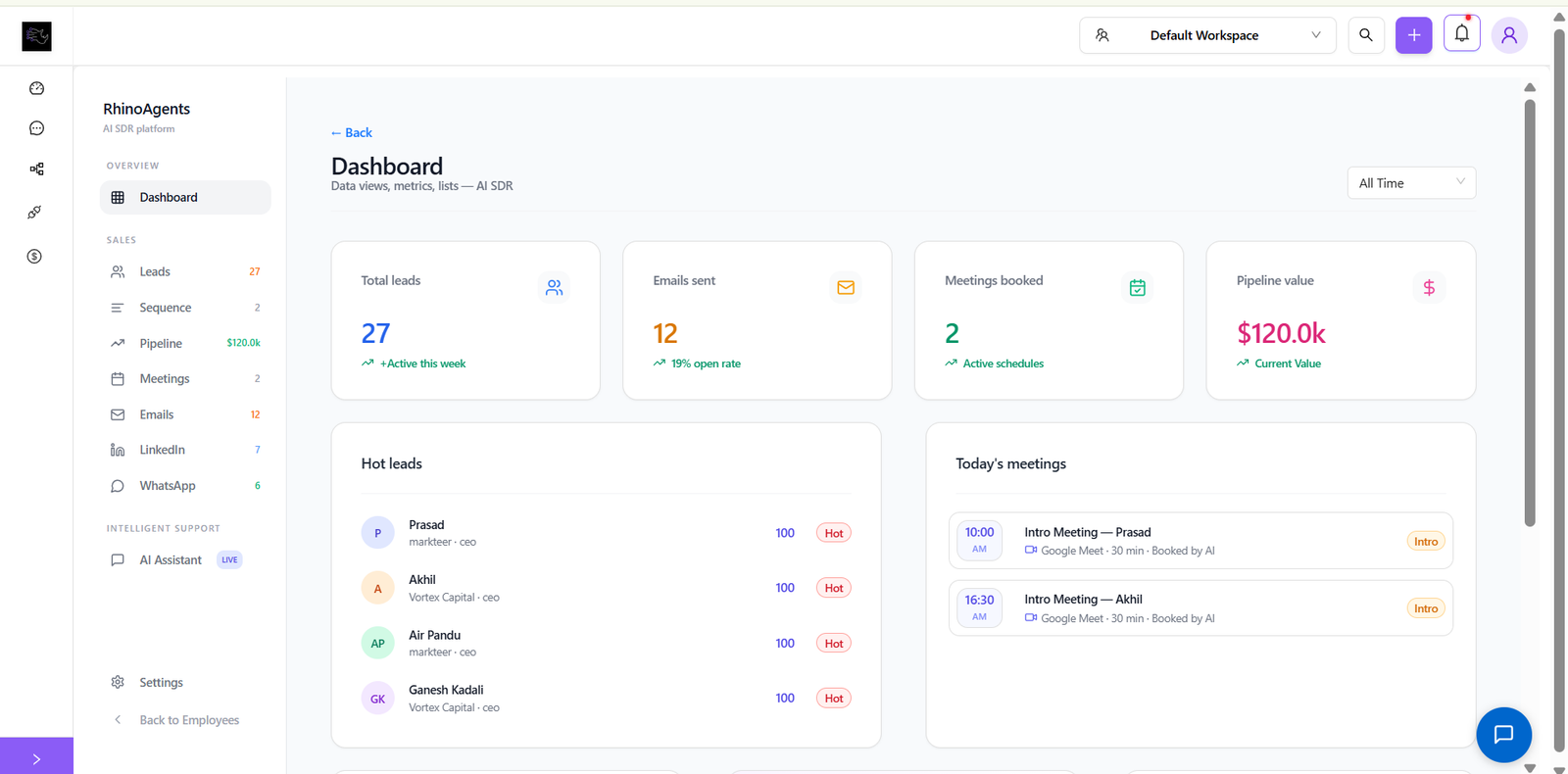
What is Autonomous Marketing Automation?
Autonomous Marketing Automation is the agentic orchestration of full-funnel customer acquisition, intent-based nurturing, dynamic creative generation, and paid ad spend rebalancing. Unlike legacy marketing automation platforms that force teams to draw hundreds of fragile flowchart branches in visual workflow builders, an AI Head of Marketing continuously evaluates live buying intent across all touchpoints. It detects when target accounts research pricing, automatically deploys personalized content, reallocates ad budgets toward high-converting channels, and ties every dollar of spend directly to closed-won revenue.
Intent-Driven Nurturing
Discards rigid 7-day timed email drips. Dispatches relevant case studies, product comparisons, and executive guides dynamically based on user engagement signals.
Autonomous Bid & Budget Optimization
Monitors cost-per-click and pipeline velocity across Google Ads, LinkedIn, and Meta 24/7. Automatically shifts ad spend toward high-ROAS audiences and pauses low-performing creative.
Multi-Touch Pipeline Attribution
Connects first-touch ad clicks, middle-funnel webinar attendance, and late-stage sales calls to closed revenue in your CRM—eliminating marketing attribution blind spots.
Architectural Comparison: Manual Campaign Ops vs. Rigid Workflow Builders vs. Rhino Autonomous AI
Why brittle if/then workflow builders decay and how cognitive AI workers maintain peak acquisition velocity.
| CAPABILITY / BENCHMARK | MANUAL CAMPAIGN OPS | RIGID WORKFLOW BUILDERS (MARKETO) | RHINO AUTONOMOUS AI MARKETING |
|---|---|---|---|
| Multi-Channel Campaign Setup | 2 to 3 weeks (Coordination meetings) | 3 to 5 days (Drawing branching nodes) | < 15 minutes via conversational briefing |
| Lead Scoring Adaptability | Manual review during weekly lead routing | Static points (+5 for email open, +10 for form) | Cognitive intent modeling based on buying signals |
| Paid Ad Budget Optimization | Weekly manual bid adjustments in dashboards | Basic platform auto-bidding (Wastes budget) | Continuous cross-platform reallocation every 4 hours |
| Creative A/B Multi-Variant Testing | 2 variants tested manually per month | A/B subject line splits only | 20+ simultaneous multivariate copy & hook tests |
| Closed Revenue Attribution | Last-touch spreadsheet estimation (Guesswork) | Single-touch reporting with blind spots | 100% W-shaped multi-touch CRM attribution |
| Effective Cost per Marketing Qualified Lead (MQL) | $185 - $280 (High labor & ad waste) | $140 - $210 (Software seat costs) | $48 - $85 (65% to 75% cost reduction) |
THE $62K MARKETING BOTTLENECK
Why Traditional Marketing Automation Burns Budget
Marketing teams spend 70% of their bandwidth wrangling disconnected tools, setting up manual email workflows, and guessing which campaigns generated pipeline.
- The Broken Linear Drip: Prospect downloads a whitepaper and receives 5 generic follow-up emails on a static timer, even if they already visited the pricing page 3 times.
- Silent Ad Spend Bleed: Paid campaigns in Google and Meta burn budget on low-converting keywords for weeks because no one had time to analyze CPA data daily.
- Disjointed Tool Spaghetti: Marketers copy CSVs between Apollo, HubSpot, Google Ads, and spreadsheets, wasting 15+ hours every week on data hygiene.
- Attribution Guesswork: Sales asks "Where did this enterprise deal come from?" and marketing has no data to prove which ad or nurture touchpoint closed the account.
- Behavior-Triggered Omni-Nurturing: Instantly adapts messaging when a lead visits high-intent pages, triggering synchronized emails and retargeting ads in real time.
- Real-Time Budget Rebalancing: Evaluates ROAS across Meta, Google, and LinkedIn every 4 hours, reallocating spend to winning ad creatives automatically.
- Zero-Friction Tool Mesh via MCP: Native Model Context Protocol (MCP) links your CRM, ad platforms, and email engine with zero manual CSV exports.
- Full-Funnel Closed Pipeline Attribution: Maps every digital touchpoint to Salesforce and HubSpot opportunities, proving exact marketing ROI on every closed deal.
Four Breakthrough Capabilities of AI Marketing Employees
Rhino bridges audience intent telemetry, ad network APIs, and content generation into a unified growth engine.
1. Real-Time Account Intent Synthesis
Enriches anonymous website traffic using reverse-IP firmographic APIs (Clearbit, 6sense). Identifies target accounts reading your documentation and immediately launches tailored multi-channel campaigns.
2. Cross-Channel Ad Spend Allocation
Monitors ad performance across Google Search, Meta Ads, and LinkedIn Sponsored Content. Automatically pauses losing ad variants and scales top-converting ad sets to protect your blended CAC.
3. Dynamic 1:1 Creative Personalization
Generates personalized landing pages, ad hooks, and email copy calibrated to the prospect's industry vertical, company size, and tech stack—delivering 3.2x higher conversion rates.
4. Multi-Touch Attribution Modeling
Calculates W-shaped and linear attribution curves across the buyer journey. Correlates top-of-funnel content impressions with closed revenue in your CRM to show exact marketing ROI.
How Human-in-the-Loop Controls Protect Your Brand
AI drives creative volume and real-time execution, but marketing executives retain complete oversight over ad budgets, messaging guidelines, and public-facing campaigns.
Ad Budget Reallocation Threshold
Routine daily bid adjustments execute automatically. Any proposed budget reallocation exceeding your limit (e.g. >$2,500/month) triggers a Slack card for 1-click VP approval.
Brand Voice & Compliance Sign-Off
Campaign copy is pre-checked against your brand dictionary and legal guardrails. Major creative launches route to Slack for editorial review before publishing.
CAC Anomaly Killswitch
If an ad set experiences an unexpected CAC spike or click-fraud surge, the AI pauses the campaign instantly and alerts the team on Slack with root cause analysis.
Context: Q3 B2B Intent Surge across 42 FinTech Target Accounts.
Proposed Action: Reallocate $4,200 from underperforming Google Search display campaign → LinkedIn Matched Audience sponsored content.
Projected Impact: +28 Demo Requests • Projected CAC: $64 (Down from $112)
How the Autonomous Marketing DAG Operates
From top-of-funnel intent signal extraction to ad rebalancing and closed revenue attribution, every campaign executes through deterministic logic.
Intent Signal Ingestion
Captures real-time signals: website pageviews, content downloads, ad engagement, and reverse-IP account matches.
Account Scoring & ICP Matching
Evaluates company headcounts, revenue bands, and tech stacks to assign an account Tier (Tier 1 Enterprise vs Tier 2 Mid-Market).
Dynamic Creative Generation
Drafts personalized ad copy, high-relevance email angles, and customized landing page copy matching the prospect's industry.
Omnichannel Orchestration
Synchronizes marketing touchpoints across Email nurture in HubSpot, LinkedIn sponsored content, and Google search retargeting.
HITL Budget & Brand Review
Checks ad spend shifts against safety ceilings. Pings marketing leadership on Slack for approval prior to scaling new campaigns.
Attribution & Feedback Loop
Connects booked demos and closed-won opportunities in Salesforce to the specific ad creative, updating predictive ROAS models.
Watch the AI Orchestrate an Account-Based Nurture
Real telemetry trace showing website intent identification, dynamic LinkedIn ad generation, and email nurture delivery in 4.2 seconds.
198.51.100.44 browsed Pricing & Security pages for 3m 42s.Time Saved & Marketing Financial ROI Model
Compare the operational overhead of traditional manual marketing operations against autonomous AI campaign execution.
Reallocating ad spend across Meta, Google, and LinkedIn in real time eliminates ad waste and drives qualified pipeline for significantly less cost.
Engaging buyers with personalized multi-channel touchpoints the moment they show intent accelerates lead-to-opportunity cycles from 42 days to 13 days.
Recovering 26 hours per week across a 4-person marketing team while consolidating disconnected software licenses saves nearly $180,000 annually.
| PERFORMANCE FACTOR / METRIC | TRADITIONAL MANUAL OPERATIONS | RHINO AUTONOMOUS AI MARKETING | NET EFFICIENCY BENEFIT |
|---|---|---|---|
| Campaign Operations & Workflow Labor | 1,350 hours / year ($94,500 value) | 65 hours / year (Slack strategy sign-offs) | 1,285 Hours Reclaimed |
| Annual Paid Ad Budget Waste | $48,000 / year (Delayed bid pauses & fatigue) | < $4,500 / year (Real-time reallocation) | $43,500 Saved Ad Spend |
| Disjointed Marketing Tech Stack Subscriptions | $36,000 / year (Workflow, attribution, copy tools) | Integrated natively into Rhino Workforce | 75% Tool Consolidation |
| Lead-to-Opportunity Conversion Rate | 3.8% conversion rate | 11.4% conversion rate (Intent-triggered) | 3.0x Pipeline Growth |
| Net Annual Financial Impact | -$220,000 / year (Overhead & ad waste) | +$178,000 Net ROI Value | 11.8x Investment Multiple |
Relevant AI Employees for Marketing Automation
Pick a specialized AI role to deploy into your marketing and demand generation stack. After quick registration, you'll be redirected straight to the onboarding builder for this employee.
AI Head of Marketing
role: ai-head-of-marketing
Coordinates full-funnel strategy, rebalances ad spend across paid media, models multi-touch pipeline attribution, and orchestrates team campaigns.
AI Content Marketer
role: ai-content-marketer
Researches high-intent keyword clusters, writes authoritative thought leadership articles, and creates downloadable lead magnet assets.
AI Paid Ads Specialist
role: ai-paid-ads-specialist
Manages Google Search, Meta Ads, and LinkedIn campaigns. Tests multi-variant ad headlines, adjusts bidding algorithms, and optimizes ROAS.
AI Email Marketer
role: ai-email-marketer
Builds dynamic lead nurture flows, writes high-converting promotional broadcasts, maintains sender deliverability, and segments lists.
Autonomous Marketing Automation Explained
Answers on dynamic nurturing, ad budget allocation, multi-touch attribution, and CRM connections.
What is autonomous marketing automation?
Autonomous marketing automation is the self-directed planning, execution, and optimization of marketing campaigns by AI employees. Rather than requiring human marketers to manually configure rigid if/then decision trees in HubSpot or Marketo, an AI Marketing Employee monitors lead buying intent across website visits, ad clicks, and content downloads, automatically deploying customized email sequences, shifting ad budgets toward top-performing channels, and attributing closed revenue in real time.
How do AI marketing employees differ from traditional workflow builders like HubSpot or Marketo?
Traditional tools rely on static linear workflows that break whenever a prospect's behavior doesn't match predefined rules. Rhino's AI employees use cognitive language models and real-time intent telemetry to dynamically adapt messaging, calibrate delivery timing, test multi-variant ad copy, and orchestrate touchpoints across Email, LinkedIn, Meta, and Google Ads without manual branching logic.
How does Rhino automate cross-channel lead nurturing without sounding robotic?
Rhino synthesizes each prospect's firmographic profile, recent website page views, company news, and industry vertical to generate 1:1 personalized content angles. It enforces strict anti-cliché brand voice guardrails, referencing real case studies and concrete business metrics rather than generic marketing jargon.
What is the Human-in-the-Loop (HITL) approval process for ad budgets and brand campaigns?
You maintain total strategic and financial control. When the AI recommends shifting ad spend exceeding your pre-set limits (e.g. >$2,500 budget reallocation) or before major public campaigns launch, the AI posts an interactive summary to Slack or Microsoft Teams with projected ROAS and CAC metrics. Your marketing team approves or adjusts with a single click.
How much time and money does autonomous marketing automation save?
Marketing teams save an average of 26 hours per week on campaign configuration, reporting, and ad bidding. Organizations deploying Rhino cut Customer Acquisition Cost (CAC) by 42%, increase lead-to-opportunity conversion velocity by 3.2x, and achieve over $178,000 in net annual productivity gains and reduced software seat licenses.
Which marketing automation, ad network, and CRM platforms does Rhino integrate with?
Rhino integrates natively via Model Context Protocol (MCP) and APIs with HubSpot, Marketo, Salesforce Marketing Cloud, Google Ads, Meta Ads Manager, LinkedIn Campaign Manager, GA4, Segment, Webflow, and WordPress.
Related Marketing Use Cases
Ready to Automate Full-Funnel Marketing?
Deploy an autonomous AI Head of Marketing that orchestrates multi-channel campaigns, cuts ad waste, and accelerates pipeline 24/7. Start with 100 free credits today.