
By RhinoAgents Revenue & Sales AI · Last reviewed November 2026
Every sales leader knows the math. A lead fills in your demo form at 4:47 p.m. on a Friday. Your SDR team has gone home. By Monday morning, that buyer has talked to two of your competitors, and the one who replied first is the one who gets the meeting.
That gap between interest and response is exactly what AI SDRs were created to close. In 2026, the category has matured from “a chatbot that writes slightly better cold emails” into a real spectrum of products: autonomous outbound agents, inbound qualifiers, data and enrichment engines, and ready-to-use AI employees that behave like a teammate you can brief in plain English.
The problem is choosing. Every vendor promises more meetings, lower cost and zero ramp time. This guide cuts through that. We compare ten AI SDR tools, explain what each one is genuinely good at, who it fits, and where it may fall short, so you can shortlist with confidence.
A note on transparency: RhinoAgents is our own product, so we have listed it first and explained it in the most detail. The other nine are real, widely used tools, and we have tried to describe them fairly. Pricing and features change quickly in this category, so always confirm current details with each vendor before you buy.
What Is an AI SDR?
An AI SDR (sales development representative) is software that performs the work a human SDR does at the top of the funnel: researching accounts, qualifying inbound leads, writing and sending outreach, handling replies and objections, and booking meetings on an account executive’s calendar.
The important distinction is between tools that assist a rep and tools that act like one. A lead scorer assigns a number and stops. An email writer drafts copy and stops. A true AI SDR carries the work through to a booked meeting and a clean CRM record.
Most products fall into one of four types:
- Autonomous outbound agents that find prospects, write messages and run sequences with minimal human input.
- Inbound qualifiers that engage website visitors and form submissions in real time.
- Data and orchestration engines that supply the contacts, signals and workflows other agents rely on.
- AI employees that you brief conversationally, connect to your tools, and manage the way you would manage a new hire.
Knowing which type you actually need is half the buying decision.
How We Evaluated These AI SDR Tools
We looked at each tool through the lens of a revenue team that wants meetings, not just activity. The criteria:
- Speed to lead. How quickly does it respond to a new inbound lead?
- Qualification depth. Does it genuinely qualify, or just collect an email address?
- Outbound quality. Is the personalization real, or is it mail-merge with extra steps?
- Control and oversight. Can a human approve, override or take over?
- Integrations. Does it write back to your CRM, calendar and email without duplicate records?
- Transparency of cost. Is pricing published, and what makes the bill grow?
- Time to value. How long from signup to the first booked meeting?
Here is the shortlist at a glance.
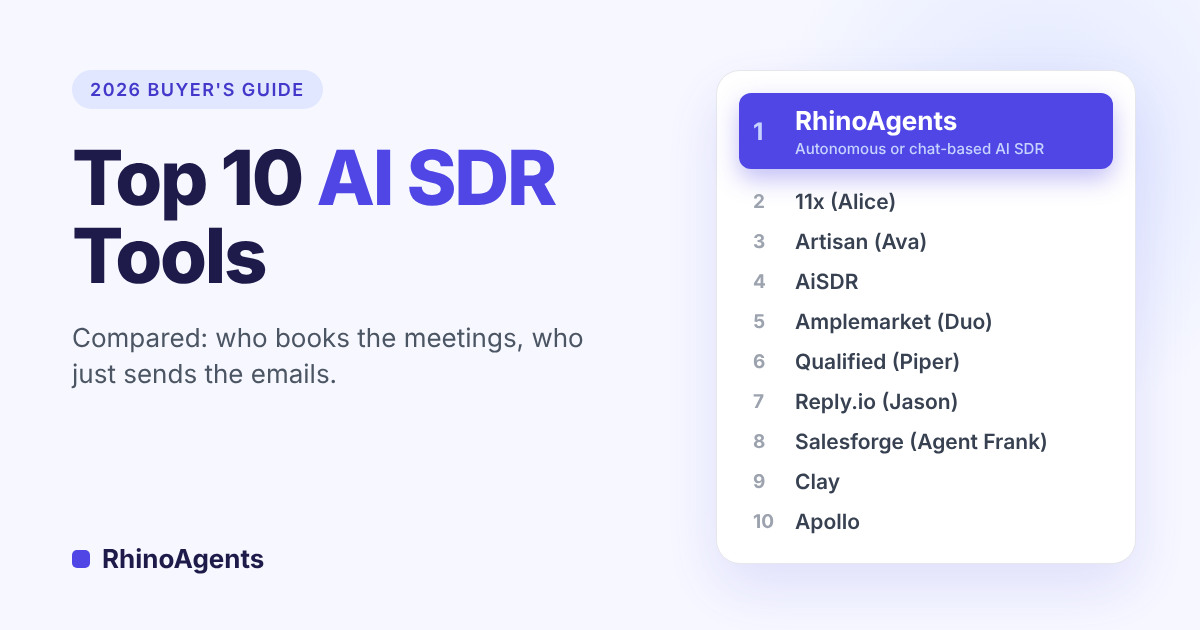
| # | Tool | Best for | Type |
|---|---|---|---|
| 1 | RhinoAgents | Teams that want a deployable AI SDR for inbound and outbound, with control | AI employee + master/sub-agent system |
| 2 | 11x (Alice) | Mid-market teams that want outbound run by an agent | Autonomous outbound agent |
| 3 | Artisan (Ava) | Small teams with no SDRs | All-in-one AI BDR |
| 4 | AiSDR | Teams that want transparent, usage-based pricing | Autonomous outbound agent |
| 5 | Amplemarket (Duo) | Teams that want AI with a human in the loop | AI-assisted prospecting and outreach |
| 6 | Qualified (Piper) | Enterprise Salesforce teams with high website traffic | Inbound AI SDR |
| 7 | Reply.io (Jason AI SDR) | Teams that want multichannel sequencing with an AI layer | Sequencer + AI SDR |
| 8 | Salesforge (Agent Frank) | Cold outreach teams focused on deliverability | Full-stack outbound agent |
| 9 | Clay | RevOps teams that want to design their own data workflows | Data enrichment and orchestration |
| 10 | Apollo | Teams that want data and engagement in one place | Database + engagement platform |
1. RhinoAgents: The Ready-to-Use AI SDR for Inbound and Outbound
Best for: B2B startups, agencies, SaaS companies and sales teams that want an AI SDR working within a day, with human control when they want it.
RhinoAgents takes a different approach from most tools on this list. Rather than handing you a sequencer with AI bolted on, it gives you a ready-to-use AI SDR that you brief the way you would brief a new hire: tell it your ideal customer profile, your qualification criteria and your tone, connect your tools, and it gets to work.
It comes in two forms, and you can choose the one that fits how your team likes to work.
Option A: The Autonomous Master AI SDR Agent
The Autonomous AI SDR Agent is a master agent that orchestrates nine specialized sub-agents, each owning one part of the revenue workflow:
- Inbound triage and speed-to-lead: captures demo requests, form fills and chat queries and responds in under 60 seconds, around the clock.
- Account intelligence: researches companies, tech stack signals and priorities so every message is relevant.
- BANT and MEDDPICC qualification: runs conversational discovery and writes auditable scorecards into your CRM.
- Omnichannel outbound: sends personalized one-to-one messages across email and LinkedIn instead of mass blasts.
- Demo scheduling and routing: checks real AE calendars and books meetings using round-robin or territory rules.
- No-show prevention: sends pre-meeting agendas and one-click rescheduling, and follows up quickly on missed calls.
- Objection handling: responds to pricing, timing and competitor pushback using your own battlecards.
- Intent and trigger monitoring: reacts to buying signals such as job changes and funding events.
- Closed-lost win-back: revisits dormant opportunities when something changes.
It runs in two modes. In Co-Pilot Mode, every outbound sequence waits for a one-click approval. In Autonomous Mode, it runs hands-free and escalates to a human only when the situation calls for it.
Option B: The Chat-Based AI SDR Employee
If you prefer to work conversationally, the AI SDR Employee behaves like a real teammate. You talk to it in plain English: “Qualify all inbound leads from last week, score them against our ICP, and book discovery calls for the top ten who respond.” It pulls the leads from your CRM, enriches them, scores them, drafts the outreach and asks for approval where you want it.
Because you manage it through conversation, you can change its focus mid-campaign. Ask for a pipeline update, point it at a new segment, or change its outreach angle without touching a configuration screen.
What Makes RhinoAgents Different
It is an AI employee, not just a tool. You give it a name, a role, responsibilities, tasks and schedules, then it works. It can check for new leads every hour, run enrichment every morning, and send follow-ups on Day 3, 7 and 14 on its own.
Autonomous or chat-based, your choice. Some teams want a hands-off master agent. Others want a rep they can talk to and steer. RhinoAgents supports both, so you are not forced into one way of working.
Your business content powers every message. Upload your positioning, ICP definition, buyer personas, case studies and your best-performing emails. The AI SDR draws on that knowledge, so what it writes sounds like your company, not a generic template.
You can switch the AI model. Models improve constantly. With RhinoAgents you can change the underlying model your AI SDR runs on without redoing your setup, so you are never locked into yesterday’s choice.
Tools are easy to change. Moving from one CRM, email provider or calendar tool to another does not mean starting again. Connect what you use today, swap it later, and keep your AI SDR’s instructions, knowledge and schedules intact. It integrates with Salesforce, HubSpot, Apollo, Outreach, Salesloft, LinkedIn Sales Navigator, ZoomInfo, Gong, Calendly, Google Workspace, Microsoft 365 and Slack, with 400+ connectors available on higher plans.
You can track everything. Every action is logged, every qualification scorecard lands in your CRM, and managers can follow activity through live dashboards and a full audit trail. You see what your AI SDR did, why, and what it produced.
Human oversight is built in. Set approval rules by account type. For example, first-touch emails to C-suite contacts or enterprise accounts can wait for a one-click approval in Slack, while routine follow-ups run automatically. A human rep can take over at any point.
Support when you want it. Most teams go live within a day, and the RhinoAgents team can help with onboarding, custom integrations and implementation sprints for more complex sales territories and CRM setups.
Pricing with no per-seat tax. Plans start at $20 per month, there is a 14-day free trial, and unlimited teammates can use it without paying extra seat fees.
Security. RhinoAgents lists SOC 2 Type II and GDPR compliance, with your pipeline data isolated and not used to train public models.
Where it may not fit: if you only want a pure data provider or a standalone email sequencer with no AI employee layer, a specialized point tool may be a closer match.
Try it: start with the AI SDR Employee if you want to brief and manage it conversationally, or the Autonomous AI SDR Agent if you want the full master-and-sub-agent system.
2. 11x (Alice): Autonomous Outbound for Mid-Market Teams
Best for: mid-market teams that want outbound largely run by an agent.
11x is one of the best-known names in the category, built around “Alice,” an autonomous outbound agent that researches prospects, writes outreach and manages multichannel sequences with little human involvement. Third-party roundups describe it as aimed at teams that want to hand off top-of-funnel prospecting entirely, and list entry pricing starting in the low thousands of dollars per month.
Strengths: high autonomy, strong brand recognition, built for volume.
Consider: the price point puts it out of reach for very small teams, and a hands-off agent needs good targeting and clear guardrails to protect your brand and domain reputation.
3. Artisan (Ava): The All-in-One AI BDR
Best for: small teams that have no SDRs and want one product to do the whole job.
Artisan‘s “Ava” combines a built-in lead database, personalized email and LinkedIn outreach, and meeting booking in a single product. That all-in-one design is appealing if you do not want to assemble a stack from separate data, sequencing and writing tools.
Strengths: quick to start, bundled data and outreach, minimal tool sprawl.
Consider: all-in-one products trade flexibility for convenience. Review the quality of the built-in data for your target market, and check how much control you have over approvals and messaging before committing.
4. AiSDR: Transparent Usage-Based Pricing
Best for: teams that want a fast launch and pricing they can predict.
AiSDR is known for open, pay-as-you-go style pricing, with roundups citing a per-prospect rate rather than a seat-based contract. It handles outreach, reply handling and meeting booking, which makes it a straightforward option for teams that want to test AI outbound without a large annual commitment.
Strengths: pricing clarity, quick setup, flexible commitment.
Consider: usage-based costs scale with volume, so model your expected prospect count before assuming it will stay cheap.
5. Amplemarket (Duo): AI With a Human in the Loop
Best for: teams that want AI to do the groundwork while reps stay in control.
Amplemarket pairs a contact and signal database with an AI assistant called Duo that helps find leads, draft outreach and surface buying signals. It is frequently described as a human-in-the-loop approach: the AI prepares and suggests, and your team reviews and sends.
Strengths: strong data foundation, rep oversight, good fit for teams cautious about full autonomy.
Consider: because reps stay involved, it saves time rather than replacing the SDR function. If you want a fully autonomous option, look at the agents above.
6. Qualified (Piper): Real-Time Inbound for Salesforce Teams
Best for: enterprise teams with significant website traffic and a Salesforce-centered stack.
Qualified‘s “Piper” is an AI SDR focused on inbound. It engages website visitors in real time, qualifies them, and routes or books meetings for the right rep. Pricing is generally quote-based on annual contracts, which positions it toward larger organizations.
Strengths: deep Salesforce alignment, real-time website engagement, enterprise readiness.
Consider: it is inbound-centric. If you also need proactive outbound prospecting, you will need to cover that separately.
7. Reply.io (Jason AI SDR): Multichannel Sequencing With AI
Best for: teams that already think in sequences and want an AI layer on top.
Reply.io is an established multichannel sales engagement tool, and its “Jason” AI SDR adds automated prospecting, personalized messaging and reply handling. It suits teams that want sequencing flexibility across email, LinkedIn and other channels with AI assistance.
Strengths: mature sequencing features, multichannel coverage, familiar workflow for outbound teams.
Consider: the AI sits on top of a sequencing product, so setup may feel more like configuring campaigns than briefing a teammate.
8. Salesforge (Agent Frank): Full-Stack Cold Outreach
Best for: outbound teams that care about deliverability and want one connected outreach stack.
Salesforge‘s “Agent Frank” is positioned as a full-stack cold outreach agent, working alongside the company’s sending and deliverability infrastructure. It appeals to teams running high-volume cold email who want the sending side handled as carefully as the writing side.
Strengths: deliverability focus, connected outreach tooling, built for cold email at scale.
Consider: it is outbound-oriented. Inbound qualification and objection-handling depth may need other tools.
9. Clay: The Data and Orchestration Layer
Best for: RevOps and growth teams that want to design their own enrichment and outreach workflows.
Clay is less an AI SDR than the engine many AI SDRs depend on. It pulls data from many providers, enriches accounts, and lets you design custom workflows for research and personalization. Teams often pair it with a sending tool or an agent.
Strengths: exceptional data flexibility, highly customizable, strong reputation among RevOps teams.
Consider: it rewards teams with the time and skill to design workflows. If you want something that works the day you connect it, a ready-to-use AI employee is faster.
10. Apollo: Data and Engagement in One Place
Best for: teams that want a large contact database plus sequencing and AI assistance in a single product.
Apollo combines a large B2B contact database with email sequencing, a dialer and AI features. It is closer to giving your existing reps a faster co-pilot than hiring an autonomous agent, which makes it a good fit if you want to keep a human-led SDR team and speed it up.
Strengths: broad data coverage, accessible entry pricing, familiar tooling.
Consider: it supports your reps rather than replacing the SDR role, and data quality varies by market, so validate it against your own target accounts.
How to Choose the Right AI SDR
The best tool depends on your motion, your team and how much control you want. A simple way to decide:
If your biggest leak is slow response to inbound leads, prioritize speed to lead and calendar booking. RhinoAgents and Qualified are the strongest fits here, depending on your stack and budget.
If you want to scale outbound with minimal effort, look at autonomous agents such as RhinoAgents’ master agent, 11x, Artisan and AiSDR.
If you want AI help but want reps firmly in control, Amplemarket and Apollo are natural choices. RhinoAgents’ Co-Pilot Mode also lets you require one-click approval on every message.
If your team is technical and loves building custom workflows, Clay is hard to beat as a data layer.
If you want one teammate you can brief in plain English and manage through chat, the RhinoAgents AI SDR Employee is built for exactly that.
Questions to Ask Every Vendor
- Can I approve messages before they send, and can I take over at any time?
- Where does the data come from, and how is it verified?
- How does it protect my domain and sender reputation?
- What does the bill look like at 10x my current volume?
- Does it write back to my CRM without creating duplicates?
- Can I change my tools or the underlying AI model later without starting over?
- How do I see exactly what it did and why?
A vendor that answers these clearly is usually one you can trust.
Common Mistakes When Adopting an AI SDR
Treating it as set-and-forget. Even the best AI SDR improves with feedback. Review early output, tighten your ICP rules and refine your messaging in the first weeks.
Skipping the knowledge step. An AI SDR is only as good as the business context it has. Upload your positioning, case studies and winning emails so its messages reflect how you actually sell.
Ignoring deliverability. Sending volume without domain protection can damage your sender reputation. Choose a tool that throttles, warms up and checks authentication for you.
Removing humans from the wrong moments. Let the AI handle volume and speed, but keep a human approval step for strategic accounts and executive first touches.
Measuring activity instead of outcomes. Emails sent is a vanity metric. Track qualified meetings booked, show rate and pipeline created.
What Results Should You Expect?
Realistic expectations matter. A well-configured AI SDR can respond to every inbound lead within a minute, qualify far more leads than a human can handle manually, keep your CRM clean, and never forget a follow-up. Autonomous outbound usually takes a few weeks of tuning before results stabilize, because targeting and messaging improve with feedback.
The teams that see the best results treat the AI SDR like a new hire: they brief it well, give it the right knowledge and tools, review its early work, and then give it more responsibility as it earns trust.
Frequently Asked Questions
What is the best AI SDR tool in 2026?
There is no single best tool for every team. RhinoAgents is a strong choice if you want a ready-to-use AI SDR that handles both inbound and outbound with built-in human control. 11x and Artisan suit teams focused on autonomous outbound, Qualified suits enterprise inbound, and Clay or Apollo suit teams that want to stay closer to the data layer.
Can an AI SDR replace a human SDR?
An AI SDR can take over the repetitive work: instant response, research, qualification, follow-ups and CRM updates. Most teams keep humans for strategic accounts, complex conversations and relationship-building. The best setups let AI handle volume and speed while people handle judgment.
What is the difference between an autonomous AI SDR and a chat-based AI SDR?
An autonomous AI SDR runs on its own against your rules, escalating only when needed. A chat-based AI SDR is one you talk to in plain English, asking it to run a task, report on pipeline or change focus. RhinoAgents offers both: the Autonomous AI SDR Agent and the AI SDR Employee.
How much does an AI SDR cost?
The range is wide. Some tools cost thousands per month on annual contracts, others charge per prospect, and others start at a low monthly fee. RhinoAgents plans start at $20 per month with a 14-day free trial and no per-seat fees. Always model the cost at your expected volume, not just the entry price.
Will AI SDR emails land in spam?
They can if the tool ignores deliverability. Look for domain warm-up, sending limits, authentication checks and easy unsubscribe handling. Ask each vendor how they protect your sender reputation.
How fast can I get an AI SDR live?
It varies by tool. With RhinoAgents, most teams are live within a day: brief the AI SDR on your ICP, connect your CRM and email, set approval rules and review the first batch of drafts.
Can I switch tools or models later?
With RhinoAgents, yes. You can change connected tools and the underlying AI model without rebuilding your instructions, knowledge or schedules. Ask any other vendor the same question before you commit.
Final Thoughts
The AI SDR category is crowded, but the decision becomes simpler once you know what you need: speed on inbound, scale on outbound, control for your reps, or flexibility in your data.
If you want a ready-to-use AI SDR that works the way you do, whether that is an autonomous master agent or a teammate you chat with, with your own business content behind every message, full tracking, easy tool and model changes, and human approval where it matters, RhinoAgents is built for that.
Explore the Autonomous AI SDR Agent or meet the AI SDR Employee, and start with the free trial. If your pipeline is also fed by website visitors or phone calls, take a look at the RhinoAgents Sales AI Chatbot and Voice AI Phone Agent, which work alongside your AI SDR.
Competitor details in this article are based on publicly available information and third-party roundups as of November 2026. Features and pricing change often, so please verify directly with each vendor.
