
If you run an IT services company, a software development shop, a marketing agency, a consultancy or a recruitment agency, you already know the strange rhythm of your pipeline. When delivery is quiet, everyone prospects. When delivery is busy, prospecting stops, follow-ups slide, proposals go out late, and three months later you wonder why the pipeline is empty.
This is not a talent problem. It is a structural one. In a service business, the same people who sell are the people who deliver. The founder who wrote last quarter’s best proposal is also the one reviewing code, managing a client escalation or interviewing candidates. Sales work gets squeezed into whatever time is left over, and there is never much left over.
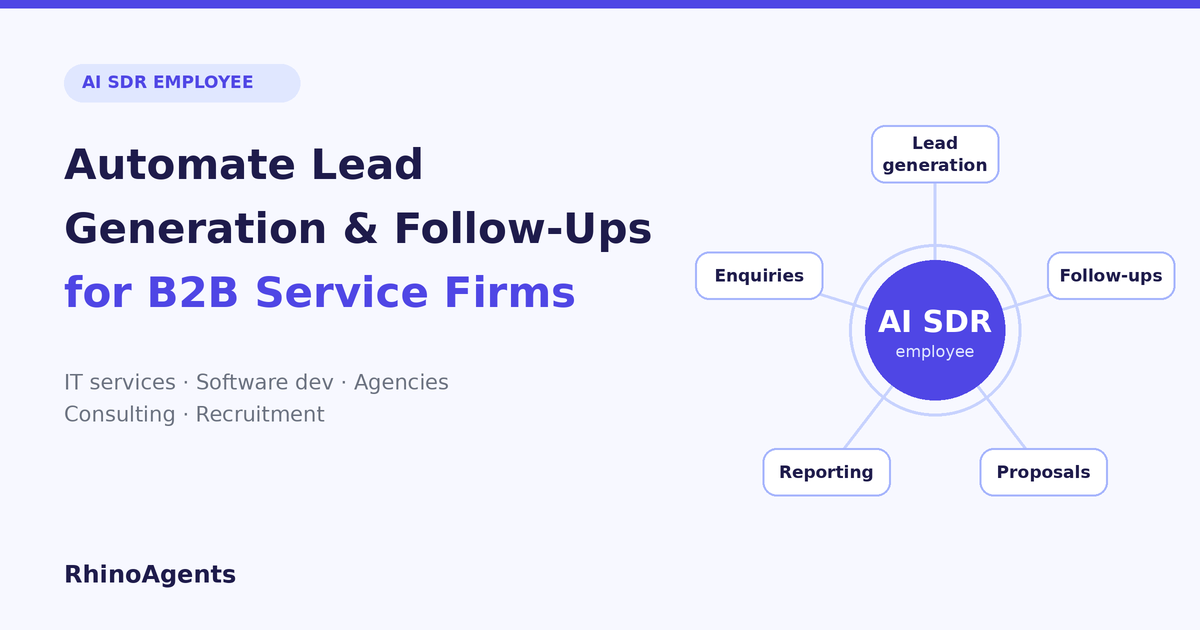
An AI SDR employee changes that structure. Instead of asking busy people to do more, you deploy a ready-to-use employee whose only job is the top of your funnel: finding prospects, starting conversations, following up, answering enquiries, preparing proposals and reporting on what is working. This guide explains where service companies lose pipeline, what an AI SDR employee actually does about it, and how each type of service business can put one to work.
Why service companies lose deals before the first call
Product companies can lean on marketing automation, self-serve trials and inbound volume. Service companies sell trust, expertise and availability. A buyer choosing an IT partner, an agency or a consultant is deciding who seems responsive, credible and easy to work with. That makes the early pipeline unusually sensitive to speed and consistency.
Here is where it usually breaks down.
1. Lead generation depends on whoever has time
Most service firms do not have a dedicated outbound team. Prospecting happens in bursts: a LinkedIn campaign after a slow month, a list bought for a one-off push, a few emails from the founder between meetings. Because it is irregular, results are irregular. You cannot forecast revenue from a pipeline that only fills when someone remembers to fill it.
2. Follow-ups die quietly
Most deals are not won on the first touch. They are won on the third, fifth or seventh, by whoever stays visible and useful without becoming annoying. In a busy service firm, the follow-up is the first thing to be dropped. A prospect says “send me something next week,” the week passes, and the thread goes cold. Nobody decided to lose that deal. It simply fell off a to-do list.
3. Proposals take too long
A proposal is often the moment a deal either accelerates or stalls. When it takes five working days to turn around a scope, an estimate and a deck, the buyer’s momentum fades and a faster competitor gets a conversation first. The delay is rarely about the writing itself. It is about gathering requirements, pulling past examples, checking availability and finding a senior person with an hour to review.
4. Reporting is manual and late
Leadership wants to know how many conversations started this week, which ones are stuck, which proposals are outstanding and where deals are being lost. In most firms, answering that means someone exports a CRM view, cleans it up in a spreadsheet and sends it around days later. By the time the report arrives, the moment to act has passed.
5. Customer enquiries wait for office hours
A prospect fills in your contact form at 9 p.m., or sends a question over a weekend, or writes from a different time zone. If the first reply arrives the next afternoon, you have already lost ground. Buyers comparing several service providers tend to move forward with the ones that respond quickly and clearly.
Each of these problems is small on its own. Together they explain why capable firms with strong delivery still have an unpredictable pipeline.
What an AI SDR employee does
A Sales Development Representative traditionally owns the early stage of the funnel: researching prospects, making first contact, qualifying interest and handing warm opportunities to a closer. An AI SDR employee does that same job, continuously and consistently, without needing to be managed hour by hour.
With RhinoAgents, you deploy a ready-to-use AI SDR employee, connect it to the tools you already use, and give it your ideal customer profile, your services and your tone of voice. From there it takes on the following work.
Starting conversations with the right prospects. It works from your ideal customer profile, such as mid-sized SaaS companies that need a development partner, retailers looking for a performance marketing agency, or finance teams that need a transformation consultant. It opens conversations that are relevant to the prospect’s situation instead of sending generic blasts.
Qualifying interest. When a prospect replies, the AI SDR employee asks the questions your team would ask: what they are trying to achieve, what timeline they have, what size of project they have in mind and who else is involved. It separates serious opportunities from casual enquiries before a human spends time on them.
Following up without being asked. It keeps the conversation alive on a sensible cadence. If a prospect asked to be contacted next quarter, it remembers. If a proposal has been sitting unopened, it nudges. If someone replies with an objection, it responds to the objection instead of repeating the same message.
Answering enquiries around the clock. Questions about your services, process, case studies or typical engagement models get a prompt, accurate reply at any hour, based on the knowledge you provide.
Preparing proposals and next steps. Once a prospect is qualified, the AI SDR employee can gather the requirements, summarise the opportunity for your team, and prepare the groundwork for a proposal so that a senior person reviews and refines instead of starting from scratch.
Reporting on the pipeline. It keeps a running view of conversations started, replies, qualified opportunities, outstanding proposals and where deals are stalling, so you get a report without asking someone to compile one.
The important shift is that these tasks happen every day, not only when somebody has spare time. Consistency is the entire advantage.
AI SDR playbooks for five types of service business
The underlying work is similar across service firms, but the details differ. Here is how each type of business can use an AI SDR employee.
IT services companies
IT services buyers are usually reacting to something: a failed migration, an ageing system, a security concern, a compliance deadline or a leadership decision to modernise. The AI SDR employee can:
- Reach out to companies that match your target size, industry and technology profile, referring to the type of problem you solve rather than a generic services list.
- Qualify by environment and urgency: current stack, scale of the challenge, internal capacity, budget range and decision timeline.
- Handle common enquiries about engagement models, such as managed services versus project work, and route anything technical to the right engineer.
- Follow up consistently on long enterprise cycles, where deals can take months and a missed follow-up is easy.
Software development companies
Development shops often win work through referrals and then struggle to replace them when the referral stream dries up. The AI SDR employee can:
- Start conversations with founders and product leaders who are likely to need an external team, such as recently funded startups or companies expanding their product line.
- Ask scoping questions up front: what they want to build, what stage it is at, what technology constraints exist, how fast they need to move.
- Answer the questions every buyer asks, such as how you run sprints, how communication works, how you handle IP and what a typical team looks like.
- Prepare a structured brief for your delivery lead so the first call is a real scoping discussion, not an introduction.
Marketing agencies
Marketing agencies sell to people who understand marketing, which means they notice sloppy outreach immediately. Quality and relevance matter. The AI SDR employee can:
- Personalise outreach to the prospect’s channels, market and visible growth goals.
- Qualify by budget, current spend, existing agency relationships and the outcomes they care about, such as pipeline, revenue or brand reach.
- Follow up after audits, pitches and proposals, which is where agencies commonly lose momentum.
- Respond quickly to inbound enquiries from your website, which are often the highest-intent leads you have.
Consulting companies
Consulting is a relationship business with long cycles and senior buyers. Subtle, well-timed follow-up matters more than volume. The AI SDR employee can:
- Maintain regular, thoughtful contact with prospects over many months without letting relationships go cold.
- Qualify the underlying problem, the stakeholders involved and whether the buyer has the authority and budget to act.
- Share relevant insights, case summaries or perspectives that keep your firm visible and credible.
- Hand your partners a clear summary of each opportunity, so their time goes into the conversations that matter.
Recruitment agencies
Recruitment agencies have two pipelines: client companies with open roles and candidates to fill them. Business development for new client accounts is the part that most often gets neglected, because recruiters are busy with live searches. The AI SDR employee can:
- Reach hiring managers and talent leaders at companies likely to be hiring in your specialisation.
- Qualify the hiring need: number of roles, seniority, urgency, whether they already use an agency and what terms they expect.
- Follow up with prospects whose hiring plans are still forming, so you are first in mind when a role opens.
- Keep new-client business development running while your recruiters focus on filling roles. For the candidate side of the workflow, an AI Recruitment Specialist employee can handle sourcing and screening conversations, so both pipelines keep moving.
Before and after: a week of prospecting
It helps to picture the difference concretely.
Before: a typical week at a 25-person IT services firm.
Monday, the managing director plans to send outreach to 40 target accounts but is pulled into a client escalation. Tuesday, two website enquiries arrive in the shared inbox, and neither gets a reply until Wednesday afternoon. Wednesday, a prospect who asked for a proposal “by end of week” is still waiting because the solutions architect is on a project. Thursday, nobody remembers to chase the three conversations that went quiet last week. Friday, the managing director asks for a pipeline summary and gets a spreadsheet that was last updated on Tuesday.
Outcome: few new conversations, slow replies, one proposal at risk, no clear picture of the pipeline.
After: the same firm with an AI SDR employee deployed.
Monday, outreach goes out to the full list of target accounts, written for each prospect’s situation. Tuesday, both website enquiries receive a helpful reply within minutes, and one of them is already qualified by the time a human sees it. Wednesday, the requirements for the pending proposal are gathered and summarised for the solutions architect, who reviews and finalises the scope in an hour instead of starting from zero. Thursday, the quiet conversations receive a relevant follow-up, and two of them respond. Friday, the managing director opens a report showing conversations started, replies, qualified opportunities and outstanding proposals.
Outcome: more conversations, faster replies, a proposal that goes out on time, and a pipeline view that is current.
Nothing about the people changed. The work that used to fall through the cracks simply has an owner.
Deploying an AI SDR employee in days, not months
Many service firms avoid sales automation because they associate it with long implementations, complicated sequences and tools that need a dedicated operator. A ready-to-use AI employee works differently. The setup is closer to onboarding a new hire than integrating a platform.
A practical rollout looks like this.
- Define who you want to reach. Describe your ideal customer profile: industries, company sizes, roles and the problems you solve best. The sharper this is, the better the outreach.
- Share what you know. Provide your service descriptions, case studies, pricing approach, engagement models and common objections. This becomes the knowledge your AI SDR employee draws on when it talks to prospects.
- Set the tone and the rules. Decide how formal or conversational the voice should be, which topics need a human, and when a conversation should be handed to someone on your team.
- Connect your tools. Link the email, calendar and CRM you already use so that conversations, meetings and updates land where your team expects them.
- Start small, then expand. Begin with one segment or one service line, review the conversations, and widen the scope once you are happy with the quality.
Because the AI SDR employee is ready to use, you are configuring and deploying, not building from scratch. Most teams can be live in days. If you want to see how outbound and inbound sales roles fit together, you can also look at the AI BDR employee, which focuses on business development and new-account outreach.
What to measure
Once an AI SDR employee is working, track a small number of metrics so you can see whether it is helping and where to tune it.
- First response time. How quickly does a new enquiry get a meaningful reply? This should drop sharply, and it is one of the easiest improvements to see.
- Conversations started per week. This shows whether your outreach is consistent instead of coming in bursts.
- Reply and qualification rate. What share of conversations turn into real discussions, and what share meet your qualification criteria?
- Meetings booked. The point of the role is to put qualified prospects in front of your team. Count the meetings that actually happen.
- Proposal turnaround time. Measure the time from qualified conversation to proposal sent. Shorter is better, as long as quality holds.
- Stalled opportunities recovered. Count the conversations that had gone cold and restarted after a follow-up.
Avoid judging the results on a single week. Service-business cycles are long, and the real signal is a steadier pipeline over a quarter, not a spike in one month.
Common concerns, answered
Service firms tend to raise the same worries about automating early-stage sales.
“Won’t it sound robotic and damage our reputation?” This is the right concern, because your reputation is your product. The answer is in the setup: give the AI SDR employee your real positioning, your real case studies and a clear tone of voice, and define when it should hand over to a person. Review early conversations and tighten the guidance. The goal is relevant, respectful outreach, not volume for its own sake.
“Will it replace our sales team?” For most service firms, the realistic comparison is not an AI SDR versus a team of SDRs. It is an AI SDR versus no consistent prospecting at all. The AI SDR employee covers the repetitive early stage so your senior people spend their time on discovery calls, proposals and relationships.
“What about complex or sensitive conversations?” Set clear rules for what should be escalated, such as pricing negotiations, contract terms or anything involving a confidential situation. The AI SDR employee handles the first stages and hands over when a human is needed.
“We already have a CRM. Does this replace it?” No. It works alongside the tools you already use, keeping records current and reducing the manual data entry that CRMs usually depend on.
Frequently asked questions
What is an AI SDR employee?
An AI SDR employee is a ready-to-use digital team member that handles the work of a Sales Development Representative: reaching out to prospects, qualifying interest, following up, answering enquiries and keeping your pipeline organised. You deploy it, connect your tools and give it guidance on who to target and how to speak.
How is an AI SDR different from a human SDR?
A human SDR brings judgment, relationships and creativity, but works fixed hours and has limited capacity. An AI SDR employee works continuously, follows up consistently and handles a high volume of conversations. For many service firms, the two are complementary: the AI covers consistency and speed, and people handle strategy and relationship-building.
How is an AI SDR different from a basic email sequence?
A sequence sends pre-written messages on a timer, whatever the recipient says. An AI SDR employee reads replies, understands intent, answers questions and adjusts its next step. It behaves like a person working a conversation, not a scheduled blast.
How is an AI SDR different from an AI BDR?
The two roles overlap. An SDR typically focuses on qualifying inbound and outbound leads and moving them to a closer, while a BDR focuses more on opening new accounts and building new business relationships. Many firms deploy both, depending on how their sales process is structured.
Which service companies benefit most?
Firms with long sales cycles, inconsistent prospecting and a small team doing both selling and delivery see the clearest gain. IT services, software development, marketing, consulting and recruitment businesses all fit that description.
How long does it take to get started?
Because the AI SDR employee is ready to use, setup is mostly about defining your target customer, sharing your service knowledge and connecting your tools. Many teams can be live within days, then refine over the following weeks.
Will prospects know they are talking to an AI?
That is your decision. Many firms choose to be transparent, and prospects are generally comfortable with it when the replies are fast, relevant and helpful. What matters most is that the conversation is useful and that a person steps in when it counts.
Final thoughts
Service companies do not lose pipeline because they lack skill. They lose it because selling competes with delivering, and delivery always wins the argument. Lead generation becomes irregular, follow-ups slip, proposals run late, reports arrive too late to help and enquiries wait for the next working day.
An AI SDR employee gives that early-stage work a dedicated owner. It starts conversations, keeps them alive, qualifies interest, prepares the ground for proposals and reports on what is happening, every day, in the background of your business. Your team stays focused on what it does best: winning trust in conversations that matter and delivering great work.
If your pipeline depends on whoever happens to have time, it may be worth putting a dedicated employee on it. Explore the AI SDR employee to see how it could fit your firm, and start with one service line to see the difference within weeks.
