
Every recruiting team knows the feeling. A strong senior engineer applies on a Tuesday night. The resume lands in an inbox nobody checks until the following week. By the time a recruiter reviews it, schedules a screen and loops in four interviewers, the candidate has already accepted an offer somewhere else.
None of this is a people problem. Recruiters are not slow; the work around them is. Screening, calendar coordination, reference chasing, scorecard nagging and ATS data entry consume most of a recruiter’s week, and every one of those tasks has a hard deadline set by a competitor you cannot see.
This post explains how an autonomous recruitment agent system works, what each of its nine sub-agents actually does, where humans stay in control, and how talent teams deploy it without hiring a prompt engineer. Everything here reflects the live RhinoAgents recruitment agents page, so you can check each capability against the source.
The Real Cost of a Slow Hiring Pipeline
Hiring speed is not a vanity metric. Top candidates are typically in several processes at once, and the one that moves fastest usually wins. Slowness leaks in predictable places:
- The resume black hole. Applications sit unreviewed for days or weeks. Candidates read the silence as disinterest.
- After-hours applications. A large share of engineering and executive applications arrive in the evening, at weekends and across time zones, when nobody is watching the queue. RhinoAgents cites 62% of such applications arriving outside working hours.
- Scheduling ping-pong. A four-person panel across three time zones can take a dozen emails to lock down, and each reschedule restarts the loop.
- Reference checks that stall offers. Chasing referees by email can add weeks between a verbal yes and a written offer.
- Missing scorecards. Busy interviewers forget to submit feedback, so debriefs slip and decisions drift.
- ATS drift. When recruiters re-key data by hand, the applicant tracking system becomes a rough approximation of reality.
- Wasted silver medalists. Candidates who reached the final round and narrowly missed out sit in a database that nobody revisits.
Individually, each leak looks small. Together they explain why time-to-hire stretches and why good people slip away.
What Is an Autonomous Recruitment Agent?
An autonomous recruitment agent is software that takes a recruiting goal, breaks it into steps, uses your actual tools to complete those steps, and escalates to a person when judgment is needed. It is different from a chatbot, which answers questions, and different from a rules-based automation, which only runs the exact path someone scripted in advance.
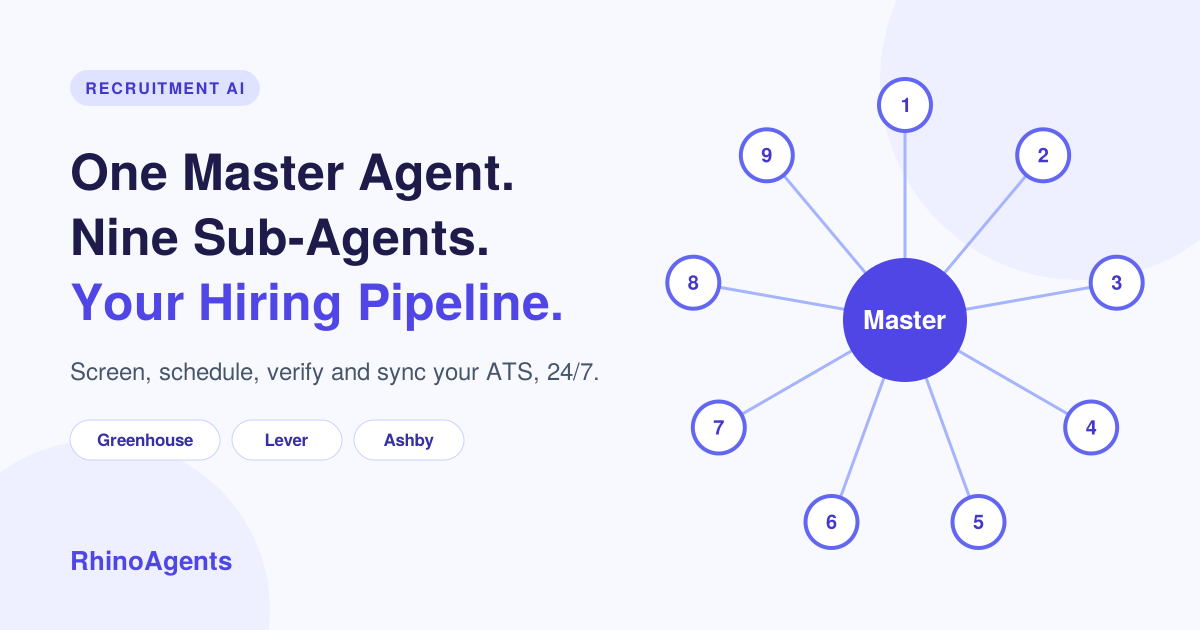
RhinoAgents organizes this as a Master Recruitment Agent that orchestrates nine specialized sub-agents. The master agent receives the trigger (a new application, a finalist reaching the reference stage, an offer being accepted), decides which sub-agent should act, passes along context, and writes the outcome back to your ATS. Each sub-agent is narrow and good at one job, which keeps behavior predictable and easy to audit.
The master agent handles multi-step pipelines end to end: scoring an inbound resume, coordinating interviewer availability, sending prep briefs, and moving the candidate to the next stage in Greenhouse or Lever. When something goes wrong, such as a calendar conflict, it corrects course instead of failing silently.
Meet the 9 Sub-Agents
1. Candidate Intake & Application Pre-Screener
The first sub-agent receives every inbound application from Greenhouse, Lever, Ashby, Indeed and LinkedIn, parses the resume semantically, and scores it against a role-specific rubric. RhinoAgents reports screening in under 18 seconds, replacing a review lag that often runs 7 to 14 days.
The important detail is how it scores. Rather than matching keywords, it looks at domain depth, scale of systems or teams handled, project outcomes and career trajectory. The result is a structured scorecard attached to a de-duplicated candidate profile in your ATS. A recruiter opens a profile that already says why this person matches 94 out of 100 for a distributed systems role, rather than a raw PDF.
2. Technical Sourcing & GitHub/Portfolio Agent
The best engineers are rarely browsing job boards. This sub-agent searches for passive candidates by analyzing GitHub commit history, open-source pull requests, technical publications and LinkedIn profiles, then matches them to your ideal candidate profile.
Because it indexes real contributions rather than buzzwords, the outreach it drafts can reference specific work, such as a pull request on a consensus protocol. That specificity is why RhinoAgents cites a 38% response rate on this kind of outreach, compared with the very low rates most generic recruiter messages earn.
3. Interview Coordinator & Calendar Dispatch
This is the sub-agent most recruiters ask about first. It reads availability across Google Calendar and Outlook 365, resolves time zones, finds a slot for a three-to-five-person panel, provisions the Zoom or Teams bridge, and sends the candidate a one-click booking link along with a briefing packet.
When a candidate or interviewer needs to move, it re-plans the whole panel in seconds rather than starting an email thread. It also sends interview kits and scorecards to the hiring team ahead of time, and SMS and email reminders aimed at keeping no-shows low.
4. Reference Check Automation
Once a candidate becomes a finalist, this sub-agent collects referee details and sends structured, competency-based questionnaires over secure SMS or email. Referees answer through a mobile-friendly form, which is far easier than scheduling a phone call.
The agent then compares answers with the resume, flagging discrepancies in titles, tenure or project scope, and produces a reference verification memo, typically within 24 hours. The hiring manager gets a concise summary and the original responses sit in the ATS for reference.
5. Offer Letter & Compensation Benchmarking
Offers lose deals when they are slow or miscalibrated. This sub-agent benchmarks base salary, equity and sign-on against market data sources such as Radford, Levels.fyi and Pave, stays inside your approved bands, and generates a DocuSign offer package routed through your approval workflow.
When a candidate counters, it does not negotiate on its own. It benchmarks the request against the department’s budget and presents recommended options to the hiring manager, who makes the final call. That keeps internal pay equity intact while still moving quickly.
6. Passive Candidate Outreach (LinkedIn)
Where sub-agent 2 focuses on technical portfolios, this one runs multi-touch outreach for executive and revenue roles. It researches each prospect, such as quota attainment, tenure milestones and shared connections, and builds personalized InMail sequences with sensible spacing between follow-ups.
When a prospect replies with interest, it books a screening call straight onto the recruiter’s calendar, so the human only joins once the candidate has said yes.
7. Background Screening & Compliance
The moment an offer is signed, this sub-agent triggers background checks through providers such as Checkr, Sterling or Certn, monitors clearance status, and alerts recruiters if documents are missing or a screening is delayed.
It also maintains an archive of candidate disposition histories, which matters for teams that need to stand up to EEOC and OFCCP review. Clearance status is written back to the ATS so onboarding can start the day it is ready.
8. Candidate Nurture & Pipeline Warming
Silver medalists are among the cheapest and highest-quality hires available, yet they usually vanish into a dormant database. This sub-agent tags runner-up candidates, keeps their interview notes, and sends relevant company updates so the relationship stays warm.
When a matching requisition opens, it re-engages them and can fast-track them past early rounds. RhinoAgents reports that this approach can fill a meaningful share of new engineering roles from past candidates, with no sourcing spend.
9. Hiring Manager Collaboration & Feedback
The last sub-agent solves the problem every recruiter dreads: chasing interviewers for feedback. Minutes after a panel ends, it nudges each interviewer in Slack or Microsoft Teams with a one-click scorecard form.
When the scorecards are in, it highlights disagreements, such as one interviewer rating a candidate a strong hire and another a strong no-hire, and assembles a one-page debrief packet for the hiring manager. Debriefs start on time and with the full picture.
Before and After: A Senior Engineer Applies on a Friday Night
Here is the same candidate journey with and without an agent system. The scenario is illustrative, assembled from the behavior described above.
Before. Priya, a senior platform engineer, applies at 9:40 pm on Friday. The application waits until Monday, when a recruiter skims it between other tasks. It reaches the hiring manager on Wednesday. Scheduling a four-person panel takes eleven emails and finishes the following Tuesday. Two interviewers submit scorecards late. By the time an offer is drafted, Priya has accepted another job.
After. Priya applies at 9:40 pm. Within seconds her resume is scored against the role rubric and a profile with a scorecard appears in Greenhouse. She receives a confirmation and a booking link for a recruiter screen. After a pass, the scheduling sub-agent finds a panel slot, creates the video bridge and sends her a prep packet. Interviewers receive a Slack nudge right after the session and all four scorecards are in within hours. References go out the moment she reaches the finalist stage, and the compensation agent has a band-compliant offer ready for the hiring manager’s approval.
The recruiter’s role has not disappeared. It has moved to the parts of hiring where human judgment matters: conversations, selling the opportunity, and the final decision.
Fair Hiring, Compliance and Human Oversight
Any AI that touches hiring decisions has to earn trust, and talent leaders are right to ask hard questions. Here is how the RhinoAgents recruitment system is designed to address them.
Demographic redaction during screening. Candidate names, photos, home zip codes, graduation years and similar proxies are redacted before initial resume scoring, so the rubric is applied to skills and achievements rather than personal attributes.
Transparent, rubric-based scorecards. Every score comes with the criteria and reasoning behind it, so a recruiter or auditor can see why a candidate was advanced or not.
Audit logs and adverse impact reporting. Candidate scores, rubric justifications, interview dispatches and stage changes are logged, and the system supports adverse impact analysis, including four-fifths rule reporting, to help federal contractors and teams subject to rules such as NYC Local Law 144 prepare for audits.
Recruiter in the loop. The system escalates to people for judgment calls, and offer negotiation stays with the hiring manager.
Data privacy. Candidate data is encrypted in transit and at rest, is not used to train public models, and the platform supports GDPR candidate rights and state salary disclosure rules. Enterprise options include SSO, role-based permissions and dedicated environments.
A practical note: no tool makes a team compliant on its own. Your legal and HR leaders should still review rubrics, retention policies and audit procedures for your jurisdiction. What the agent system provides is consistency and a complete paper trail, which is much harder to produce manually.
Works With the Tools You Already Use
A recruitment agent is only useful if it writes back to the systems your team lives in. RhinoAgents connects to:
- ATS and HRIS: Greenhouse, Lever, Ashby, Workday, SmartRecruiters, Bullhorn, Jobvite and BambooHR
- Sourcing and job boards: LinkedIn Recruiter, Indeed and GitHub
- Assessments: HackerRank and Codility
- Background checks: Checkr and Sterling
- Scheduling and communication: Google Workspace, Outlook, Calendly, Zoom, Slack and Microsoft Teams
- Automation: Zapier, plus webhook and API connectors for custom systems
Sync is two-way, which means candidate records, scorecards, stages and background check results update in your ATS without anyone copying and pasting. Technical assessments are covered too: when a candidate passes the recruiter screen, the agent dispatches the right coding challenge, sends deadline reminders and attaches the scored result to the candidate profile.
How Teams Deploy It in Three Steps
You do not need prompt engineers or developers. The setup follows a simple path.
Step 1: Deploy your recruitment lead. Start with the Master Recruitment Agent, which comes preconfigured for technical recruiting, executive search, panel coordination and reference checking, with the nine sub-agents ready to run.
Step 2: Set your rules in plain English. Describe role requirements, required competencies, minimum experience, compensation limits, interview stages and escalation contacts. You can change them at any time, and the interview panel round-robin rules take only a few clicks.
Step 3: Go live across your feeds. Activate the agent on your careers site, LinkedIn Recruiter, Indeed and ATS webhooks. From that moment it provides continuous coverage, including nights and weekends.
If your team has no spare operations or IT capacity, RhinoAgents offers a chargeable white-glove onboarding sprint. The solutions team connects your Greenhouse or Lever API keys, maps your scorecard rubrics, calibrates panel calendars and runs end-to-end test candidates before launch.
Pricing: Pay for Execution, Not Seats
Traditional recruiting software charges per user per month, which penalizes you for inviting hiring managers and interviewers into the process. RhinoAgents uses a credits-based model: you pay for the executions your agents consume, and there is no per-seat fee, so recruiters, interviewers and coordinators can all take part without extra license costs.
Plans, credit allowances and add-on packs are listed on the RhinoAgents pricing page, where you can also see the current free trial offer. For complex stacks, you can book a strategy call to scope your sub-agent architecture and get a credits estimate before committing.
Who Gets the Most Value
The system fits any team where hiring volume or speed is a constraint:
- In-house talent acquisition teams at high-growth companies, where a handful of recruiters support dozens of open requisitions.
- Technical recruiting leads who need engineers sourced from real work rather than keyword searches.
- Staffing agencies and RPOs, which run many parallel searches and benefit most from after-hours coverage and consistent ATS hygiene.
- Federal contractors and regulated employers, where audit-ready records and consistent rubrics are as important as speed.
- Talent operations managers responsible for process quality, scorecard compliance and reporting.
If candidates first reach you through your website or by phone, RhinoAgents also offers a recruitment website chatbot and a voice AI phone agent for recruitment. The three modalities share the same hiring goals, so you can start with the one that matches your biggest bottleneck. You can also browse the full range of RhinoAgents AI agents by industry.
Frequently Asked Questions
How does the AI screen resumes without bias? It scores candidates against objective, competency-based rubrics built on verified skills and achievements, and redacts demographic variables such as names, photos, addresses and graduation years during pre-screening. Every decision produces an auditable scorecard. As with any hiring tool, review your rubrics regularly and test outcomes for adverse impact.
Which ATS platforms does it integrate with? Greenhouse, Lever, Ashby, Workday, SmartRecruiters, Bullhorn, Jobvite and BambooHR, with two-way sync so records stay current without manual entry.
Can it schedule panel interviews in real calendars? Yes. The coordination sub-agent connects to Google Calendar, Outlook 365, Calendly, Zoom and Teams, resolves availability across multiple interviewers, sends one-click booking links to candidates, and handles reschedules automatically.
How does passive outreach work? Two sub-agents research prospects across LinkedIn Recruiter, GitHub and public technical work, then write personalized messages that reference specific accomplishments. When a prospect responds, the agent books a call with a recruiter.
Does it handle technical assessments? Yes. It dispatches coding challenges through platforms like HackerRank and Codility, tracks deadlines, sends reminders, and attaches scored results to the ATS profile.
How do reference checks work? Finalists provide referee contacts, and the agent sends structured questionnaires by SMS or email, flags inconsistencies and compiles a verification memo, usually within 24 hours.
Can it negotiate offers? It benchmarks offers against live compensation data and prepares compliant offer letters. When a candidate counters, it recommends options to the hiring manager, who makes the final decision.
What happens if a candidate declines? The agent captures structured reasons such as compensation, location or a competing offer, and the nurture sub-agent keeps the candidate warm for future roles.
Is it suitable for OFCCP-regulated employers? It is designed with audit readiness in mind: timestamped logs, rubric justifications and adverse impact analysis support federal contractor reporting. Your compliance team should still validate the setup for your obligations.
How quickly will we see results? RhinoAgents reports that screening lag drops from days to seconds right after deployment, and that customers see improvements in time-to-hire and interview attendance over the first 30 days. Results vary by team and hiring volume.
Conclusion: Give Recruiters Their Time Back
Hiring is a race against time and a contest of relationships. The routine work, such as screening, scheduling, chasing references and nagging for scorecards, is what slows recruiters down, and it is also work that software can now do reliably around the clock.
A Master Recruitment Agent with nine specialist sub-agents does not replace your talent team. It clears the administrative backlog so recruiters can spend their hours on candidates, hiring managers and closing offers.
Ready to see it work? Explore the recruitment agents page, start a free trial, or book a strategy call to map the right setup for your hiring pipeline.
