
It is 9:47 on a Friday night. A buyer has spent twenty minutes on a listing page, scrolling photos, checking the price history, glancing at the school ratings. At 9:48 they tap “Request a tour.” Your office is dark, your agents are at dinner, and the inquiry drops into the CRM like any other lead. On Monday morning someone calls. The buyer already toured two homes with a different agent on Saturday.
Nobody on your team did anything wrong. The process simply runs on business hours, and home shoppers do not. Evenings, weekends and Sunday open-house afternoons are exactly when buyers browse, ask questions and decide who to call, and they are exactly when most brokerages are slowest to respond.
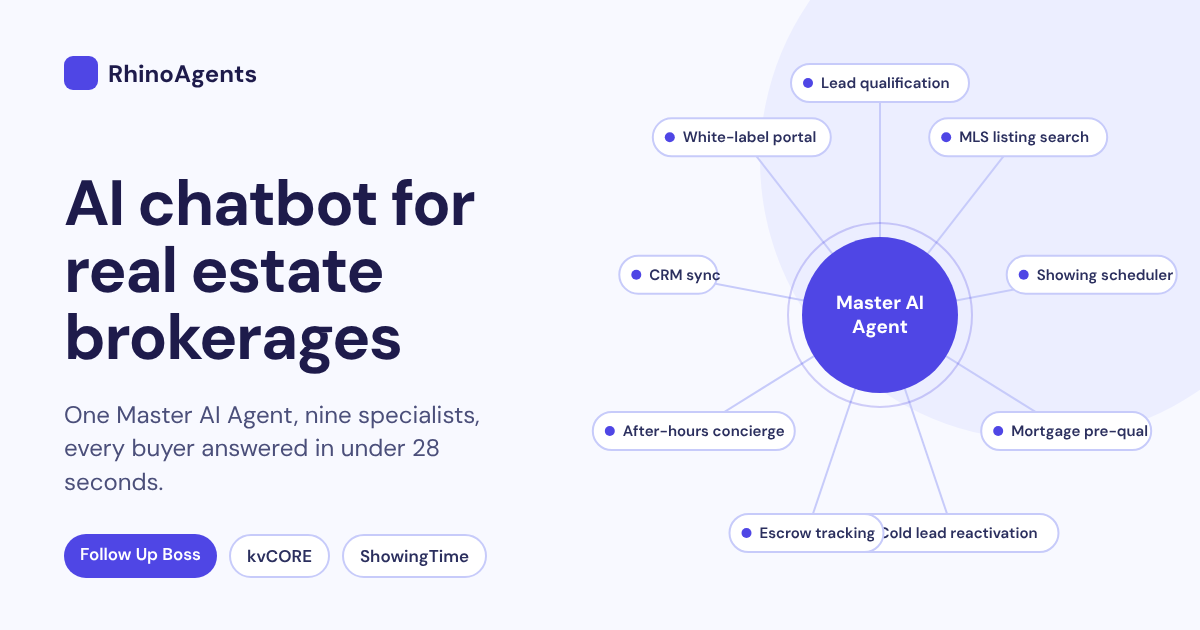
This guide explains how an AI real estate chatbot closes that gap. We will look at where brokerages actually lose commission, what a modern AI chatbot does (and does not do), how the RhinoAgents real estate AI chatbot is organized as a Master AI Agent coordinating nine specialized sub-agents, and what the before-and-after looks like for a working brokerage. We will also cover Fair Housing guardrails, integrations, pricing and the questions managing brokers ask most often.
The problem: where brokerages quietly lose commission
Most brokerages do not have a lead-generation problem. They pay for portal leads, run Facebook ads, maintain an IDX website and host open houses. The leak is what happens in the minutes, hours and days after the inquiry arrives. Six leak points show up again and again.
1. Slow speed to lead. When a buyer submits an inquiry on Zillow, Realtor.com or your IDX site, they are usually submitting the same inquiry to several agents at once. The agent who replies first with something useful tends to win the conversation. A two-hour callback, which RhinoAgents describes as the typical industry response time, is a long time to be invisible.
2. After-hours silence. Home search activity peaks in the evening and over the weekend, while the front desk is closed. RhinoAgents cites that roughly half of home-search activity happens after 6 PM. Every one of those visitors who asks a question and gets no answer is a visitor who moves to the next tab.
3. Unqualified showings. Agents lose entire Saturdays driving buyers to homes they cannot afford, with no pre-approval letter and no financing plan. Every wasted tour is time not spent on a buyer who is ready to write an offer.
4. Showing coordination chaos. Confirming a private tour means juggling the buyer’s availability, the listing agent’s calendar, the seller’s restrictions, lockbox access and reminders. It often takes five to ten messages across SMS, email and phone for a single appointment.
5. A graveyard of cold leads. Almost every brokerage database holds thousands of contacts who inquired once, went quiet and were never contacted again. They are the cheapest leads you will ever have, because you already paid for them, and they are mostly untouched.
6. Manual data entry and thin audit trails. Agents paste notes into the CRM when they remember to. Pre-approval letters live in someone’s inbox. When a dispute or compliance question arrives months later, nobody can reconstruct what was said and when.
Each of these is small on its own. Together they add up to a steady drain on closed transactions, and they all share the same root cause: the work between “inquiry received” and “agent in the room” depends on humans being available at the exact moment the buyer is.
What an AI real estate chatbot actually is
The phrase “real estate chatbot” makes many brokers think of a pop-up widget that answers three FAQs and collects an email address. That is not what we mean here, and it is not what moves the numbers.
A modern AI real estate chatbot is closer to a ready-to-use AI employee for your brokerage’s front line. It holds a real conversation in plain language, remembers context, looks up live listing data, checks calendars, books appointments and writes everything back to your CRM. It works across website chat, SMS, WhatsApp and portal lead forms, and it hands off to a licensed human when a conversation moves into advice, negotiation or contract territory.
Three ideas separate this approach from the old widget model:
- It acts, not just answers. It does not only tell a buyer that tours are available. It checks the listing agent’s calendar, reserves the slot through ShowingTime and sends the confirmation.
- It is grounded in your data. Answers about HOA fees, taxes, lot size and listing status come from your MLS and IDX feed, not from a model’s guesses.
- It is organized by job. Instead of one monolithic bot, work is divided among specialists, each responsible for one part of the buyer and seller journey.
That last point is the architecture behind RhinoAgents’ real estate solution, and it is worth walking through.
The architecture: a Master AI Agent and nine specialists
The RhinoAgents real estate deployment centers on a Master AI Agent, described on the page as a Brokerage Operations Director, that orchestrates nine specialized sub-agents. When a buyer or seller reaches out, the Master Agent works out what they need, delegates to the right specialist and keeps the conversation coherent from the first message to the booked showing.
Think of it as a small, tireless team that never goes home. Here is what each member does.
1. Lead Qualification and Buyer Pre-Screening
This specialist engages online shoppers from Zillow, Realtor.com, Facebook ads and your website property pages, with a target response time under 28 seconds by SMS or web chat. It confirms contact details, asks about budget, timeline and pre-approval status, scores buyer intent and routes high-intent buyers to the right agent. It also creates a de-duplicated buyer profile in your CRM with verified tags, so nobody starts from a blank record.
2. MLS Listing Search and Property Matching
Buyers ask detailed questions: Is there an HOA? Is the pool permitted? What are the taxes? Which school zone is this? This specialist connects to your MLS and IDX feed through retrieval, so answers about square footage, HOA restrictions, tax estimates and lot lines come from live listing data. It checks status (active, contingent or pending) and, when a home goes under contract, suggests comparable alternatives so the conversation continues instead of ending.
3. Showing and Open House Scheduling
The scheduler eliminates phone tag. It checks real-time availability, reserves ShowingTime slots, adds the appointment to agent calendars and sends the buyer confirmation, directions and access instructions. It sends 24-hour and 2-hour reminders and, after the tour, requests feedback that you can pass back to the seller. RhinoAgents reports show-up rates in the high 80s percent for tours coordinated this way.
4. Mortgage Pre-Approval and Financial Qualification
This specialist calculates full monthly payments (principal, interest, property taxes, insurance and HOA) using local assumptions, and it ingests pre-approval letters, loan type and down-payment details. Buyers who are not yet approved are routed to your brokerage’s preferred lending partners, which turns a stalled lead into a referral opportunity. The result is that agents spend Saturday with buyers who can actually buy.
5. Cold Database Reactivation
The reactivator monitors dormant contacts in Follow Up Boss and kvCORE, then reaches out with a relevant trigger: a price reduction in a saved neighborhood, a new listing in a target price band or a change in rates. The message reads like a person wrote it, not like a blast. A reply such as “yes, let’s see it” flows straight into the scheduler.
6. Transaction Coordination and Escrow Tracking
Once a contract is executed, this specialist extracts key dates (earnest money, inspection, appraisal, financing contingency, closing), builds a milestone timeline and sends proactive reminders to the buyer, listing agent, lender and title company. Fewer missed contingencies means fewer deals falling out of escrow for avoidable reasons.
7. After-Hours Concierge
This is the specialist that handles the 10:45 PM yard-sign scan. A buyer parked in front of a listing texts the number on the sign. The concierge identifies the property, verifies it is still active, sends the price sheet and virtual tour link and books a morning walkthrough. It also prepares a morning briefing for the listing agent so the overnight leads are waiting when the day starts.
8. Two-Way CRM Synchronization
Every conversation, tag, criterion, showing and pre-approval document is written back to Follow Up Boss, kvCORE, Lofty or Dotloop without manual entry. The specialist matches phone numbers and emails to existing records to prevent duplicates and can distribute verified leads by round-robin, territory or price tier.
9. White-Label Brokerage Portal
Client-facing widgets, search experiences and conversational assistants can run under your own domain, with your logo, colors, disclaimers and no third-party branding. The goal is that home shoppers associate the fast, helpful experience with your brokerage, not with a vendor.
Beyond these nine roles, the same system handles two high-value use cases that brokers ask about constantly. For sellers, it can produce an instant comparative market analysis from recent sold comps and book a listing consultation. For open houses, it replaces the paper sign-in sheet with a QR code, then follows up by text shortly after the visitor leaves to answer questions and propose a second private tour.
Before and after: four scenarios
Architecture is only interesting if it changes what happens on a Tuesday. Here are four everyday situations, told both ways.
Scenario 1: The Friday-night portal lead
Before. A buyer requests a tour at 9:48 PM. The lead sits in the CRM. The on-call agent sees it Saturday around noon, calls and reaches voicemail. A text goes out. The buyer replies Sunday that they already have a showing booked elsewhere.
After. The lead qualification specialist texts within seconds, confirms budget range, loan type and timeline, and asks whether the buyer is already working with an agent. The MLS specialist answers the question about HOA fees and a pool permit using live listing data. The scheduler offers Saturday slots, checks the listing agent’s calendar and books the tour through ShowingTime. The CRM record shows the buyer’s tags, budget and appointment before anyone on your team wakes up.
Scenario 2: The Sunday open house
Before. Forty people walk through. Twelve write legibly on the paper sign-in sheet. The agent enters those names on Monday evening, sends a generic “thanks for coming” email Tuesday and hears back from almost nobody.
After. Visitors scan a QR code at the door. About fifteen minutes after each one leaves, a text arrives with the feature sheet and disclosures and a question about what they thought. Interested visitors are offered a second private tour right in the thread. The agent’s Monday starts with a short list of warm, qualified follow-ups rather than a pile of handwriting.
Scenario 3: The six-month-old lead
Before. A buyer inquired in the spring, went quiet and was never contacted again. Their record sits in a database of thousands.
After. A home in the buyer’s favorite ZIP code drops in price. The reactivation specialist sends a short, natural message that mentions the specific reduction. The buyer replies, the conversation moves to the scheduler and a tour is booked. The brokerage spent no ad money to produce that appointment.
Scenario 4: The contract that almost slipped
Before. A purchase agreement is signed. Contingency dates live in a PDF and in the agent’s memory. The inspection window closes a day earlier than anyone remembered.
After. The transaction specialist extracts the dates the moment the contract is executed, builds the milestone timeline and sends reminders to title, lender and both agents ahead of each deadline. The file stays organized in Dotloop or Brokermint, and the closing stays on track.
What the numbers say
Results vary by market, lead source and how well the system is configured, so treat the following as figures RhinoAgents reports on its real estate page rather than guarantees.
- Under 28 seconds for portal lead response, compared with the multi-hour industry norm the company cites.
- Up to 42% more private showings booked by engaging shoppers on listing pages before they leave.
- Higher lead-to-tour conversion and show-up rates, with the page citing +39% and +44% respectively for the instant-response and scheduling functions.
- Round-the-clock coverage across evenings, weekends and open-house nights.
- Reactivation upside from existing databases, with the page citing meaningful average commission value per reactivated lead.
One managing broker quoted on the page describes private showing volume rising 142% over 60 days after moving buyer pre-qualification and tour booking to the AI chatbot. Another credits after-hours coverage with capturing contract volume that would otherwise have gone to paid portal agents. Your numbers will differ, which is why the sensible way to evaluate any of this is to measure your own baseline first. We cover how below.
Fair Housing, NAR rules and compliance
If a conversational AI talks to buyers on your behalf, compliance is not a footnote. It is the first question a managing broker should ask.
RhinoAgents’ real estate deployment is designed around several safeguards:
- Fair Housing guardrails. Linguistic filters are intended to prevent steering and commentary about the demographics of neighborhoods, and the system is built to stay within federal Fair Housing Act boundaries. Adversarial prompt-injection protections help stop users from coaxing the assistant off script.
- Buyer representation disclosures. The system is configured to surface buyer-broker representation disclosures in line with recent changes in the industry, so the conversation does not skip a step your brokerage requires.
- Clear escalation. When a buyer asks a legal or contract question outside the assistant’s rules, it recognizes the boundary and transfers the conversation to your licensed broker or the assigned agent, with a summary, verified contact details and the listing number, so nobody has to ask the buyer to start over.
- Audit trails. Lead inquiries, qualification conversations, showing confirmations and assignments are logged with timestamps, which helps with supervision and dispute defense. You can learn more about how this works in the platform’s audit logs and guardrails.
- Human approvals where it matters. Sensitive actions can be configured to pause for a human decision through human-in-the-loop approvals.
- Pre-launch testing. Evaluation suites test qualification logic, payment calculations and listing accuracy against thousands of synthetic and historical journeys before an update goes live. See evaluations.
- Data privacy. Buyer pre-approval letters and income details are handled with in-memory masking, encryption in transit and at rest, and a zero-data-retention approach so your client roster is not used to train external models.
A practical note: guardrails reduce risk, they do not replace your brokerage’s own policies. Have your compliance lead review the configuration, the tone and the escalation rules before you go live, just as you would for a new team member.
Works with the stack you already use
No brokerage wants to replace its CRM to try a chatbot, and it should not have to. The conversational layer sits on top of your existing systems. RhinoAgents lists integrations with Follow Up Boss, kvCORE, Lofty (Chime), LionDesk, Sierra Interactive, BoomTown, Dotloop, Brokermint, ShowingTime, Google Calendar and Meet, Slack, Zapier and webhooks, plus direct MLS and IDX connections through RESO Web API, RETS or an IDX broker feed.
The key detail is two-way sync. Pre-approval status, touring disclosures, tags and appointment notes are written back to the CRM rather than trapped in a chat transcript. For teams that live in WhatsApp, the assistant also works over the WhatsApp channel, and it draws on a shared CompanyBrain knowledge base so that your office policies, showing rules and FAQs are answered consistently across every channel, backed by cross-conversation agent memory.
How deployment works in practice
The point of a ready-to-use AI employee is that you are not starting from a blank page. The process on the RhinoAgents real estate page is straightforward:
- Describe what you want in plain English. For example, a chatbot that qualifies home buyers, verifies mortgage pre-approval, stores leads in Follow Up Boss and books private tours in Google Meet.
- Set your brokerage’s rules. Name the assistant and define showing windows, minimum pre-approval thresholds, round-robin order and the preferred lender contact.
- Review the workflow. Inspect the qualification logic, CRM actions, calendar connections and disclosure steps on a visual canvas.
- Test in a sandbox. Chat with the assistant as a buyer would. Try awkward questions, vague budgets and out-of-scope legal queries before real leads ever see it.
- Go live. Paste a lightweight embed snippet into your brokerage website, whether it runs on WordPress, Squarespace, Webflow or an IDX platform.
If you would rather not do the setup yourself, the RhinoAgents team offers white-glove onboarding to connect your MLS feed, configure CRM routing, verify calendar sync and run end-to-end tests before launch. That is a sensible route for multi-office brokerages and teams with complicated lead-routing rules.
There is also a broader point here. The same platform supports a wider family of AI employees, including an AI SDR for outbound prospecting and an AI receptionist for phone coverage. Many brokerages begin with the chatbot and add voice later once the website and portal workflows are running smoothly.
How to measure whether it is working
Before you launch, record a baseline for four numbers. After launch, track the same four weekly.
- Median first-response time to portal and website leads, split between business hours and after hours.
- Lead-to-tour rate, meaning the share of new inquiries that become a booked private showing.
- Show-up rate, meaning the share of booked tours that actually happen.
- Cost per showing, including portal fees, ad spend and agent hours.
Two secondary measures round out the picture: reactivated leads that turn into tours, and the number of agent hours returned to selling. The page cites agents saving many hours a week on texting and scheduling. If your numbers show something similar, that is time your best producers can spend on offers and negotiations.
Review transcripts weekly for the first month. You will find phrasing to tune, questions the assistant should hand off sooner and local details worth adding to the knowledge base. Good teams treat the first thirty days as onboarding for a new hire, not as a switch that gets flipped once.
Pricing: credits, not seats
Traditional real estate software often charges per agent, per month. For a growing team, that means headcount and software cost rise in lockstep. RhinoAgents takes a different approach: usage-based credits with no per-seat license fee, so team leaders, listing agents and transaction coordinators can all collaborate without additional user charges. New accounts receive 1,000 free credits to test live workflows, and the company offers both a self-service route and a done-for-you onboarding sprint for teams that want engineers to handle integrations. Check the pricing details on the real estate page for current plans and what the trial includes, since offers change.
Who this is for
The real estate AI chatbot is built for several kinds of operators:
- Managing brokers and franchise brokerages who want consistent lead handling across many agents and offices.
- Top-producer teams that generate more leads than their buyer agents can personally work.
- Independent brokers who cannot staff the phones at 9 PM but do not want to lose evening inquiries.
- Teams with large dormant databases who want to mine existing contacts before buying more leads.
If your brokerage receives only a handful of inquiries a month, the payoff will be smaller. If you pay for portal leads, run listing ads or host regular open houses, the cost of slow response is already visible in your numbers.
Frequently asked questions
Do my agents need technical skills to use an AI real estate chatbot?
No. Rules such as showing hours, minimum pre-approval amounts and round-robin order are set in plain English through a visual dashboard. If you need help connecting your MLS feed or CRM, the implementation team can handle the technical setup.
How quickly does it respond to online shoppers?
The Master AI Agent is designed to respond in under 30 seconds across website chat, SMS, WhatsApp and portal lead forms, at any hour, every day of the year. The aim is to engage buyers while they are still looking at photos and pricing.
Which CRMs and transaction tools does it connect to?
RhinoAgents lists certified two-way integrations with Follow Up Boss, kvCORE, Lofty (Chime), LionDesk, BoomTown, Dotloop, Brokermint and ShowingTime. Inquiries, CMA requests, pre-approval letters and tour bookings sync to your existing workflow without copy-pasting.
Can it handle sellers as well as buyers?
Yes. On the buyer side it covers pre-qualification, neighborhood search and private showing coordination. On the seller side it can produce an instant comparative market analysis from recent sold comps, capture valuation requests and book listing consultations.
What happens when a buyer asks a legal or contract question?
The assistant recognizes that the question falls outside its rules and transfers the conversation to your licensed broker or assigned agent by SMS and CRM notification, including a summary, contact details and the MLS number, so your agent can pick up without missing a beat.
Does it support multi-office brokerages?
Yes. The architecture supports multi-office brokerages and regional teams, can reference listings across multiple MLS boards and can route buyers to local specialists by ZIP code, neighborhood or school district.
Will it replace my agents?
No, and that is not the goal. It handles the repetitive front end of the funnel (first response, qualification, scheduling, reminders, data entry) so that licensed agents spend their time on advice, negotiation and relationships, which are the parts of the job clients actually pay for.
The bottom line
Real estate is a relationship business, but relationships begin with a response. The brokerage that answers first, answers accurately and gets the buyer onto a calendar is usually the brokerage that gets the call-back, the offer and the closing. A Master AI Agent coordinating specialists for qualification, MLS search, showings, mortgage readiness, reactivation, escrow tracking, after-hours coverage and CRM hygiene gives every lead that experience, including the ones that arrive at 9:48 on a Friday night.
If you want to see how it would handle your listings and your lead sources, you can explore the real estate AI chatbot, start a free trial with 1,000 credits, or book a live demo. You can also browse the full range of AI chatbots and AI agents from RhinoAgents, or contact the team to talk through your brokerage’s workflow.
