
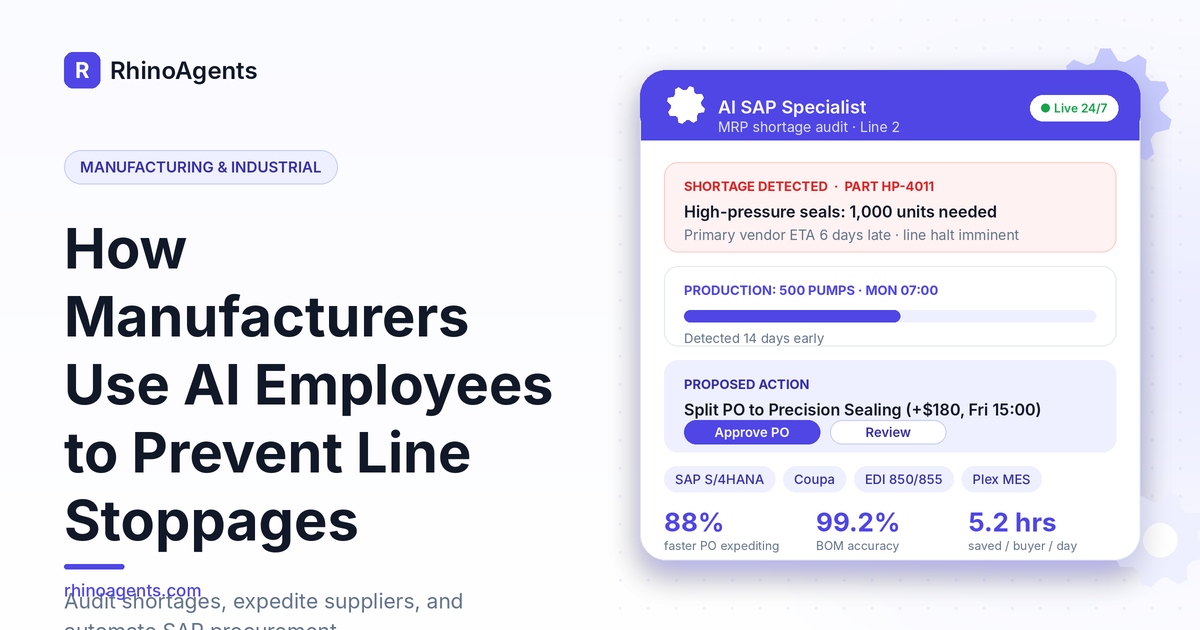
It is Thursday afternoon at a mid-sized machinery plant. Production is scheduled to start Monday at 7:00 AM on 500 industrial hydraulic pumps. Somewhere in the supply chain, a tier-2 supplier has quietly slipped. The high-pressure seals, a part that costs a couple of dollars each, are now six days late. Nobody in purchasing knows yet, because the confirmation email is buried in an inbox and the ERP still shows the original delivery date. By Monday morning, the line will stop. A multi-million-dollar assembly operation will sit idle waiting for a component that costs less than a coffee.
Anyone who has worked on a plant floor or in industrial procurement knows this story. It is not a failure of effort. It is a failure of bandwidth. Plant buyers, planners, and logistics coordinators spend large parts of every day on manual SAP keystrokes, supplier chasing, and spreadsheet reconciliation. The work is repetitive, time-sensitive, and unforgiving: miss one slipped lead time and the consequences ripple through the entire production schedule.
This guide explains how manufacturers are using AI employees to change that. These are ready-to-use digital team members that audit bills of materials, track supplier purchase orders, execute SAP transactions, schedule receiving docks, and match invoices, all inside the governance rules your plant already enforces. We will walk through the problems they solve, the roles available, the architecture that keeps them accurate, the guardrails that keep humans in control, and the economics for a typical plant. For the complete overview, see the Autonomous AI Workforce for Manufacturing & Industrial Plants page.
The Problem: Plants Run on Manual Work That Cannot Keep Up
Modern manufacturing has become dramatically more complex. A single assembly may contain thousands of sub-tier components across multi-level indented BOMs. Suppliers are spread across regions and tiers. Customers expect shorter lead times and higher customization. Yet the administrative backbone that supports all of this, the daily work of keeping materials flowing, is still handled largely by people clicking through screens.
Four pain points show up again and again.
1. Component stockouts that stop the line
The most expensive problem in discrete manufacturing is also the most preventable. A missing seal, connector, or micro-controller can halt a line worth millions. The warning signs usually exist: a supplier email mentioning a delay, a confirmation that never arrived, a lead time that quietly grew. But those signals are scattered, and by the time someone connects them, the window to react has closed.
2. Supplier expediting that eats the buyer’s day
Plant buyers spend a surprising share of each day on status chasing: emailing suppliers for tracking numbers, confirming ship dates, re-entering those dates in SAP, and escalating when answers do not arrive. This is necessary work, but it crowds out the work that actually creates value, such as negotiating pricing, qualifying new vendors, and auditing supplier quality.
3. Receiving dock chaos
In process and CPG facilities, inbound material has to match silo capacity, forklift crew shifts, and carrier arrival windows. When dock scheduling is manual, trucks queue at the gate, yard dwell grows, and detention charges mount. Meanwhile, paperwork has to match: the bill of lading, the purchase order, the goods receipt, and the vendor invoice all need to agree before anyone pays.
4. Maintenance that reacts instead of anticipates
Unplanned equipment downtime is another major cost driver. Telemetry exists, runtime hours are logged, and vibration data is collected, but converting that information into timely preventative work orders often depends on someone remembering to look.
Behind all four problems is the same dynamic: critical, rules-based work is performed manually by a small team, under time pressure, across disconnected systems. That is precisely the kind of work AI employees are built to take on.
The Solution: A Configurable AI Workforce Grounded in Your ERP
The idea is simple. Instead of asking more humans to do more manual work, you add AI employees that own specific jobs. Each one has a defined role, a set of tools, a documented workflow, and a body of plant knowledge it must follow. The RhinoAgents manufacturing workforce is designed around this model for discrete assembly plants and continuous process facilities.
Two features matter most to plant leaders.
It is ready to use. You start from pre-configured role templates, connect your systems, load your plant context, and deploy. The emphasis is on days to value, not a multi-quarter integration project.
It is grounded. Industrial operations have no tolerance for conversational AI that guesses. An employee that invents a supplier lead time or misquotes a unit price is worse than no employee at all. The architecture described below is built so that every action ties back to your ERP data and business rules.
Two Plant Models, Two Ways to Use AI Employees
Model A: Discrete assembly and machinery
High-mix, low-volume equipment manufacturers live and die by component availability. For these plants, the key AI employee is an SAP specialist working alongside a procurement specialist. They continuously evaluate multi-level indented BOMs against scheduled job releases, flag lead time slips as much as 14 days before they cause a stockout, and coordinate split shipments with alternative vendors when a primary supplier falls behind.
Capabilities in this model include:
- Continuous BOM auditing across 10,000 or more line items
- Supplier PO confirmation tracking through email, EDI 850 and 855 transactions, and webhooks
- Direct execution of SAP MM purchase requisitions and inventory transfers
The practical effect is leverage. The page describes the outcome as one plant buyer managing sourcing for five complex assembly lines, because the routine monitoring and data entry no longer consumes the buyer’s day.
Model B: Process and CPG facilities
Batch, chemical, and consumer packaged goods plants face a different bottleneck: the flow of material in and out of the facility. For them, the central employee is a logistics coordinator that schedules inbound carrier deliveries to match silo capacity and forklift crew shifts, performs 3-way matching between bills of lading and purchase orders, and triggers preventative maintenance work orders based on equipment hours and vibration telemetry.
Capabilities in this model include:
- Dock door scheduling that uses telematics ETAs to cut yard dwell
- Maintenance work order generation in the CMMS triggered by runtime
- Real-time 3-way matching across delivery slips, SAP goods receipts, and vendor invoices
The page frames the result as capacity: processing 50,000 or more inbound material shipments with zero detention.
Meet the AI Employees: Six Roles for the Plant
The manufacturing workforce is organized into roles that plant teams will recognize from their own org charts. You can start with a template and customize skills, workflows, tools, and escalation criteria for your plant.
1. AI SAP Specialist
This employee executes SAP Materials Management and Production Planning transactions, audits master data discrepancies, runs MRP shortage evaluations, and creates purchase requisitions. The page cites sub-15-minute MRP shortage auditing, which turns a task that might otherwise happen once a day, or once a week, into something that effectively runs continuously. It works with SAP S/4HANA, SAP ECC, SAP Ariba, and Microsoft Teams.
Master data problems are a quiet source of plant disruption. Wrong lead times, outdated minimum order quantities, and mismatched units of measure cause bad MRP results. An employee that audits these discrepancies as part of its routine helps fix the root cause, not just the symptom.
2. AI Plant Procurement Specialist
The procurement specialist monitors supplier purchase order confirmations, tracks delivery lead times, manages vendor scorecards, and supports pricing conversations on packaging and consumables. It connects to Coupa, SAP Ariba, Oracle SCM, and NetSuite. The headline figure is 88 percent faster PO expediting, driven by autonomous vendor EDI and tracking.
Supplier communication is where this role shines. It contacts vendors through conversational email, supplier portal webhooks, and EDI transactions. It requests tracking numbers, expected ship dates, and quantity confirmations, then parses the replies and updates SAP delivery dates automatically. The buyer sees the result, not the chase.
3. AI Factory Logistics Coordinator
This employee schedules carrier pickup and delivery appointments at factory receiving docks, audits bills of lading, and confirms delivery handoffs with distribution centers. It works with tools such as Opendock, MercuryGate, C3 Solutions, and Descartes. The target outcome is zero dock delays: carriers get appointments that fit the plant’s real capacity, and the receiving team knows what is arriving and when.
If your operation also involves broader freight and warehouse flows, the logistics and supply chain industry page covers the wider transportation side of the picture.
4. AI Operations Manager
The operations manager synthesizes overall equipment effectiveness (OEE) metrics, tracks production shift output variances, alerts floor supervisors to line balance bottlenecks, and coordinates changeovers. It connects with Plex MES, Tableau, Microsoft Teams, and ServiceNow. This is the employee that turns raw production data into timely nudges for the people running the floor.
5. AI Industrial Data Analyst
Plants generate far more data than they can review. The data analyst aggregates machine IoT telemetry, models yield loss patterns, analyzes supplier defect rates, and produces daily executive production summaries for plant directors. It works with Power BI, Snowflake, PostgreSQL, and Python. Instead of waiting for a weekly report, leadership starts each morning with an up-to-date picture.
6. AI Raw Material AP Specialist
Accounts payable for raw materials depends on getting three documents to agree. This employee performs 3-way matching between raw material invoices, electronic bills of lading, and SAP goods receipts. It also captures early-pay supplier discounts automatically, which turns a back-office function into a source of savings. It connects with SAP, OpenText, Coupa, NetSuite, and QuickBooks.
How It Works: Four Composable Layers Built for Plant Rigor
The difference between a useful industrial AI employee and a risky one is architecture. The manufacturing workforce separates four layers so that behavior stays predictable and tied to your rules.
Layer 1: Employee role. This defines responsibilities and administrative authority. Examples include the AI SAP Specialist, the AI Plant Procurement Buyer, the AI Receiving Dock Coordinator, and the AI Operations Manager. Each has an industrial profile that spells out what it may and may not do.
Layer 2: Industrial skills. These are the transactional tools an employee can use: SAP RFC and BAPI connectors and OData connectors (including BAPI_PO_CREATE1), EDI 850, 855, and 856 parsing, CMMS work order dispatch, and QMS non-conformance logging. There are more than 400 enterprise connectors available.
Layer 3: Workflow engine. Workflows are visual, multi-step processes with deterministic logic. Examples include the MRP shortage to PO expediting loop, inbound factory receiving dock scheduling, and 3-way goods receipt matching. Because the logic is deterministic, the same input produces the same, auditable sequence of actions.
Layer 4: Plant context. This is a searchable industrial knowledge base grounded in multi-level BOMs, approved vendor lists, receiving dock time slots, and purchase price variance rules. Its purpose is to keep every answer and action consistent with your ERP business rules.
This layering is what prevents the failure mode plant leaders worry about most: a confident but wrong answer. When the employee needs a lead time, it reads it from the system of record and from supplier confirmations. It does not improvise.
How SAP Integration Works in Practice
For most manufacturers, the ERP is the heart of the operation, and any new technology has to respect it. The manufacturing workforce connects to SAP S/4HANA and SAP ECC through pre-built connectors that use standard OData REST APIs or secure RFC and BAPI calls, such as BAPI_PO_CREATE1 and BAPI_GOODSMVT_CREATE.
There are three practical points worth noting:
- No invasive ABAP modification. The employee accesses SAP through a dedicated service user account, with strictly scoped transactional authorizations.
- Least-privilege access. You decide which transactions the account can execute, so the employee can only do what you permit.
- A full trail. Because actions are executed through standard interfaces under a named service user, they are visible in the same audit trails your team already reviews.
On the supplier side, communication runs through conversational email, portal webhooks, and EDI 850 (purchase order), 855 (PO acknowledgment), and 856 (advance ship notice) transactions. The employee parses vendor responses and writes confirmed dates back to SAP, so planners are working from current information.
Guardrails: Autonomy That Respects Plant Safety, Engineering Control, and IP
No plant director wants an AI system that can rewrite a bill of materials or commit millions in purchasing without oversight. The manufacturing workforce is designed with deterministic guardrails to keep humans in charge of the decisions that matter.
Mandatory buyer and engineering change attestation
Every purchase order release above a preset threshold, every material specification amendment, and every BOM restructuring proposed by the AI requires sign-off from a supervising buyer. Engineering change control stays with engineering.
Proprietary BOM and recipe isolation
CAD assembly files, chemical mixing formulas, and supplier pricing contracts are among a manufacturer’s most valuable assets. In this model they remain isolated in private tenant partitions, with zero training on external models.
ITAR and CMMC readiness for defense manufacturing
Precision fabricators and defense suppliers have additional obligations. The platform offers ITAR-compliant computing boundaries designed to keep technical data within authorized US personnel enclaves, and the page highlights CMMC and private VPC readiness.
You set the purchasing authority
In most deployments, the AI prepares purchase requisitions and draft POs in SAP and notifies the purchasing manager for one-click approval. For routine catalog reorders with contracted suppliers below a threshold you choose, such as $2,500, you can authorize autonomous execution. The point is that you establish exactly where autonomy begins and ends.
The approval gate in action
Return to the opening scenario. With an AI SAP specialist and procurement specialist in place, the late seals are caught early. The employee flags a shortage on Line 2: 1,000 high-pressure seals are required for 500 pumps starting Monday at 7:00 AM, and the primary vendor’s ETA is six days late, which means a line halt is imminent. It then prepares a recommendation: route a purchase order to a secondary vendor at roughly $180 more, with a Friday afternoon delivery. It stops and waits for the material planner to authorize the split PO and reschedule the production line. A human makes the call, but the analysis, the alternative sourcing, and the draft paperwork are already done.
Before and After: A Week in the Life of a Plant
Scenario 1: The slipping component
Before: A tier-2 supplier’s delay is mentioned in a reply that sits unread for two days. The ERP still shows an on-time delivery. On Friday afternoon, the planner discovers the gap. Air freight is the only option, and the cost is substantial.
After: The procurement specialist requests confirmation from the supplier as soon as the open PO enters its tracking window. When the reply indicates a delay, the SAP specialist checks the impact on scheduled releases and proposes an alternative source with a clear cost delta. The planner approves in minutes, and the part ships by standard ground freight.
Scenario 2: Dock gridlock
Before: Six trucks arrive within the same hour. The dock team improvises, one carrier waits four hours, and detention charges are added to the invoice.
After: The logistics coordinator schedules appointments to match silo capacity and crew shifts, using telematics ETAs to adjust in real time. Trucks arrive in a steady flow and yard dwell shrinks.
Scenario 3: The three-way mismatch
Before: An invoice arrives that does not agree with the goods receipt. Accounts payable emails receiving, receiving emails purchasing, and by the time the discrepancy is resolved the early-pay discount window has closed.
After: The AP specialist performs the 3-way match as soon as documents arrive, flags the quantity variance with the supporting records, and routes it to the right person. Clean invoices are paid in time to capture the early-pay discount.
Scenario 4: A damaged shipment
Before: Receiving finds damaged material and tells a supervisor. Someone must log the rejection in SAP QM, write a non-conformance report, email the vendor with photos, set up a return, and recalculate safety stock. Steps get missed.
After: When receiving staff flag the defect in the quality management system, the workflow logs the inspection lot rejection in SAP QM, generates the NCR, emails the vendor with photo evidence, starts the return material authorization process, and recalculates line safety stock.
The Financial Case: What a Mid-Sized Plant Can Expect
The manufacturing page models the economics for a mid-sized discrete plant with three assembly lines and $60 million in annual throughput. It estimates that such a plant can incur more than $740,000 annually in unplanned line stoppages, emergency air freight expedite fees, and buyer administrative overtime.
For a plant in the $40 million to $100 million range, the projected annual net impact breaks down as follows:
- 10,800 buyer and SAP hours saved annually, returned to higher-value work
- About $378,000 per year in purchasing staff time reclaimed
- About $280,000 per year in avoided assembly line shutdown hours
- About $125,000 per year in reduced emergency premium freight
- About $64,000 per year in supplier price variance surcharges reclaimed
The total estimated annual bottom-line impact is roughly $847,000. The page also highlights a headline of more than $380,000 in downtime cost avoidance from flagging critical stockout risks as much as 14 days early, and 5.2 hours returned daily to each material buyer by eliminating manual SAP keystrokes.
These are modeled projections for a specific plant profile, not guarantees. Your results depend on your supplier base, your BOM complexity, your current expedite costs, and how well the employees are configured. The most reliable approach is to use the ROI calculator on the manufacturing AI workforce page with your own numbers, and start where the biggest leak is.
Other operating metrics cited for the workforce include:
- Sub-15-minute MRP shortage auditing
- 88 percent faster PO expediting
- 99.2 percent BOM inventory accuracy from real-time demand versus stock audits
A Practical Rollout Plan
You do not need to automate the entire plant at once. A phased approach reduces risk and builds trust.
Phase 1: Observe and audit. Deploy the SAP specialist in a read-focused mode. Let it run MRP shortage evaluations and master data audits, and compare its findings with what your planners already know. This builds confidence and often surfaces cleanup opportunities.
Phase 2: Supplier follow-up. Add the procurement specialist for PO confirmation tracking on a defined set of suppliers or part families. Have it draft communications and updates for buyer review before moving to autonomous follow-up.
Phase 3: Draft and approve. Allow the employees to prepare purchase requisitions and draft POs in SAP, with one-click approval from the purchasing manager. Set clear thresholds for what needs sign-off.
Phase 4: Extend to receiving and AP. Bring in the logistics coordinator and the AP specialist. By this point your plant context is already loaded, so these roles go live faster.
Phase 5: Expand into operations and analytics. Add the operations manager and the data analyst to turn production and telemetry data into daily guidance.
If your organization builds equipment and also manages large capital projects or site work, you may find the construction industry page a useful companion. Teams building connected products or software-driven machinery may want to look at the technology and engineering page, and automotive suppliers can see how the same approach applies on the automotive and dealerships page.
Principles for a Successful Industrial AI Deployment
- Start with clean master data. The AI will surface problems in lead times, units, and vendor records. Treat that as a benefit and fix the root causes.
- Define authority explicitly. Write down purchasing limits, approval rules, and escalation paths before go-live.
- Keep engineering change control human. BOM and specification changes should always require attestation.
- Use scoped service accounts. Grant only the SAP authorizations required, and review them periodically.
- Measure the right outcomes. Track stockout incidents, expedite spend, buyer hours on manual entry, dock dwell time, and early-pay discount capture before and after.
- Treat employees like new hires. Give them clear roles, review their early work, and refine instructions as you learn.
Manufacturing AI FAQ
How does the AI connect to SAP S/4HANA or SAP ECC without custom coding?
Through pre-built connectors that use standard OData REST APIs or secure RFC and BAPI calls, such as BAPI_PO_CREATE1 and BAPI_GOODSMVT_CREATE. No invasive ABAP modifications are needed. The AI uses a dedicated service user with strictly scoped transactional authorizations.
Can it handle complex multi-level bills of materials?
Yes. It works with multi-level indented BOMs, parent-child assemblies, phantom assemblies, and engineering change notices. It evaluates requirements down to raw material level and tracks lead times and minimum order quantities across every tier.
How does it communicate with tier-1 and tier-2 suppliers?
Through automated conversational email, supplier portal webhooks, and EDI transactions (850, 855, and 856). It asks for tracking numbers, expected ship dates, and quantity confirmations, parses responses, and updates SAP delivery dates automatically.
Does the AI have authority to issue purchase orders?
Only as far as you allow. In most deployments it prepares requisitions and draft POs for one-click approval by the purchasing manager. For routine reorders from contracted suppliers under a threshold you set, such as $2,500, autonomous execution can be authorized.
What happens if a shipment is damaged or fails inspection?
When receiving flags a defect in the QMS, the workflow logs an inspection lot rejection in SAP QM, generates a non-conformance report, emails the vendor with photo evidence, starts a return material authorization, and recalculates line safety stock.
Is my proprietary data safe?
CAD files, formulas, and supplier contracts stay isolated in private tenant partitions with no training on external models. For defense suppliers, ITAR-compliant computing boundaries and CMMC readiness are part of the offering.
Will this replace our buyers and planners?
The aim is to remove repetitive keystrokes and status chasing so your people can focus on supplier negotiation, quality, and planning decisions. Humans stay in control of approvals, engineering changes, and exceptions.
Explore Other Industries
Manufacturing is one of many verticals where AI employees are reshaping operations. Related pages include:
- Logistics and Supply Chain for freight, warehousing, and transportation workflows
- Construction for project-based operations
- Retail and E-Commerce for downstream order and inventory flows
- Local Business and Home Services for field service contractors
You can browse every vertical on the RhinoAgents industries hub.
Conclusion: Keep the Line Running
The most expensive problems in manufacturing are rarely dramatic. They start as small, easily missed signals: a supplier reply that never arrived, a lead time that grew by a few days, a receiving dock booked beyond capacity. Catching them in time requires constant attention across many systems, which is exactly what human teams cannot provide around the clock.
AI employees close that gap. They monitor continuously, act within the rules you set, execute transactions in your ERP, communicate with suppliers, and hand decisions to your people with the analysis already done. The result is fewer line stoppages, less emergency freight, faster procurement, and buyers who spend their time on work that moves the business forward.
If you want to see what that looks like in your plant, start with the manufacturing and industrial AI workforce, then deploy your first manufacturing AI employee. If you would like a walkthrough connected to your own SAP environment, you can book a technical operations briefing with the team.
