
Search for voice AI in banking and you will find dozens of vendors using nearly identical language. Conversational IVR, virtual assistants, and automated voice systems all sound alike in a demo. The differences show up after go-live, when real customers call with half-remembered account details, background noise, and a fraud alert they are anxious about.
This guide ranks ten options for banks, credit unions, neobanks, lenders, and fintechs. We cover what each one does well, where it falls short, and who it suits. We also explain why the shape of the product matters as much as the voice quality: a bank does not need a phone bot, it needs a voice AI employee that knows the customer, remembers past conversations, and can act on what it hears.
What Is Voice AI in Banking?
Voice AI in banking is software that answers and places phone calls on behalf of a financial institution. It understands what the customer says, verifies identity, looks up account information, completes routine requests, and hands complex cases to a person with the full context attached.
It differs from the phone systems banks have used for decades. A traditional IVR forces callers through menus (“press 1 for balances”). Keyword-matching bots break the moment a customer phrases something unexpectedly. A modern voice AI listens to open-ended speech, works out the intent, and responds in natural language, across as many conversational paths as the customer needs.
Voice AI is not designed to replace advisory conversations, discretionary lending decisions, or sensitive dispute handling. Its job is to resolve the high-volume, repetitive calls quickly and securely, so your trained staff spend their time on the conversations that need them.
Where Voice AI Works in Banking
Most banks start with a narrow set of calls and expand from there. The strongest early use cases are:
- Balance and transaction questions. The most common call in retail banking, and the easiest to automate safely.
- Card services. Activation, freezing a lost card, replacement requests, and travel notices.
- Fraud alert confirmation. An outbound call asking “Did you make this purchase?” reaches the customer in minutes instead of hours.
- Payment reminders and promises to pay. Polite, consistent outreach that logs every outcome.
- Loan application status and document follow-ups. Customers get an update without waiting in a queue.
- Branch hours, appointments, and routing. The call lands with the right team, with the reason for the call already captured.
Complex lending advice, formal disputes, and hardship cases should still go to trained staff, and a good voice AI knows when to hand over.
How We Evaluated These Platforms
We looked at how each option behaves in regulated, high-volume settings rather than in a polished demo. Six criteria shaped the ranking:
- Conversation quality under real conditions: turn-taking, interruptions, accents, and latency.
- Memory and context: whether the system knows who is calling and what happened before.
- Channel coverage: voice only, or voice together with chat and WhatsApp.
- Integration depth: actual connections to core banking, CRM, KYC, and fraud systems, not just an open API.
- Compliance and governance: audit logs, PII controls, access control, and certifications.
- Pricing clarity: whether you can model cost at peak call volume.
Pricing and review figures below come from vendor pages and published third-party summaries such as Retell AI’s guide to voice AI for banking. Vendors change them often, so confirm current details before you commit.
The 10 Best Voice AI Agents for Banking at a Glance
| # | Platform | Best for | Model |
| 1 | RhinoAgents | A voice AI employee with memory across voice, chat, and WhatsApp | Ready-to-use AI employee, usage-based |
| 2 | PolyAI | Enterprise voice quality and multilingual contact centers | Managed, quote-based |
| 3 | Cognigy | Complex multi-channel orchestration | Enterprise, quote-based |
| 4 | Parloa | Regulated, high-volume enterprise voice | Enterprise, quote-based |
| 5 | Retell AI | Programmable phone workflows for engineering teams | Usage-based, per minute |
| 6 | Vapi | Developer-led voice infrastructure | Usage-based, API-first |
| 7 | Kore.ai | Large banks needing a broad conversational suite | Enterprise, quote-based |
| 8 | Voice.ai | Banks and credit unions wanting a banking-focused voice offering | Vendor-led |
| 9 | RaftLabs | Custom voice builds integrated with core banking APIs | Project-based |
| 10 | SquadStack | High-volume outbound sales and collections | Managed, contract-based |
1. RhinoAgents: The Voice AI Employee for Banking
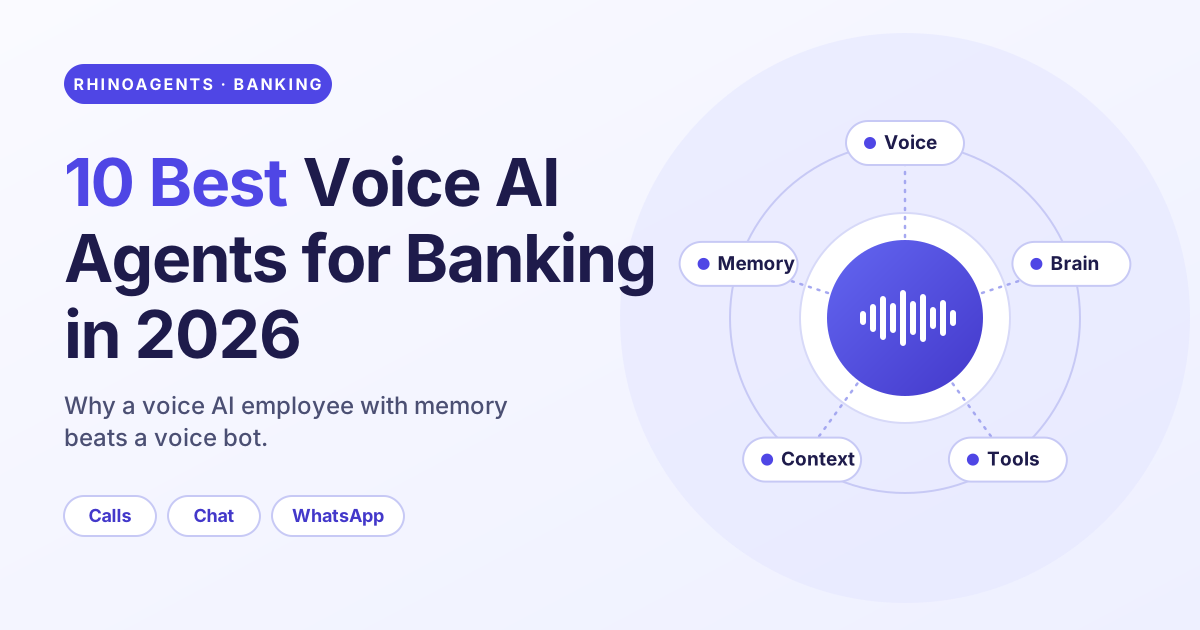
Most voice AI products are a voice with a script attached. RhinoAgents takes a different approach: it gives you a ready-to-use voice AI employee that does the job of a service or collections team member, with everything that job requires in one place.
An employee is more than a voice. They have a brain that reasons, tools to act with, context about the customer, and a memory of the relationship. A voice AI employee from RhinoAgents has all of those together, which is why it behaves less like an answering machine and more like a colleague who has read the file before picking up the phone.
The Voice
Customers judge a bank by how a call feels in the first ten seconds. The RhinoAgents voice AI employee speaks naturally, handles interruptions, and keeps its pace steady when a customer is flustered or in a hurry. It answers instantly, around the clock, so a customer who notices a suspicious charge at 2 a.m. gets a real response and not a voicemail box. Calls run on a voice AI platform built for response times under 500 milliseconds, with telephony and SIP connectivity and 50+ voices to choose from.
The Brain
Behind the voice is a reasoning layer that understands intent, not keywords. A customer who says “I think someone’s using my card, and I’m abroad” is raising a fraud concern, a card freeze request, and a travel context in a single sentence. The brain separates those, handles them in the right order, and decides when a human should step in. You set the rules, including approval gates and confidence thresholds, for where the employee acts on its own and where it escalates, such as dispute cases, hardship situations, and anything above a defined risk threshold.
The Tools
A banking conversation is rarely only a conversation. The employee needs to look up a balance, check a transaction, freeze a card, update a contact detail, log a case, and book a branch appointment. RhinoAgents connects the voice AI employee to your CRM, core systems, calendars, and ticketing tools through 400+ pre-built integrations, so it can take the action while the customer is still on the line. Identity verification happens through your own systems before any account detail is shared.
The Context
Context is what separates a useful call from a frustrating one. The voice AI employee draws on one shared knowledge base, so the answer a customer hears on the phone matches the answer in chat and on WhatsApp. It knows your product terms, fee schedules, eligibility rules, and policies, and it does not improvise when a policy question comes up.
The Memory
This is where the employee model pays off most. The RhinoAgents voice AI employee has memory. It remembers the customer’s previous requests, the open loan application, the card that was replaced last week, and the promise to pay that was agreed on Tuesday. The customer does not have to repeat their story, and neither does your team. Memory works in layers, from the individual session to long-term customer history, with retention rules and privacy purge controls so you decide what is kept and for how long.
Chat History and WhatsApp History in the Same Place
Banking conversations rarely stay on one channel. A customer might start with a WhatsApp message about a pending document, follow up by phone, and finish in web chat. With most tools, each channel is a separate silo, so the voice agent has no idea what was said on WhatsApp.
With RhinoAgents, the voice AI employee can see the chat history and the WhatsApp history in the same place as the call history. When a customer rings to ask about the document they sent over WhatsApp yesterday, the employee already knows it arrived, whether it was complete, and what is still missing. It can say so in plain language, without asking the customer to explain it all again.
It Communicates Clearly
Banking calls fail when the customer leaves unsure about what happened. The RhinoAgents voice AI employee is built to communicate clearly. It confirms what it understood, states what it has done, explains what happens next, and offers to send a summary by WhatsApp or message so the customer has a written record. For a caller who is worried about money, that closing summary is often what turns a stressful call into a resolved one.
Pros
- One employee covering voice, chat, and WhatsApp, with shared memory and history
- A single knowledge base, so answers stay consistent across channels
- Tool access to act on requests, not just discuss them
- Clear handoff to human staff with the conversation context attached
- Usage-based pricing without a platform subscription, which makes cost easier to forecast
- Enterprise controls including immutable audit logs, role-based access, PII data classification guardrails, and SOC 2 Type II, GDPR, and HIPAA compliance
- Multilingual support across 95+ languages
Cons
- Best value comes from deploying the employee across several channels, so a team that only wants a single narrow phone script may not use the full capability
- Integrations with older core banking systems still need proper scoping and testing
Who Should Use It
Banks, credit unions, neobanks, lenders, and fintechs that want one AI employee serving customers consistently over the phone, in chat, and on WhatsApp, and that want it live in days rather than months.
Who Might Look Elsewhere
Institutions that need a fully bespoke, custom-engineered voice stack and have a large internal team to run it.
2. PolyAI
PolyAI focuses on voice-first conversational quality for large enterprises. Its agents are known for natural-sounding, multilingual calls and for holding context through a multi-turn conversation. It is typically deployed in contact centers with managed onboarding and ongoing support.
Strengths: Strong conversational fidelity, multilingual coverage, and a structured rollout process with enterprise support.
Limitations: Pricing is by quote, with reports that contracts can run into six figures a year. Managed deployment means slower iteration, and it is less suited to quick, low-cost pilots.
Best for: Large banks that want premium voice quality and are comfortable with a managed implementation.
3. Cognigy
Cognigy (part of NiCE) is an enterprise conversational automation suite covering voice and digital channels. It offers a low-code flow builder and a large connector library for CRM, ticketing, and contact center systems, with governance and audit features that suit regulated industries.
Strengths: Deep orchestration across channels, broad integrations, and access controls built for compliance teams.
Limitations: Setup is complex and usually needs specialist or developer support. Pricing is quote-based, and the feature set can exceed what a voice-only pilot requires.
Best for: Large institutions with automation or IT teams and complicated back-end systems.
4. Parloa
Parloa is an enterprise voice platform for automating complex inbound and outbound conversations in contact centers. It is commonly used by banks and insurers, and it emphasizes live CRM data in call logic, simulation and QA tooling before launch, and strong compliance controls.
Strengths: Context-aware conversations, pre-launch testing, and enterprise-grade governance.
Limitations: There is no public pricing or self-serve tier, deployments run on longer timelines, and implementation usually involves professional services.
Best for: Large regulated organizations running high-volume voice operations with budget and time for a structured rollout.
5. Retell AI
Retell AI is a voice-first platform for running live inbound and outbound phone calls in production. It exposes programmable call logic through APIs and supports batch outbound calling, webhooks for backend integrations, and usage-based pricing that starts at a published per-minute rate with no platform fee.
Strengths: Fine control over call behavior, transparent per-minute pricing, strong reported adoption, and published security certifications.
Limitations: Complex banking integrations need engineering time. It is voice-first, so chat and SMS are newer and there is no built-in email or social inbox. Costs have several usage components, so they need active monitoring.
Best for: Banks with engineering resources that want programmable control of phone workflows such as reminders, follow-ups, and qualification.
6. Vapi
Vapi is developer-first infrastructure for voice agents, exposing APIs and SDKs so engineering teams can choose and orchestrate speech models, telephony, and call flows themselves.
Strengths: Flexibility, model choice, and fine-grained orchestration for teams that want to own the stack.
Limitations: There is no packaged campaign manager, dialer, or analytics layer. Compliance, monitoring, and failure handling sit with the buyer, and total cost depends on telephony and model choices.
Best for: Fintechs and banks with strong in-house engineering that want to assemble a custom voice layer.
7. Kore.ai
Kore.ai is a long-established conversational AI company serving large enterprises, with banking among its core verticals. Its suite spans voice and digital channels, with tooling for building and governing virtual assistants at scale. Its published banking story describes a U.S. regional bank that replaced a legacy IVR with voice and digital AI agents.
Strengths: Breadth of capability, enterprise references, and a mature governance model.
Limitations: It is geared toward large organizations, so rollouts are heavier and slower than lightweight alternatives. Pricing is negotiated.
Best for: Large banks that want a single enterprise vendor for a wide conversational program.
8. Voice.ai
Voice.ai markets a banking-and-finance voice offering aimed at banks, credit unions, mortgage lenders, and wealth managers. Its positioning centers on handling routine queries such as account inquiries and payment support, with human intervention reserved for complex cases and multilingual support to widen access.
Strengths: A clear financial services focus and an emphasis on accessible, multi-language service.
Limitations: Public technical detail on integrations, governance, and pricing is limited, so you will need a detailed vendor conversation to evaluate it.
Best for: Institutions that want a banking-oriented voice offering and are prepared to validate integration depth during procurement.
9. RaftLabs
RaftLabs builds custom voice AI for banks, neobanks, and credit unions. Typical builds include balance and transaction query agents connected to core banking APIs, fraud-callback agents, loan status agents, and flows with step-up authentication and keypad fallback for accessibility.
Strengths: Tailored builds that integrate with your own systems, with practical attention to authentication and fraud workflows.
Limitations: As a project-based service, timelines and costs depend on scope, and you take on ongoing maintenance and iteration decisions.
Best for: Banks that want a bespoke solution and are happy to run it as a project.
10. SquadStack
SquadStack combines AI voice agents with managed operations for sustained outbound programs, including sales, collections, and re-engagement. It provides campaign setup, CRM integration, reporting, and human handoffs.
Strengths: Strong execution on outbound campaigns and an outcomes focus that reduces internal operational load.
Limitations: Less control over conversation logic and telephony details, and custom contracts limit pricing transparency. It is not a developer-first stack.
Best for: Lenders and collections teams running large outbound programs who prefer a managed model.
Why a Voice AI Employee Beats a Voice Bot in Banking
Looking across these ten, a pattern emerges. Most tools are strong in one dimension: voice quality, orchestration, developer control, or outbound throughput. Few treat the customer relationship as continuous.
Banking is a relationship business. A customer is not a series of unconnected calls. They are someone with an open application, a recent card replacement, a message sent last night, and a worry about a charge. When the system answering the phone forgets all of that, every interaction starts at zero.
A voice AI employee fixes this by combining the pieces a human employee relies on:
| What a human employee has | What the voice AI employee has |
| A voice and manner | Natural, clear speech with fast, interruption-friendly turn-taking |
| Judgment | A reasoning layer that understands intent and knows when to escalate |
| Access to systems | Tools connected to your CRM, core systems, and calendars |
| Product knowledge | One shared knowledge base across voice, chat, and WhatsApp |
| Memory of the customer | Persistent memory of prior requests, cases, and promises |
| The case file | Chat history and WhatsApp history alongside the call record |
Each piece alone is useful. Together, they produce calls that end with the customer saying “that was easy” and not “let me speak to a person.”
A Quick Before and After
Without memory and shared history: A customer messages on WhatsApp to say they have uploaded their income documents for a loan. Two days later they call to check progress. The voice system has no record of the message, asks for the application number, asks what the call is about, and offers a generic status. The customer repeats everything, gets frustrated, and asks for an agent.
With a RhinoAgents voice AI employee: The same customer calls. The employee recognizes the caller, verifies identity through your systems, and says it can see the documents arrived on WhatsApp on Wednesday. It notes that one page of the payslip was cut off, explains what is still needed, and offers to send a short message on WhatsApp with the exact request. The call takes two minutes, and the loan team gets a clean case note.
How to Choose a Voice AI for Your Bank
Start with risk and integration, not the demo.
Pick one use case first. Balance inquiries, fraud confirmation, payment reminders, and loan status are all good starting points. A narrow first scope proves value and surfaces integration issues early.
Check integration depth, not API availability. Ask how the system connects to your core banking platform, CRM, authentication layer, and case system. Can it fetch data securely, take action, and log everything for audit?
Look at memory and channel coverage. Ask whether the system remembers prior interactions and whether voice, chat, and WhatsApp share one history. If each channel is a silo, your customers will feel it.
Review compliance before voice quality. Audit logs, encryption, role-based access, consent recording, PII masking, data residency, and recognized certifications are the baseline in finance. A voice that sounds slightly less human is a smaller problem than a gap in governance.
Define the handoff. Decide in advance which calls always go to a person, using human-in-the-loop approval gates and live handoff, and make sure the human receives a summary so the customer does not start over.
Model pricing against peak volume. Pilot pricing often looks inexpensive. Model the busiest week of the year, including telephony, AI processing, and verification costs.
Plan ownership. Even simple deployments need a technical owner, a compliance stakeholder, and an operations lead who maintains workflows and escalation rules.
A Simple Pilot Plan
A pilot gives you real evidence in weeks. A sensible shape looks like this:
- Week 1: Scope and connect. Choose one call type (the template library is a quick place to start), define the escalation rules, and connect the employee to the systems it needs.
- Week 2: Test internally. Staff call the employee with real scenarios, including edge cases, accents, and angry callers. Review transcripts and tighten the rules.
- Weeks 3 and 4: Limited live traffic. Route a small share of real calls, track resolution rate, handoff rate, and customer feedback, and refine.
- Week 5 onward: Expand. Add the next call type or channel, using what the first one taught you.
The best banking voice AI is the one customers barely notice, because their issue was resolved securely, quickly, and without escalation.
Frequently Asked Questions
How is voice AI used in banking?
Banks use voice AI to answer balance and card questions, confirm fraud alerts, send payment reminders, follow up on loan applications, book appointments, and route calls to the right team, while keeping complex cases with human staff.
What is a voice AI employee, and how is it different from a voice bot?
A voice bot follows a script or handles a single channel. A voice AI employee combines a voice, a reasoning layer, tools, shared context, and memory, and it can work across phone, chat, and WhatsApp. It remembers the customer and acts on requests, instead of only answering questions.
Can a voice AI see our WhatsApp and chat history?
With RhinoAgents, yes. The voice AI employee works from the chat history and WhatsApp history in the same place as the call history, so it can pick up where the customer left off, supported by layered memory. The customer does not need to repeat what they have already told you.
Are voice AI agents secure enough for banks?
They can be, when implemented properly. Look for encrypted data transmission, identity verification through your own systems, audit logs, role-based access, PII masking, and recognized compliance certifications. Security also depends on integration design and your own governance policies. RhinoAgents details its controls on the enterprise security page.
Can voice AI replace human banking staff?
Not entirely. It works best on high-volume, repetitive interactions. Complex lending conversations, disputes, and sensitive fraud cases still need trained people. The goal is to give your team more time for those conversations.
How does the voice AI employee remember customers?
It keeps a record of prior conversations, requests, open cases, and agreed actions, and it draws on that record at the start of each new interaction. This makes calls shorter and more personal, and it reduces repeated questions.
What pricing traps should banks watch for?
Watch for per-minute telephony charges, model processing fees, authentication costs, and add-on compliance features. Ask for a volume-based cost simulation using your real call data before you sign.
How long does deployment take?
Simple deployments can go live in days with a ready-to-use AI employee. Timelines depend mainly on how many systems you connect and how your compliance team reviews the setup.
What should we automate first?
Start with high-volume, low-risk calls such as balance questions, branch hours, card freezes, or payment reminders. Prove the result, then widen the scope.
Final Thoughts
The right voice AI for a bank fits your compliance framework, your core systems, and your operating model, even when another vendor’s demo sounds a little more human. Enterprise suites like PolyAI, Cognigy, Parloa, and Kore.ai suit large institutions with the budget for managed rollouts. Retell AI and Vapi suit teams that want to engineer their own voice layer. RaftLabs and SquadStack serve bespoke and outbound-heavy needs.
If you want something that behaves like a member of your team, with a voice, a brain, tools, context, and memory, and that sees the same chat and WhatsApp history your customers have already created, a RhinoAgents voice AI employee is the one to pilot first.
Ready to hear it on a real banking call? Book a demo with RhinoAgents and see a voice AI employee handle a balance check, a fraud confirmation, and a loan status call end to end, or start a free trial.
