


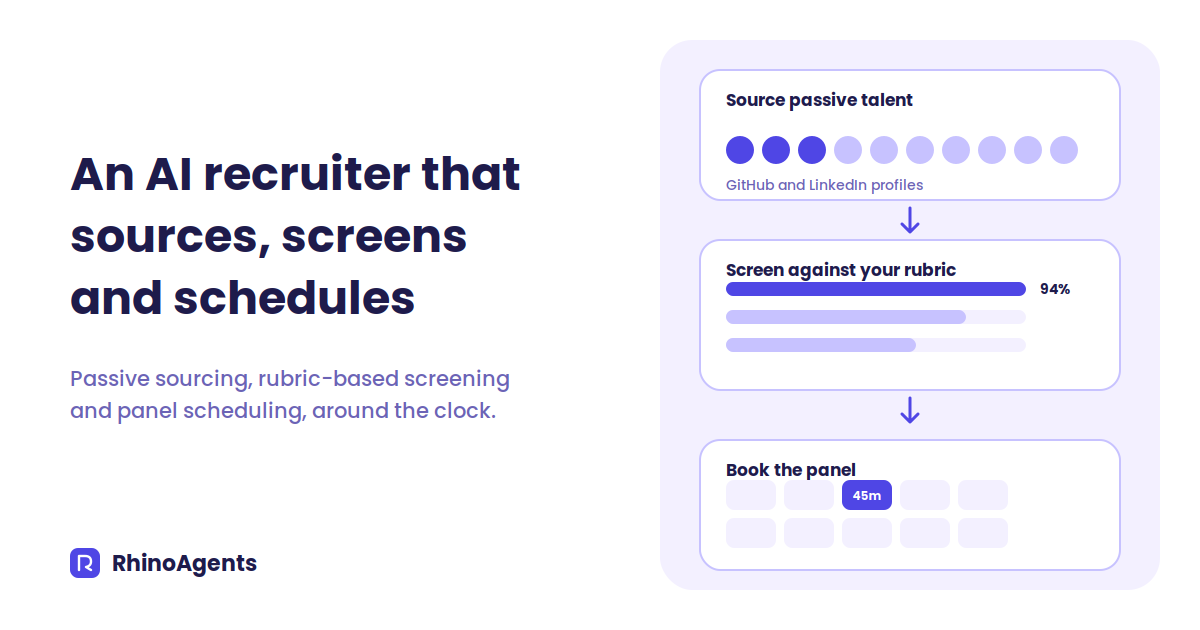
Most recruiters did not choose the profession to read hundreds of unqualified resumes, copy-paste the same InMail template, or play calendar tag with five interviewers. But that is where the hours go. Sourcing, screening, outreach, and scheduling are the repetitive core of every hiring process, and they are the parts that quietly stretch a ten-day search into a ten-week one.
The AI Recruitment Specialist from RhinoAgents is built to take that work off your team’s plate. Meet Maya: a ready-to-use AI employee that finds passive candidates on LinkedIn and GitHub, screens inbound applications against your job requirements, coordinates panel interviews, and keeps your applicant tracking system up to date, all day and all night. In this post we cover what Maya does, how a real sourcing sprint plays out, where humans stay in control, how to configure the employee, and what it costs.
The problem: recruiting runs on repetitive work
Hiring is a high-stakes function that is also full of low-leverage tasks. A typical in-house recruiter or small talent team spends their week on the same loop:
- Reading resumes that were never going to fit. RhinoAgents puts the figure at roughly 80% of a recruiter’s day spent on manual review of unqualified resumes, scheduling chases, and templated outreach. Whatever the exact number in your team, the pattern is familiar: the volume of applications grows faster than the time to read them.
- Generic outreach. Passive candidates, the engineers and specialists who are not actively job hunting, receive a steady flow of near-identical messages. RhinoAgents cites a reply rate of about 8% for generic recruiter templates.
- Calendar tag. Booking a multi-interviewer technical loop means reconciling several calendars and a candidate’s availability across a string of emails. Every day of delay is a day a strong candidate may accept another offer.
- Agency fees. When internal capacity runs out, the fallback is often a staffing agency. RhinoAgents cites contingency fees of around 25% per hire, which can be $35,000 or more for a senior technical role, plus about three weeks to see a first shortlist.
- Inconsistent screening. When screening depends on who read the resume and how tired they were, two equally qualified candidates can get different outcomes.
The cost shows up in time-to-hire, candidate experience, and budget, and it hits lean teams hardest. A startup with three open roles and no dedicated recruiter simply cannot do all of this well at once.
What is an AI recruitment specialist?
An AI recruitment specialist is a digital team member assigned to the talent acquisition role. It is not a resume filter bolted onto an ATS, and it is not a chatbot that answers candidate questions. It owns a set of recruiting responsibilities, connects to the tools a recruiter uses, follows your rubrics, and reports back on results.
Maya is RhinoAgents’ ready-to-use employee for this role. She sits in the HR and Talent Acquisition department, can be addressed in Slack or Microsoft Teams like any other colleague, and works from your job descriptions, scoring rubrics, compensation bands, and culture playbooks. You deploy her, connect your systems, set your approval rules, and she starts executing against the tasks you assign.
What Maya does: four jobs, done continuously
1. Passive candidate sourcing
Maya searches LinkedIn Recruiter, GitHub code commits, and professional communities using boolean strings and semantic skill matching. For technical roles she can look at what engineers actually build: open-source contributions, the technologies they use, and their domain expertise. In RhinoAgents’ own example, a request for distributed systems engineers produces ten candidates identified by recent Rust and Raft activity, not by keyword matches on a profile headline.
2. Resume screening against objective rubrics
Inbound applications are parsed and scored against the competencies your role requires: verified technical skills, relevant experience, architecture background, and project impact. Maya produces ranked shortlists with match scores and a short executive summary for the hiring manager. RhinoAgents says demographic data is anonymized during evaluation, so the scoring rubric, not a candidate’s name or background, drives the ranking.
3. Personalized outreach
Instead of a templated InMail, Maya drafts messages that reference a candidate’s specific work, such as a repository, a project, or a career milestone. She sends sequences through channels like Greenhouse Talent Community, LinkedIn InMail, and Gmail, and schedules automated follow-ups so a good candidate does not slip through after a single message. RhinoAgents reports reply rates around three times higher than generic templates, with a headline figure of 42%.
4. Interview scheduling
Maya reads interviewer availability from Google Calendar and Microsoft Outlook, books multi-stage panels, sends self-scheduling links to candidates, and delivers prep notes to hiring managers. The goal is no more back-and-forth emails and no double-booked interviewers.
After each step she syncs notes and stage changes to your ATS, so the system of record stays current without anyone retyping updates.
A sourcing sprint, step by step
The clearest way to understand the role is to watch a request come in. This is the example RhinoAgents shows on the product page.
A hiring lead writes to Maya: “We need to hire two Staff Distributed Systems Engineers (Rust/Go, Kubernetes, Raft consensus). Source 10 qualified passive candidates on GitHub and screen our 45 inbound applicants in Greenhouse.”
Before: the manual version
A recruiter builds boolean searches by hand, scrolls through GitHub profiles, and copies promising names into a spreadsheet. In parallel, 45 inbound resumes sit in the ATS waiting for a first read. Outreach gets written from a template because there is no time to personalize ten messages. Once the top applicants are identified, scheduling begins: emails to the VP of Engineering, emails to candidates, emails to confirm. The shortlist reaches the hiring manager days later, and several candidates have gone cold by then.
After: with Maya
Maya completes the sprint in one pass:
- Passive sourcing. She identifies ten engineers on GitHub with active Rust and Raft commits and drafts personalized outreach that references their specific open-source work.
- Inbound screening. She parses all 45 Greenhouse resumes against the required competencies and ranks the top three, each with a match score of 94% or higher.
- Automated panel scheduling. She sends self-scheduling links to the top three candidates for 45-minute technical screens with the VP of Engineering.
- Review and send. The hiring lead reviews the candidate list, the scorecards, and the ten outreach drafts. Once they approve the outreach, Maya sends it through Greenhouse Talent Community and LinkedIn InMail, moves each candidate to the “Outreach Sent” stage, and sets a three-day follow-up cadence.
The humans on the team spent their time on the decisions that need judgment: who to approve for outreach and who to interview. The legwork was done before they asked twice.
Where humans stay in control
Recruiting involves people’s careers and your company’s reputation, so some actions should never happen without a person’s sign-off. Maya is configured with human-in-the-loop rules that you control, delivered as interactive cards in Slack or Microsoft Teams that a manager can approve or reject in one click, even from a phone.
A typical setup looks like this:
- Auto-send: initial screening invitations to the top 5% of rubric-matching profiles, which dispatch an interview booking link automatically.
- Auto-sync: ATS status and interview-note updates in Greenhouse and Lever.
- Approval required: formal offer letter generation, which needs sign-off from the VP of People and the CEO before anything reaches a candidate.
- Approval required: rejection of candidates who completed the final round, which routes through hiring manager feedback review first.
You decide where the lines are. A new deployment might require approval on all outreach and relax over time as the team gains confidence. Every action is recorded in an immutable audit log, so you can always trace what was done and who approved it.
Connected to the tools your team already uses
A recruiting employee is only useful if it works inside your existing stack. Maya connects natively to Greenhouse, Lever, Ashby, Workday Recruiting, BambooHR, SmartRecruiters, and LinkedIn Recruiter, along with Google Calendar, Outlook, Gmail, and Slack. RhinoAgents lists more than 400 enterprise connectors in total, using scoped OAuth 2.0 permissions and bi-directional sync.
That matters for two reasons. First, candidates and stages stay consistent between Maya and your ATS, so there is a single source of truth. Second, your team keeps working where they already work. Hiring managers can ask for a pipeline update in Slack, and recruiters see the results in the ATS they open every morning.
Configure your own recruiting employee in 10 steps
Maya is ready to deploy as-is, but every company hires differently. RhinoAgents provides a ten-step studio to tailor the employee to your playbook, with no engineering work required:
- Identity. Choose a name, department, and communication style so teammates can mention the employee in Slack like a colleague.
- Roles and responsibilities. Define what the employee owns, for example sourcing 40 or more senior candidates a week across LinkedIn and GitHub, or screening all inbound resumes against your rubric in under two minutes.
- Skills. Toggle capabilities on or off: resume parsing and rubric scoring, passive sourcing, interview calendar coordination, personalized outreach, Slack approval dispatch, and a compensation matrix lookup.
- Tasks. Set the daily backlog and priorities. Screening new applications within 15 minutes of submission can be marked critical, for instance.
- Schedules. Set recurring runs in plain English.
- Workflows. Lay out the pipeline from new requisition through sourcing, scoring, hiring lead review, invitation, interview lock-in, ATS sync, and hire.
- Memory. Upload job descriptions, compensation bands, culture and values playbooks, and compliance guidelines so every output follows your standards.
- Human-in-the-loop. Decide which actions are automatic and which need approval.
- Testing. Validate outputs against sample scenarios before production access.
- Deploy. Go live. RhinoAgents says this can happen in under 24 hours.
The memory step deserves special attention. Uploading your real job descriptions, rubrics, and examples of strong past hires is what turns a general recruiter into one that sounds like your company and scores like your best interviewer.
A day in the life: the schedule
Because Maya runs on schedules, the work arrives before the team does. A sample day from the product page looks like this:
- 7:30 AM: triage and score overnight inbound applications.
- 11:00 AM: run passive candidate sourcing across LinkedIn and GitHub.
- 2:30 PM: coordinate screening calls and sync calendars.
- 5:00 PM: send the hiring manager a daily candidate pipeline digest in Slack.
- Friday 4:00 PM: deliver a weekly report on ATS funnel health and time-to-hire.
The weekly report also covers pipeline diversity and funnel velocity, which gives the HR lead a regular view of where candidates are moving and where they stall.
Screening that is structured, consistent, and reviewable
Resume screening is where fairness concerns are most acute, so it is worth being precise about what an AI employee can and cannot do. Maya scores applicants against a written rubric of competencies, which makes the criteria explicit and applies them the same way to every resume. Demographic information is anonymized during evaluation, and the rubric can include your compliance guidelines, such as sourcing policies, as part of its memory.
RhinoAgents reports calibration results of 97.2% match with a senior technical recruiter benchmark and 99.5% on a blinded bias-minimization test, and describes its enterprise tier as supporting EEOC compliance logging. Those are useful signals, but they are not a substitute for your own oversight. Hiring law varies by jurisdiction, and some places regulate automated screening tools directly. Keep a human decision-maker on every rejection and offer, review your rubric regularly, and check requirements with your legal counsel.
Agency recruiting vs. an AI recruitment specialist
| Traditional staffing agency | Maya, the AI Recruitment Specialist | |
|---|---|---|
| Cost | About 25% contingency fee per hire | Flat monthly employee pricing, no placement fees |
| Time to first shortlist | About 3 weeks | Sourced, ranked, and screened shortlist in under 60 minutes |
| Outreach | Generic templates, around 8% reply rate | Personalized to a candidate’s work, around 3x the reply rate |
| Scheduling | Days of calendar tag | Automated multi-interviewer coordination |
| Screening | Varies with the reviewer | Rubric-based scoring applied consistently |
This is not necessarily either-or. Agencies still bring value for executive search and relationships in niche markets. But for the high-volume, repeatable parts of hiring, an AI employee changes the economics.
Results RhinoAgents reports
RhinoAgents highlights these headline figures for the role: a 12-day time-to-hire compared with a 45-day baseline, a 42% reply rate on outreach, around $18,000 saved in recruiter fees, and the ability to screen more than 1,000 resumes in about ten minutes. Customer stories on the page describe time-to-hire dropping by about two-thirds.
Treat these as benchmarks for a well-configured deployment, not guarantees. Your results will depend on how clear your rubrics are, how well your ATS data is maintained, and how active your passive-candidate market is.
Who is it for?
RhinoAgents positions the AI Recruitment Specialist for three kinds of teams:
- Early startups and boutiques (1 to 5 open roles). Teams that cannot justify agency fees and have no dedicated recruiter. Maya handles sourcing, outreach, and screening against a scorecard.
- High-growth scale-ups and in-house talent teams (10 to 50 open roles). Teams managing high-volume pipelines in Greenhouse or Lever who need fast resume triage, interview loop scheduling, and interviewer scorecard collection.
- Enterprise talent acquisition and global staffing (100+ annual hires). Organizations that need structured screening frameworks, compliance logging, executive search pipelines, and global contractor recruitment.
Industries span software engineering, healthcare and nursing staffing, fintech, construction and trade labor, sales, consulting, marketing and creative, and supply chain and operations.
Pricing
Pricing follows the same simple structure as every RhinoAgents AI employee, with no per-seat charges and unlimited human teammates:
- Free trial, $0 for 14 days: one AI employee role, 1,000 action credits, and no credit card required.
- Starter, $20/month: up to 3 AI employee roles, 10,000 monthly action credits, knowledge base sync, and calendar, email, and CRM sync.
- Pro, $49/month (most popular): up to 5 roles, 50,000 monthly credits, persistent memory, Slack and Teams human-in-the-loop, and multi-step workflows.
- Business, $99/month: 10 or more roles, 150,000 or more monthly credits, 400+ connectors, SOC 2 Type II and HIPAA readiness, and a dedicated SLA and solutions engineer.
- Custom enterprise, from $1,000/month: dedicated VPC or on-premise deployment.
Compare the Starter price with a single agency placement and the economics are clear. Even one hire sourced and screened through Maya can offset a long stretch of subscription.
Frequently asked questions
How does an AI recruitment specialist source passive candidates?
Maya searches LinkedIn Recruiter, GitHub commits, and professional communities using boolean strings and semantic skill matching. She then drafts personalized outreach to top passive talent that references their specific projects and contributions.
How does bias-free resume screening work?
Resumes are evaluated against required technical competencies, years of relevant experience, and role impact metrics, while demographic data is anonymized. Scoring is rubric-based so the same standard applies to every applicant. A human should still review decisions.
Can Maya coordinate complex panel interview schedules?
Yes. She reads availability across Google Calendar and Microsoft Outlook, books multi-stage technical panels, and sends prep notes to hiring managers.
Which applicant tracking systems are supported?
Maya integrates natively with Greenhouse, Lever, Ashby, Workday Recruiting, BambooHR, SmartRecruiters, and LinkedIn Recruiter, plus 400+ other enterprise tools.
Can human recruiters approve candidate shortlists?
Yes. Ranked shortlists with match scores and executive summaries go to the hiring manager in Slack for one-click interview authorization.
How does it improve candidate response rates?
Outreach references each candidate’s specific projects, repositories, and career milestones, which RhinoAgents reports increases response rates around threefold compared with generic recruiter templates.
How much does it cost?
Plans start with a free 14-day trial, then $20/month for Starter, $49/month for Pro, and $99/month for Business, with custom enterprise plans from $1,000/month. There are no per-seat fees for human teammates.
Conclusion: give your recruiters their time back
Great recruiting is about judgment: knowing who will thrive on your team, persuading the right person to take a call, and making the final decision. The rest, the searching, the first-pass reading, the scheduling, the status updates, is work that follows rules and repeats daily. That is exactly the work an AI employee can own.
Maya gives lean teams the sourcing capacity of a larger department and gives larger teams faster pipelines, with people approving the steps that matter. If you want to see how she handles your open roles, start a trial and put her on your next requisition.
Ready to try it? Hire Maya with a free trial or book an enterprise demo. You can also explore the full AI Recruitment Specialist page.
SEO details
- Suggested slug: ai-recruitment-specialist-sourcing-screening-scheduling
- Meta title: AI Recruitment Specialist: Autonomous Sourcing, Screening & Interview Scheduling
- Meta description: Meet Maya, an AI recruitment specialist that sources passive talent on LinkedIn and GitHub, screens resumes, schedules panels, and syncs Greenhouse and Lever 24/7.
- Primary keywords: AI recruitment specialist, AI resume screening, passive candidate sourcing, interview scheduling AI, Greenhouse Lever automation

