


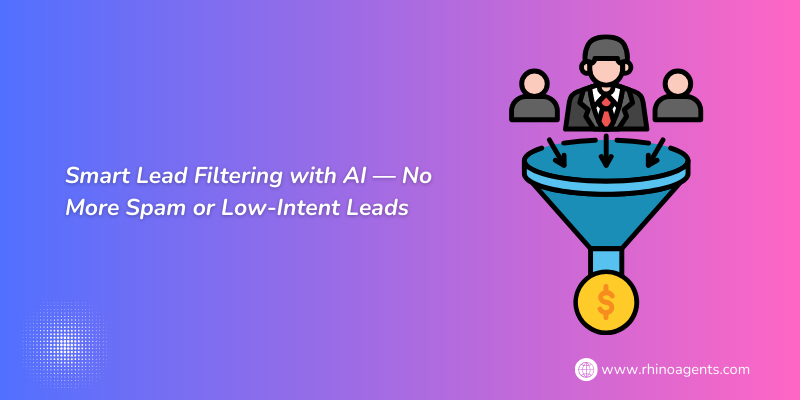
The $2.4 Trillion Problem Nobody Talks About at Sales Conferences
Let me paint you a picture you’ve probably lived through.
It’s Monday morning. Your sales team has 200 new leads sitting in the CRM from the weekend. Everyone’s fired up, coffee’s hot, and the pipeline looks healthy on paper. But by noon, the energy has evaporated. Half those leads had fake phone numbers. A quarter were students doing research for a college paper. A dozen were competitors snooping around your pricing page. And the remaining handful — the ones who might actually buy — have already gone cold because your team wasted three hours chasing the wrong people first.
This isn’t a hypothetical. It’s the daily reality for tens of thousands of sales teams operating without intelligent lead filtering, and the financial damage is staggering. According to a study by Salesforce, sales reps spend only 28% of their week actually selling. The rest gets consumed by administrative tasks, bad data, and — you guessed it — chasing leads that were never going to convert in the first place.
The global cost of bad data in sales and marketing is estimated at $3.1 trillion annually in the United States alone, according to IBM. When you layer in the opportunity cost of low-intent leads — the time your best closers spend nurturing people who downloaded a free checklist with zero intent to ever purchase — that number climbs even higher.
The good news? AI has changed the game entirely. And if you’re still relying on manual lead qualification, form-based scoring, or gut instinct to separate buyers from browsers, you’re leaving a competitive moat on the table that someone else is already swimming across.
Why Traditional Lead Qualification Is Broken Beyond Repair
Before we talk about the solution, let’s be honest about how deep the problem runs, because I don’t think most sales leaders fully appreciate how fundamentally flawed the old approach is.
Traditional lead qualification relies on a combination of demographic data, behavioral signals, and human judgment. You build a scoring model — maybe 10 points for a job title match, 5 points for visiting the pricing page, minus 10 for using a Gmail address — and then you let that score determine who gets called first. It’s logical. It’s measurable. It’s also catastrophically incomplete.
Here’s why. HubSpot’s research shows that 61% of B2B marketers send all leads directly to sales, yet only 27% of those leads are actually qualified. That means sales teams are spending nearly three-quarters of their prospecting time on people who were never going to buy. The traditional scoring model didn’t catch them because it was built on static rules written by humans who made assumptions about buyer behavior that haven’t aged well in an era of anonymous browsing, privacy tools, and AI-generated form fills.
The issue compounds when you factor in spam and fraudulent submissions. Studies from BrightVerify estimate that 20% of all B2C lead form submissions contain invalid email addresses. In industries like real estate, insurance, and home services — where lead volume is high and intent signals are weak — the spam rate on web forms can exceed 30 to 40%. Your team is literally spending time calling people who don’t exist, or who exist but provided false information because they wanted your gated content without committing to any kind of sales relationship.
Lead scoring tools have tried to address this, but even the most sophisticated rule-based systems can’t keep up with how buyers actually behave in 2025. Intent signals are scattered across dozens of touchpoints. The signals that predicted purchase in 2019 don’t mean what they used to mean today. And no human-written scoring rule can adapt in real time to the nuanced, multi-dimensional behavioral fingerprint of a genuine high-intent buyer versus someone who just stumbled onto your landing page through a viral LinkedIn post.
What AI-Powered Lead Filtering Actually Does Differently
This is where AI fundamentally changes the conversation, and I mean that in the most literal sense — AI is now capable of having actual conversations with your leads in real time, assessing their intent, validating their information, and qualifying them against your ideal customer profile before a human being ever gets involved.
The distinction is important. We’re not talking about better lead scoring. We’re talking about a completely different paradigm where the qualification process itself is dynamic, conversational, and intelligent enough to ask follow-up questions, adapt to responses, and make probabilistic assessments about buyer intent that no static scoring model could ever replicate.
Modern AI lead qualification systems work across several dimensions simultaneously. They validate contact information in real time, cross-referencing provided data against publicly available sources, behavioral patterns, and historical engagement data. They assess conversational intent by analyzing not just what a prospect says but how they say it — the specificity of their questions, the urgency in their language, the alignment between their stated needs and their browsing behavior. They enrich lead records automatically, pulling firmographic and demographic data from third-party sources to fill gaps that form submissions always leave behind. And they do all of this at a scale and speed that no human team could match.
According to McKinsey & Company, companies that deploy AI in their sales processes see revenue increases of 3 to 15% and sales ROI improvements of 10 to 20%. Those aren’t numbers that come from marginally better lead scoring. They come from fundamentally transforming who gets into the pipeline and how quickly your best people can engage with genuine buyers.
The Real Estate Lead Qualification Problem Is Uniquely Brutal
If there’s one industry where bad lead management has become genuinely existential, it’s real estate. I want to spend some time here because the numbers tell a story that most people in the industry would rather not confront.
The National Association of Realtors reports that the average real estate agent follows up with only 20% of their leads. Part of that is prioritization failure — agents don’t know which leads are worth pursuing. But a significant part of it is burnout from chasing low-quality leads that waste time and yield nothing.
Real estate leads are notoriously inconsistent in quality. A prospective buyer who fills out a home valuation form might be six months from being ready to transact, might already have an agent, might be a curious neighbor, or might be a competitor gathering market intelligence. A rental inquiry might come from someone with a credit score that disqualifies them for your properties, or from a qualified renter who needs to move next week and would sign today if you called within the hour. Traditional systems treat all of these people the same way. AI doesn’t.
This is precisely why platforms like RhinoAgents have built specialized AI qualification systems specifically for real estate — because the industry has unique qualification criteria that generic tools don’t address. Buyers need to be assessed on timeline, financing status, location preference, budget range, and working relationship with other agents. Renters need screening against income requirements, lease term preferences, and move-in timeline. Sellers need to be evaluated on motivation, timeline, pricing expectations, and property conditions.
A generic chatbot or lead scoring tool can’t conduct that kind of nuanced, multi-variable qualification in real time. An AI system built specifically for real estate — one that knows the difference between a buyer who says “we’re thinking about it” and one who says “we need to be in a home before the school year starts” — can identify the high-intent lead in three minutes of conversation and flag them for immediate agent follow-up while adding the first lead to a long-term nurture sequence.
The ROI implications are significant. Zillow’s research has consistently shown that leads contacted within five minutes of submission are 100 times more likely to convert than leads contacted after 30 minutes. AI qualification systems that identify and escalate high-intent leads immediately aren’t just improving efficiency — they’re capturing revenue that would otherwise evaporate entirely.
How AI Lead Filtering Works in Practice: A Technical Overview for Non-Technical Leaders
I’ve watched too many technology blog posts get lost in jargon at this point, so let me walk through how this actually works in terms that make sense for sales and marketing leaders rather than data scientists.
The first layer is intent detection. When a lead enters your funnel — whether through a form submission, a chatbot interaction, an inbound call, or an ad click — the AI immediately begins analyzing signals that indicate purchase intent. This goes far beyond which pages they visited. Modern intent detection models analyze language patterns in any text interaction, time-on-page relative to content depth, scroll behavior, return visit frequency, device and browser characteristics, referral source and campaign attribution, and dozens of other signals simultaneously. The model produces a probabilistic intent score that’s far more nuanced than anything a rule-based system can generate.
The second layer is identity validation. The AI cross-references provided contact information — name, email, phone number, company — against multiple data sources to assess the likelihood that the lead is who they say they are. Invalid email addresses, VoIP phone numbers commonly used for spam submissions, mismatched geographic data, and other fraud signals are identified and flagged immediately. According to data from TowerData, this kind of real-time validation can reduce spam submissions by up to 74%.
The third layer is conversational qualification. For leads that pass initial validation and show sufficient intent signals, the AI engages in a natural language conversation to gather qualification data that forms can’t capture. This might be a chatbot on your website, an AI voice agent on an inbound call, or an automated but personalized email sequence that uses AI to interpret responses and adapt accordingly. The conversation is designed to surface BANT criteria — Budget, Authority, Need, and Timeline — along with whatever industry-specific qualification variables matter for your business.
The fourth layer is routing intelligence. Based on the composite assessment from the first three layers, the AI makes a routing decision. High-intent, validated, qualified leads are escalated immediately to your best closers, with full context and recommended talking points delivered to the rep before they make contact. Medium-intent leads are entered into appropriate nurture sequences. Spam and clearly disqualified leads are filtered out entirely, keeping your CRM clean and your team focused.
RhinoAgents has built this kind of end-to-end AI qualification infrastructure specifically for businesses that can’t afford to have their pipelines polluted with low-quality leads. Their AI lead qualification agent operates across all of these layers simultaneously, and what makes it genuinely differentiated is the degree to which it can be customized to match your specific ideal customer profile and qualification criteria rather than applying a generic model that was trained on data from a completely different industry.
The Statistics That Should Make Every Sales Leader Uncomfortable
Let me hit you with some numbers that have been sitting in research reports and should be making more waves than they are.
Research from MarketingSherpa found that 79% of marketing leads never convert into sales. Not 20%. Not 30%. Seventy-nine percent. Most of the leads your marketing team is so proud of generating are going precisely nowhere, and the primary reason is a qualification and nurturing gap that AI is uniquely positioned to close.
Demand Gen Report found that nurtured leads produce, on average, a 20% increase in sales opportunities compared to non-nurtured leads. But here’s the catch — nurturing works when it’s targeted at genuine prospects. Nurturing low-intent leads just burns resources and poisons your email deliverability when those contacts mark your messages as spam.
InsideSales.com (now XANT) research demonstrated that 35 to 50% of sales go to the vendor that responds first. This is one of the most cited statistics in sales, but it’s underappreciated in the context of AI lead filtering. When AI systems are doing the initial qualification and flagging your hottest leads for immediate follow-up, you’re not just filtering better — you’re systematically winning the response time race against competitors who are still sorting manually.
Gartner predicts that by 2026, 65% of B2B sales organizations will transition from intuition-based to data-driven decision making. AI lead filtering is a core component of that transition. Organizations that haven’t started this journey yet aren’t just behind on technology adoption — they’re behind on the fundamental shift in how sales organizations will operate for the next decade.
Perhaps most sobering: Forrester Research found that companies that excel at lead nurturing generate 50% more sales-ready leads at 33% lower cost. The companies achieving those numbers aren’t nurturing all their leads. They’re using intelligence to identify which leads deserve nurturing in the first place, then deploying resources accordingly. That’s exactly what AI lead filtering enables.
What AI Lead Filtering Means for Different Business Types
The application isn’t one-size-fits-all, and I think it’s worth breaking down how the value proposition differs across business types, because the implementation looks meaningfully different depending on your model.
For B2B SaaS companies, AI lead filtering primarily addresses the problem of trial-to-paid conversion and demo request qualification. The spam problem is real — studies suggest that 15 to 20% of free trial signups are either competitors, students, or people who will never use the product. But the bigger problem is intent stratification: the difference between a champion who is trying to get internal buy-in to purchase your platform and someone who signed up because they’re mildly curious. AI systems that can detect the signals of a genuine evaluation — depth of product exploration, team invitations, integration attempts, support questions about enterprise features — can prioritize sales attention on trials that are actually progressing toward a purchase decision.
For real estate agencies and brokerages, the qualification criteria are more structured but the volume is higher and the stakes per qualified lead are enormous. A single qualified buyer in a major market represents $15,000 to $30,000 in potential commission. Spending two hours on a lead who was never going to transact costs you that time across every lead who could have. Specialized AI tools like RhinoAgents’ real estate lead qualification bot address this specifically, running through buyer or seller qualification criteria in real time and delivering agents a lead that’s been pre-qualified on the variables that actually matter for real estate transactions.
For home services businesses — HVAC, roofing, plumbing, landscaping — the challenge is a flood of leads from aggregators and comparison sites, many of whom are price shopping across five competitors simultaneously and will choose whoever calls back first with the lowest number. AI qualification can identify which of those leads has the job scope, the timeline, and the location fit to be genuinely valuable, and can surface that information to your dispatcher or sales team before they make the call.
For financial services companies, lead quality directly affects regulatory compliance and risk exposure in addition to revenue outcomes. Mortgage leads with self-reported income that doesn’t match behavioral signals. Insurance leads from high-risk ZIP codes where conversion rates historically tank. Investment leads from retail customers who don’t meet accredited investor thresholds. AI systems that catch these misalignments before they reach your licensed advisors save time and protect your business from compliance headaches.
Implementation: What You Actually Need to Get This Working
I want to be direct about something that gets glossed over in most AI marketing content: implementation is not trivial, and anyone who tells you otherwise is selling you something. That said, the implementation complexity has dropped dramatically in the past two years, and the time-to-value for modern AI lead qualification platforms is measured in weeks, not quarters.
The foundation you need before any AI system can work effectively is clean data. Your CRM needs to have historical lead and conversion data that the AI can use to calibrate what “good” looks like for your business. If your CRM is a mess of duplicate records, inconsistent fields, and years of unprocessed leads, the AI will be calibrating against a distorted picture. Before deploying AI qualification, it’s worth investing two to four weeks in data hygiene — it pays for itself immediately in the accuracy of the models you’ll be training against.
You also need clarity on your ICP — your Ideal Customer Profile. AI lead qualification is only as good as the definition of “qualified” you give it to work with. This means getting specific: not just industry and company size, but specific firmographic characteristics, behavioral signals, and conversational indicators that correlate with high-close-rate leads in your historical data. If you haven’t done this analysis, now is the time, because it forces a strategic conversation your sales and marketing teams should have been having anyway.
The integration layer is where most implementations run into friction. Your AI qualification system needs to connect to your lead sources (website forms, ad platforms, third-party lead aggregators), your CRM, your communication tools, and your analytics infrastructure. Modern platforms like those offered by RhinoAgents have pre-built integrations with the major tools in the stack — Salesforce, HubSpot, Zoho, Twilio, and others — which dramatically reduces the engineering lift. But you’ll need someone on your team who owns the integration and configuration work, even if the platform makes it relatively accessible.
Finally, you need a feedback loop. AI lead qualification systems improve over time, but only if they’re receiving signals about what happened after they made their qualification decisions. Did the leads they flagged as high-intent actually close? Did the leads they filtered out actually include any genuine buyers? Regular review of these outcomes — weekly at first, monthly once the system has matured — allows you to continuously refine the model and close the gaps between AI judgment and real-world outcomes.
The Future of Lead Intelligence: What’s Coming in the Next 24 Months
The current state of AI lead qualification is impressive. What’s coming next is genuinely transformative.
Multimodal intent analysis is moving from research labs to production systems. Within the next two years, AI qualification tools will be incorporating video call sentiment analysis, voice tone and pacing analysis during inbound calls, and even visual engagement data from personalized landing pages to build richer intent profiles than anything available today.
Predictive pipeline management — where AI doesn’t just qualify current leads but predicts future lead quality based on market conditions, competitor activity, and macroeconomic signals — is already in beta at several enterprise platforms. The vision is a system that doesn’t just filter your current funnel but tells you where to go looking for your next cohort of high-intent buyers before they enter your pipeline at all.
Conversational AI for lead qualification is becoming indistinguishable from human interaction in controlled scenarios. GPT-4 and subsequent models have crossed a threshold where the conversational qualification experience — when designed thoughtfully — feels natural enough that prospects engage as if they’re talking to a knowledgeable person, not a bot. This dramatically increases the quality of qualification data collected and reduces the drop-off rates that have historically plagued automated qualification flows.
Real-time personalization at the qualification stage — where the AI dynamically adjusts its qualification approach based on the specific signals it’s reading from a given prospect — is already emerging in sophisticated platforms. A prospect who leads with budget objections gets a different qualification conversation than one who leads with technical requirements. A prospect who comes from a competitor’s customer review site gets a different set of qualifying questions than one who comes from an organic search for a category term.
The companies that are investing in AI lead intelligence infrastructure now aren’t just solving today’s spam problem. They’re building the data assets and organizational capabilities that will power their competitive advantage as these more sophisticated applications become available.
Why RhinoAgents Understands This Problem at a Level Most Platforms Don’t
I want to talk specifically about what makes purpose-built AI qualification platforms genuinely different from generic AI tools applied to lead qualification use cases, because this distinction matters a lot for implementation outcomes.
When you apply a general-purpose AI model to lead qualification, you get general-purpose results. The model hasn’t been trained specifically on the signals that distinguish high-intent buyers from low-intent visitors in your industry. It doesn’t understand the qualification criteria that are specific to your business model. It can’t interpret industry-specific language the way a human expert would. And it hasn’t been optimized for the specific integration patterns and data structures that characterize your tech stack.
RhinoAgents has taken a fundamentally different approach. Their AI lead qualification agent is built around the reality that qualification is not a generic problem — it’s a specific problem with specific variables that differ meaningfully across industries and business models. The platform allows for deep customization of qualification criteria, conversational flows, scoring models, and routing logic in ways that generic tools simply don’t support.
For real estate specifically, their AI real estate lead qualification bot represents what happens when you build AI qualification tooling from the ground up for an industry with unique characteristics — high lead volume, specific transaction criteria, time-sensitive qualification requirements, and agents who need rich context to have effective initial conversations with prospects.
The combination of industry-specific training, deep customization capability, and real-world integration experience makes platforms like this significantly more effective than dropping a generic AI tool into your stack and hoping it figures out what “qualified” means for your business.
The Bottom Line: Your Competitors Aren’t Waiting
Here’s the uncomfortable truth that I want to close with, and I’m going to say it plainly because I think it deserves to be said plainly.
If you’re still running your lead qualification process the way you ran it three years ago, you are falling behind. Not gradually. Not in a way that will eventually catch up with you. You’re falling behind right now, this quarter, as competitors who have invested in AI lead filtering are closing deals faster, wasting less sales time, and building cleaner, more predictable pipelines.
The economics are not subtle. According to Accenture, AI adoption in sales has the potential to double sales force productivity over the next five years. The companies that will capture that productivity gain are not the ones evaluating AI in 2027. They’re the ones implementing it in 2025.
Spam leads aren’t just an annoyance. They’re a tax on your sales team’s attention, your marketing budget’s ROI, and your company’s ability to grow predictably. Low-intent leads aren’t just a conversion rate problem. They’re a strategic drag that slows your velocity, inflates your cost of customer acquisition, and erodes the morale of your best salespeople.
The technology to solve this problem exists. It’s not experimental. It’s not prohibitively expensive. It’s not technically complex to deploy. What it requires is a decision — a leadership decision to stop accepting pipeline pollution as an inevitable cost of doing business and to invest in the intelligent infrastructure that filters it out.
AI lead qualification systems, from platforms specifically designed for this purpose like RhinoAgents (https://www.rhinoagents.com) and their specialized solutions at https://www.rhinoagents.com/ai-lead-qualification-agent and https://www.rhinoagents.com/ai-realestate-lead-qualification-bot, are not the future. They are the present competitive standard for any organization serious about sales efficiency.
The question isn’t whether AI will transform lead qualification. That transformation is already underway. The question is whether your organization will be on the side of that transformation that benefits from it — or the side that gets left behind by it.
The leads are out there. The buyers are real. The intent signals are readable. The only thing standing between your sales team and a pipeline full of genuine, high-quality, ready-to-buy prospects is the intelligence layer you deploy to separate the signal from the noise.
It’s time to stop tolerating spam. It’s time to stop chasing low-intent ghosts. It’s time to let AI do what it does better than any human team ever could — read the signals, filter the noise, and surface the people who actually want to buy what you’re selling.

