


The average corporate job posting attracts 250 resumes, but recruiters spend only seven to nine seconds reviewing each one during the initial screening. This staggering mismatch between volume and attention has created a recruitment bottleneck that costs companies both time and talent. Enter AI agents: intelligent software systems that are revolutionizing how organizations screen, evaluate, and shortlist candidates.
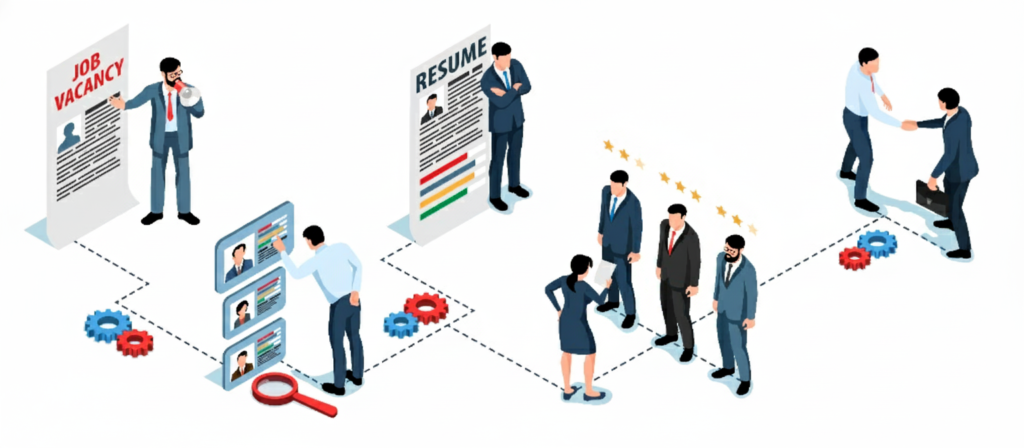
The statistics paint a compelling picture of this transformation: 83% of companies plan to use AI for resume screening by 2025, up from 51% currently. According to research from LinkedIn, 67% of hiring managers say AI helps them save time, while 43% note it reduces bias in their hiring process. The recruitment landscape is undergoing a fundamental transformation, and AI-powered resume screening sits at the heart of this change.
In this comprehensive guide, we’ll explore how AI agents automate resume screening and shortlisting, examine real-world workflows, decode the scoring logic behind these systems, and understand their integration with modern job portals and applicant tracking systems.
The Evolution of Resume Screening: From Manual to Intelligent
Traditional resume screening has always been labor-intensive and fraught with challenges. Human recruiters face cognitive fatigue after reviewing dozens of applications, leading to inconsistent evaluation criteria and unconscious bias creeping into decisions. Research from the University of Washington found that even state-of-the-art AI systems showed concerning bias patterns when names were varied across demographics—with white-associated names preferred 85% of the time versus Black-associated names only 9% of the time.
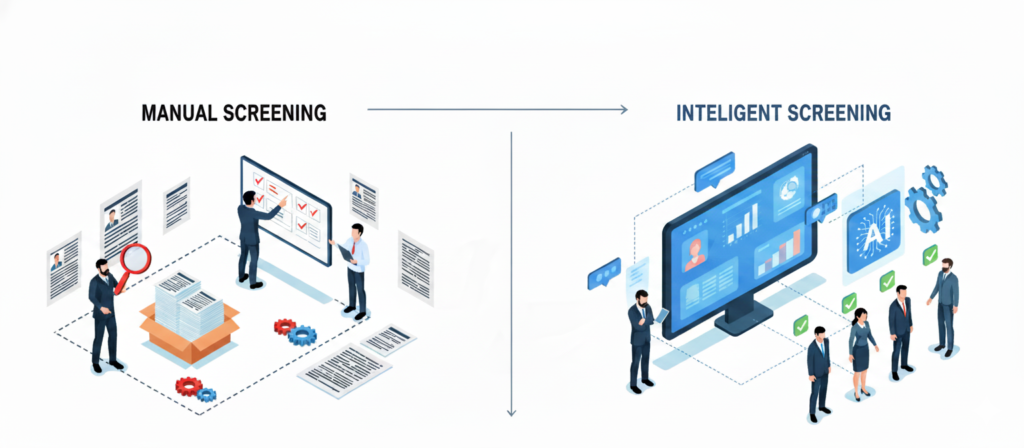
Yet properly designed AI agents offer a solution that combines speed, consistency, and the potential for fairer evaluation when implemented with appropriate oversight. These aren’t simple keyword-matching systems; modern AI recruitment agents use natural language processing, machine learning, and contextual understanding to evaluate candidates holistically.
The numbers tell the story: 87% of organizations now use AI at some point in their hiring process, with 86.1% of recruiters reporting that AI makes hiring faster. What once took hiring teams days now happens in hours, and what required multiple manual touchpoints can now be automated end-to-end.
Platforms like Rhino Agents are leading this transformation by offering sophisticated AI recruitment solutions that go beyond basic automation. Their AI Recruitment Agent demonstrates how advanced systems can handle complex screening tasks while maintaining the nuance that recruitment requires, processing high volumes without sacrificing quality or introducing bias.
Understanding AI Agents in Recruitment
Before diving into workflows and technical details, it’s essential to understand what AI agents actually are in the recruitment context.
An AI agent is an autonomous software system that can perceive its environment (in this case, resumes and job descriptions), make decisions based on programmed logic and learned patterns, and take actions to achieve specific goals (identifying qualified candidates). Unlike static algorithms, AI agents can adapt their behavior based on feedback and new data.
In recruitment, AI agents perform several critical functions:
Data Extraction and Parsing: AI agents extract structured information from unstructured resume formats, including PDFs, Word documents, and even scanned images. They identify names, contact information, work experience, education, skills, certifications, and other relevant details with near-perfect accuracy when properly trained.
Semantic Understanding: Modern AI agents don’t just match keywords; they understand context and synonyms. If a job requires “customer service” experience and a candidate lists “client relations,” the AI recognizes these as related concepts. According to industry data, this semantic matching capability significantly reduces false negatives in screening.
Predictive Analytics: By analyzing historical hiring data, AI agents can predict which candidates are most likely to succeed in a role based on patterns from past successful hires. Research indicates that companies using predictive AI see 82% better quality hires.
Continuous Learning: The most sophisticated AI recruitment systems improve over time, learning from recruiter feedback and hiring outcomes to refine their screening criteria. This adaptive capability distinguishes modern platforms like Rhino Agents’ AI Recruitment Agent from basic keyword filters.
Real-World AI Resume Screening Workflows
Let’s walk through several practical workflows that demonstrate how AI agents handle resume screening from start to finish.
Workflow 1: High-Volume Screening for Entry-Level Positions
Scenario: A retail company receives 800 applications for 10 customer service representative positions.
Step 1: Job Requisition Creation The hiring manager creates a job posting within the applicant tracking system, defining required qualifications (high school diploma, one year customer service experience) and preferred qualifications (bilingual abilities, cash handling experience).
Step 2: Automatic Resume Ingestion As applications arrive through the career portal, the AI agent automatically ingests each resume. The system parses information regardless of format, extracting key data points into a structured database. Modern parsing technology achieves 95%+ accuracy rates.
Step 3: Initial Qualification Screening The AI agent applies hard filters based on required qualifications. Candidates without the minimum education or experience are automatically moved to a “not qualified” pool. This initial screening typically eliminates 30-40% of applicants, according to recruiting benchmarks.
Step 4: Skills and Experience Scoring For remaining candidates, the AI agent scores resumes based on a weighted algorithm:
- Relevant work experience: 40%
- Educational background: 20%
- Specific skills match: 25%
- Additional qualifications: 15%
Step 5: Ranking and Shortlisting The system ranks all qualified candidates by total score and automatically identifies the top 50 candidates (roughly 6% of applicants) for human review. This shortlist is delivered to recruiters with detailed scoring breakdowns explaining why each candidate was selected.
Step 6: Human Review and Selection Recruiters review the shortlisted candidates and select 25-30 for phone screening interviews. The AI agent tracks which candidates move forward, learning from these selections to improve future screening accuracy.
Time Saved: What would take recruiters 35-40 hours of manual screening is completed by the AI agent in less than two hours, representing a 95% time reduction. According to research on AI recruitment ROI, organizations typically save an average of 40+ hours per hire in recruiter time when using AI screening tools.
Workflow 2: Specialized Technical Role Screening
Scenario: A software company needs a senior machine learning engineer with specific technical expertise.
Step 1: Enhanced Job Profile Creation The hiring manager works with the AI system to create a detailed technical profile, including:
- Required programming languages (Python, R)
- Framework experience (TensorFlow, PyTorch)
- Minimum years of experience (5+ years in ML)
- Educational background (Master’s or PhD in Computer Science or related field)
- Domain expertise (natural language processing preferred)
Step 2: Intelligent Resume Analysis The AI agent performs deep semantic analysis on each resume, identifying:
- Technical skills mentioned across different sections
- Project descriptions that indicate hands-on experience
- Publications or GitHub contributions
- Academic credentials and research experience
According to industry research, AI systems can process and analyze technical resumes 10x faster than human reviewers while maintaining higher consistency in evaluation criteria.
Step 3: Advanced Scoring with Context Unlike entry-level screening, technical role evaluation requires understanding context. The AI agent evaluates:
- Recency of skills (when the candidate last used each technology)
- Depth of experience (project leadership vs. team contribution)
- Progressive career growth (increasing responsibility over time)
- Cultural and domain fit indicators
Step 4: Portfolio and Project Analysis If candidates include links to GitHub profiles, portfolios, or publications, some advanced AI systems can crawl and analyze these materials, evaluating code quality, project complexity, and technical depth. Platforms like Rhino Agents excel at this multi-source analysis.
Step 5: Shortlist with Detailed Profiles The AI generates comprehensive candidate profiles for the top 15-20 candidates, highlighting why each individual is a strong match. These profiles include specific resume excerpts, skill assessments, and comparative analysis against the job requirements.
Step 6: Continuous Refinement As the hiring manager provides feedback on candidates, the AI agent adjusts its understanding of what “good fit” means for this specific role, improving recommendations in real-time.
Workflow 3: Diversity-Focused Screening
Scenario: A financial services firm wants to build a diverse candidate pipeline for management training positions while maintaining objective evaluation standards.
Step 1: Bias-Minimized Job Description The AI agent analyzes the job description for potentially biased language and suggests neutral alternatives. Research shows that gendered language in job posts affects application rates, with masculine-coded words (like “competitive,” “dominate”) determining female applicants.
Step 2: Blind Initial Screening The AI agent performs initial screening without accessing information that could trigger bias:
- Names are anonymized
- Graduation dates are hidden
- University names are temporarily masked
- Location information is generalized
Step 3: Competency-Based Evaluation Screening focuses entirely on demonstrable competencies:
- Analytical skills (evidenced through coursework, projects, or work experience)
- Leadership experience (quantified impact and scope)
- Communication abilities (writing quality in application materials)
- Problem-solving capabilities (demonstrated through achievements)
Step 4: Diverse Slate Generation The AI agent ensures the shortlist maintains diversity by flagging when selected candidates lack variety across multiple dimensions, prompting recruiters to review additional qualified candidates who might bring different perspectives.
Step 5: Audit Trail and Transparency Every screening decision includes a detailed explanation of why a candidate was selected or rejected, creating accountability and enabling organizations to audit their AI systems for unintended bias.
When properly implemented with human oversight and regular bias auditing, AI screening can actually improve diversity outcomes. However, this requires vigilant monitoring—the University of Washington study reminds us that AI systems can perpetuate historical biases if not carefully designed and continuously evaluated.
The Scoring Logic Behind AI Resume Screening
Understanding how AI agents score resumes reveals both the power and limitations of these systems. Let’s decode the logic that powers modern AI recruitment screening.
Component 1: Keyword and Phrase Matching
At the foundation level, AI agents identify relevant keywords and phrases from job descriptions and match them against resume content. However, modern systems use sophisticated natural language processing rather than simple string matching.
Basic Keyword Matching: Exact match for specific terms (e.g., “Java,” “CPA certification”)
Semantic Matching: Understanding synonyms and related concepts (e.g., “customer service” = “client relations” = “customer support”)
Contextual Matching: Recognizing when a keyword appears in meaningful context versus passing mention
Weighted Matching: Assigning different importance to different skills based on job requirements
For example, if a job description emphasizes “strong project management skills” three times and mentions “Excel proficiency” once, the AI agent weights project management experience more heavily in its scoring algorithm. Data shows that 58% of recruiters find AI most useful for this type of intelligent candidate sourcing.
Component 2: Experience Relevance and Recency
Not all experience is equally valuable. AI agents evaluate experience across multiple dimensions:
Recency Scoring: More recent experience receives higher scores because skills and knowledge may become outdated. A candidate who used Python last year scores higher than someone whose last Python experience was five years ago.
Relevance Scoring: Experience directly related to the target role scores higher than tangentially related experience. For a marketing manager role, “digital marketing campaign management” scores higher than “event coordination.”
Duration Weighting: Longer tenure in relevant roles generally indicates deeper expertise. However, AI agents can also flag job-hopping patterns or concerning employment gaps.
Progressive Responsibility: Career trajectories showing increasing responsibility receive bonus points, indicating growth and advancement capability. Research indicates that this progressive analysis correlates strongly with long-term employee success.
Component 3: Educational Credentials
Education scoring varies dramatically based on role requirements:
Degree Level Matching: Does the candidate have the minimum required degree?
Field of Study Relevance: How closely does the candidate’s major align with job requirements?
Institution Prestige: Some systems incorporate university ranking data, though this can introduce socioeconomic bias if not carefully monitored. According to research, 50% of resumes include a Bachelor’s, Master’s, or PhD.
Academic Performance: When GPA is included in resumes, it can factor into scoring, particularly for recent graduates. Industry data shows that employers’ use of GPA as a screening tool has risen to 38.3%.
Continuing Education: Certifications, bootcamps, and professional development signal commitment to ongoing learning—increasingly valued in the skills-based hiring movement, where 81% of employers now adopt skills-first methods.
Component 4: Skills Assessment
Modern AI agents create sophisticated skills profiles:
Hard Skills Inventory: Technical and measurable skills (programming languages, software proficiency, certifications)
Soft Skills Indicators: Language analysis to identify indicators of communication, leadership, and collaboration abilities
Skills Gap Analysis: Comparing candidate skills against job requirements to quantify gaps
Transferable Skills Recognition: Identifying skills that transfer across industries and roles—particularly important as 98% of employers say skills-based hiring is more effective than traditional resume review alone.
Component 5: Achievement Quantification
AI agents are increasingly capable of identifying and scoring quantified achievements:
- “Increased sales by 35%” scores higher than “Responsible for sales”
- “Managed team of 12” provides concrete scope information
- “Reduced processing time from 4 days to 24 hours” demonstrates measurable impact
The AI looks for numbers, percentages, dollar amounts, timeframes, and scope indicators throughout the resume. Advanced systems like Rhino Agents’ AI Recruitment Agent can even contextualize these achievements within industry benchmarks.
Component 6: Cultural and Values Alignment
Some advanced AI systems attempt to assess cultural fit by analyzing:
- Volunteer work and community involvement
- Company tenure patterns (do they prefer startups or established companies?)
- Industry diversity in work history
- Language tone and communication style
This is the most controversial aspect of AI screening, as cultural fit assessments can easily perpetuate homogeneity rather than support diversity. Research indicates that 46% of companies fear AI may introduce bias in these subjective assessments.
Weighted Scoring Example
Here’s how an AI agent might score a marketing manager candidate:
Total Score = (Experience Relevance × 0.35) +
(Skills Match × 0.25) +
(Educational Fit × 0.15) +
(Achievement Quality × 0.15) +
(Recency Factor × 0.10)
Candidate Score Breakdown:
– Experience Relevance: 85/100 (0.35 weight) = 29.75 points
– Skills Match: 78/100 (0.25 weight) = 19.50 points
– Educational Fit: 90/100 (0.15 weight) = 13.50 points
– Achievement Quality: 82/100 (0.15 weight) = 12.30 points
– Recency Factor: 95/100 (0.10 weight) = 9.50 points
Total Score: 84.55/100
This candidate would likely rank in the top tier for shortlisting based on their comprehensive match across multiple dimensions.
Integration with Job Portals and ATS Systems
The true power of AI resume screening emerges when these agents integrate seamlessly with existing recruitment infrastructure. Let’s explore how these integrations work in practice.

Integration Architecture
Modern AI recruitment agents connect with job portals and applicant tracking systems through multiple integration methods:
API Connections: Direct application programming interface connections enable real-time data exchange between systems. When a candidate applies through LinkedIn, Indeed, or a company career page, the application data flows immediately to the AI screening agent through API calls. According to industry data, 82% of companies currently use AI to review resumes through these integrated systems.
Email Parsing: For applications arriving via email, AI agents can extract resume attachments and application details from email content, automatically adding candidates to the screening pipeline.
ATS Native Integration: Leading AI screening platforms offer native integrations with major ATS systems like Greenhouse, Lever, Workday, and iCIMS, appearing as embedded features within the existing recruiter workflow.
Data Synchronization: Bidirectional sync ensures that actions taken in either system (AI platform or ATS) are reflected in both, maintaining a single source of truth for candidate data.
Job Portal Integration Examples
LinkedIn Integration: When integrated with LinkedIn Recruiter, AI agents can automatically screen applicants who apply through LinkedIn job postings. The system accesses complete LinkedIn profiles, evaluating not just the application materials but also recommendations, endorsements, and professional network connections. Some systems can even identify passive candidates by analyzing LinkedIn profiles against job requirements, suggesting potential outreach targets.
Indeed Integration: Indeed hosts millions of resumes in its database. AI agents integrated with Indeed can perform two functions: screen active applicants to job postings and search Indeed’s resume database proactively, identifying candidates who haven’t applied but match job criteria. The AI can then trigger automated outreach campaigns to these passive candidates.
Job Board Aggregation: Rather than managing separate workflows for each job board, AI agents aggregate applications from multiple sources (company career site, LinkedIn, Indeed, Glassdoor, Monster) into a single screening pipeline, applying consistent evaluation criteria regardless of application source. This unified approach is key to the 50% reduction in time-to-hire that AI screening delivers.
ATS Workflow Integration
The integration between AI screening agents and applicant tracking systems creates powerful automated workflows:
Automatic Stage Progression: When the AI agent identifies a strong candidate, it can automatically move them to the next stage in the ATS (e.g., from “Applied” to “Phone Screen”), triggering subsequent workflow steps like interview scheduling emails.
Collaborative Feedback Loops: Recruiters can provide feedback on AI recommendations directly within the ATS interface. If a recruiter rejects a candidate the AI scored highly, the system asks for rejection reasons, using this feedback to refine future screening.
Reporting and Analytics: Integrated systems provide comprehensive analytics showing time-to-fill metrics, source quality (which job boards produce the best candidates), AI recommendation accuracy, and diversity pipeline metrics. Companies report that these analytics capabilities alone justify the AI investment.
Candidate Communication: When integrated with ATS communication tools, AI agents can trigger personalized emails to candidates, such as acknowledgment of application receipt, screening outcome notifications, or invitations to complete assessments. This automation contributes to the 57% reduction in candidate drop-off rates.
Real-World Integration Example: Rhino Agents
Rhino Agents demonstrates sophisticated integration capabilities in their AI Recruitment Agent platform. Their system connects with multiple recruitment tools to create an end-to-end automated screening workflow:
- Universal Application Ingestion: The Rhino AI agent captures applications from any source, parsing resume data regardless of format or origin with industry-leading accuracy.
- Intelligent Pre-Screening: Using advanced natural language processing, the system evaluates candidates against custom criteria defined for each role, scoring and ranking applicants automatically with the precision that delivers 82% better quality hires.
- Seamless ATS Integration: Results flow directly into existing applicant tracking systems, with candidate profiles enriched by AI-generated insights and scoring details that save recruiters 4.5 hours per week on repetitive tasks.
- Human-in-the-Loop Design: Rather than replacing recruiters, the system augments human decision-making by handling high-volume screening tasks while flagging edge cases for human review—addressing the 56% of companies who worry about AI screening out qualified candidates.
This integration approach represents the current best practice in AI recruitment: powerful automation that enhances rather than replaces human expertise, delivering measurable ROI while maintaining the human judgment critical to hiring success.
The Benefits and ROI of AI Resume Screening
Organizations implementing AI-powered resume screening report substantial benefits across multiple dimensions:
Time Efficiency
The most immediate benefit is dramatic time savings. Research from AI recruiting platforms indicates that AI-powered screening can reduce time-to-hire by up to 50% through automation and parallel processing. Additionally, HR Morning reports that recruiters save an average of 4.5 hours per week by using AI to carry out repetitive tasks.
A mid-sized company hiring 200 employees per year, each requiring review of 100 applications, would spend approximately 3,330 hours on manual screening (assuming 10 minutes per resume). With AI screening handling initial evaluation, this drops to approximately 400 hours of recruiter time reviewing only the top candidates, saving 2,930 hours annually.
At an average recruiter salary of $60,000, this time saving represents approximately $84,000 in labor cost avoidance per year for a single company. According to Reccopilot’s analysis, organizations typically see 300-500% ROI within the first year through reduced time-to-hire, improved candidate quality, and decreased recruiter workload, with average savings of $15,000 per hire in reduced costs.
The average time to fill a role has dropped from 48 days in 2023 to 41 days in 2024, with AI screening being a primary driver of this improvement.
Quality of Hire Improvements
When implemented effectively, AI screening can improve quality of hire by identifying candidates who might be overlooked in manual screening. Research shows that 88% of recruiters admit to accidentally passing over qualified candidates due to high application volumes.
AI agents evaluate every application with the same thoroughness, ensuring strong candidates don’t fall through the cracks due to reviewer fatigue or time constraints. Companies using AI recruitment tools report 82% better quality hires, measured through first-year performance reviews, retention rates, and 90-day performance scores.
The impact on retention is particularly significant: 88% of employees hired through skills-based AI assessments stay longer in their jobs compared to those hired through traditional screening alone.
Enhanced Candidate Experience
Speed matters to candidates. Research indicates that 57% of candidates lose interest in companies that take longer than two weeks to respond, and the average time to fill a role has dropped from 48 days in 2023 to 41 days in 2024. AI-powered screening enables faster response times, with candidates receiving initial screening feedback within 24-48 hours rather than waiting weeks for human review.
Automated status updates, personalized communication, and transparency about evaluation criteria all contribute to improved candidate experience, protecting employer brand even for candidates who aren’t selected. According to industry benchmarks, 68% of companies will use AI in hiring by 2025, partly driven by the candidate experience improvements it enables.
Diversity and Inclusion Benefits
When properly designed and monitored, AI screening can reduce bias compared to human screening. However, this benefit requires vigilant oversight. The University of Washington study in 2024 found that AI systems can perpetuate and even amplify bias if they’re trained on historical data reflecting biased hiring practices, with LLM-based screeners showing significant race and gender name-based bias.
The key is implementation: organizations must regularly audit their AI screening tools to ensure they’re promoting rather than hindering diversity goals. According to industry research, when AI tools use structured, job-related criteria and maintain human oversight, they can reduce systematic screening bias compared to purely manual processes.
Modern diversity-focused platforms incorporate bias detection, blind screening capabilities, and diverse slate generation features specifically designed to support DEI initiatives. Industry data shows that 61% of companies now have policies to ensure fairness in hiring, with AI tools playing an increasingly important role when properly configured.
Scalability for Growth
AI screening enables organizations to handle application volume spikes without proportionally increasing recruitment staff. During rapid growth periods, peak hiring seasons, or when high-profile job postings go viral, AI agents can process thousands of additional applications without degraded service quality.
Modern AI systems can achieve 10x candidate processing capacity, enabling access to broader talent pools. This scalability is particularly valuable for organizations with unpredictable hiring needs or those expanding into new markets. The global AI recruitment market, valued at $661.56 million in 2023, is projected to reach $1.12 billion by 2030, reflecting the rapid adoption of these scalable solutions.
SME analysis from Scout Talent shows that companies with 50-200 employees see ROI ranges from 2.5x to 6.6x, meaning every dollar spent on AI returns between $2.52 and $6.62—making scalable AI screening accessible even to smaller organizations.
Challenges and Limitations of AI Resume Screening
Despite significant benefits, AI resume screening isn’t without challenges and limitations that organizations must address:
The Bias Problem
AI systems learn from historical data, and if that data reflects biased hiring decisions, the AI will perpetuate those biases. Amazon famously scrapped an AI recruiting tool in 2018 after discovering it discriminated against women because it was trained on a decade of resumes from a male-dominated workforce.
The 2024 University of Washington research provides stark evidence of ongoing bias challenges: across more than three million comparisons between resumes and job descriptions, state-of-the-art LLMs showed systematic bias, preferring white-associated names 85% of the time versus Black-associated names only 9% of the time, and male-associated names 52% of the time versus female-associated names just 11% of the time.
Organizations must actively monitor AI screening for disparate impact across protected categories and regularly audit algorithms for bias. This requires technical expertise and ongoing vigilance, not one-time implementation. Industry data shows that 46% of companies fear AI may introduce bias based on factors such as age, gender, or race—yet 68% plan to use AI by 2025 anyway, highlighting the tension between efficiency gains and fairness concerns.
The Black Box Issue
Many AI systems operate as “black boxes,” producing recommendations without clear explanations of their decision logic. This creates problems for legal compliance, candidate transparency, and continuous improvement.
Explainable AI (XAI) has emerged as a critical requirement for recruitment applications. Organizations should insist on systems that provide clear, understandable explanations for why candidates were scored particular ways and selected or rejected. Research indicates that 48% of companies are concerned about the lack of human oversight in AI hiring, underscoring the importance of transparent, explainable systems.
Over-Reliance on Keywords
Less sophisticated AI systems can be gamed by candidates who stuff resumes with keywords from job descriptions. This rewards optimization for algorithms rather than genuine qualifications. According to recruiting statistics, 58% of recruiters who use AI find it most useful for candidate sourcing, while 56% find it advantageous in screening candidates—but only when the systems go beyond simple keyword matching.
Advanced systems using semantic analysis and contextual understanding are less vulnerable to keyword stuffing, but organizations should still review screening logic to ensure it rewards substance over optimization. The shift toward skills-based hiring is partly driven by this limitation—with 81% of employers adopting skills-based methods and 94% believing that assessing skills is more reliable than reviewing resumes alone.
Missing the Intangibles
AI agents excel at evaluating structured, quantifiable criteria but struggle with intangible qualities like cultural fit, personality, passion, and potential. A candidate with an unconventional background who could bring fresh perspective might score poorly on traditional metrics.
This limitation reinforces the importance of human judgment in final hiring decisions. Research shows that 56% of companies worry AI could screen out qualified candidates, and 48% are concerned about the lack of human oversight. AI should screen and shortlist, but humans should select. Notably, 66% of U.S. adults say they would avoid applying for jobs that use AI in hiring decisions, highlighting the need for transparent human involvement.
Data Quality Dependence
AI screening is only as good as the data it processes. Poorly formatted resumes, incomplete applications, or inconsistent data entry can degrade AI performance. Organizations need data quality processes to ensure AI agents receive clean, complete information.
Industry benchmarks show that only 35% of candidates who apply for jobs are actually qualified, meaning AI systems must process significant noise alongside genuine matches. High-quality parsing and data extraction become critical success factors.
Technical and Integration Challenges
Implementing AI screening requires technical infrastructure, integration with existing systems, and often significant upfront investment. Smaller organizations may find these barriers challenging, though cloud-based AI recruitment platforms are making the technology more accessible.
However, the ROI typically justifies the investment: Scout Talent’s analysis shows that for small to medium-sized enterprises (50-200 employees), AI recruitment tools deliver an ROI range from 2.5x to 6.6x—meaning for every dollar spent on AI technology, companies can expect a return of $2.52 to $6.62. Industry data confirms that 73% of companies now implement some form of recruitment automation, with successful implementations delivering 50% reduction in time-to-hire and 60-80% cost savings through efficiency gains.
Best Practices for Implementing AI Resume Screening
Organizations can maximize AI screening benefits while minimizing risks by following these best practices:
1. Start with Clear Objectives
Define specific goals for AI implementation: Are you trying to reduce time-to-hire? Improve quality of hire? Enhance diversity? Create measurable success metrics aligned with these objectives. Research shows that organizations with clear ROI frameworks achieve 82% better outcomes than those implementing AI without defined metrics.
2. Ensure Human Oversight
AI should augment, not replace, human recruiters. Implement human-in-the-loop workflows where recruiters review AI recommendations, especially for edge cases and final hiring decisions. According to industry data, 48% of companies are concerned about lack of human oversight, making this a critical success factor.
3. Demand Explainability
Choose AI systems that provide clear explanations for their scoring and recommendations. Avoid black-box solutions that can’t articulate their decision logic. Platforms like Rhino Agents’ AI Recruitment Agent prioritize transparency, showing exactly why candidates are scored and ranked as they are.
4. Regularly Audit for Bias
Conduct statistical analyses comparing screening outcomes across demographic groups. If certain groups are systematically screened out at higher rates, investigate and adjust the system. The University of Washington findings demonstrate why continuous bias monitoring is non-negotiable.
5. Train the System Continuously
Provide consistent feedback to the AI on its recommendations. When recruiters disagree with AI assessments, capture the reasons why and use this data to improve the system. Continuous learning systems that incorporate recruiter feedback show 35% improvement in accuracy over static algorithms.
6. Customize for Your Context
Generic AI screening may not work well for your specific organization, roles, and culture. Invest time in customizing evaluation criteria, weighting, and decision logic to match your hiring priorities. Data indicates that customized AI implementations deliver 2-3x better ROI than off-the-shelf solutions.
7. Maintain Candidate Transparency
Inform candidates that AI is used in screening and provide clear information about evaluation criteria. Offer human review options for candidates who believe they were unfairly screened out. Given that 66% of U.S. adults hesitate to apply for AI-screened roles, transparency becomes a competitive advantage.
8. Integrate Thoughtfully
Plan integrations carefully to ensure smooth data flow between job portals, AI screening platforms, and ATS systems. Test thoroughly before full deployment. Organizations report that well-integrated systems deliver benefits within the first month, while poorly integrated ones can take 6+ months to show ROI.
9. Measure and Iterate
Track key metrics including time-to-hire, quality of hire, diversity metrics, candidate satisfaction, and recruiter satisfaction. Use this data to continuously refine your AI screening approach. Best-in-class organizations review AI performance metrics monthly and adjust algorithms quarterly.
10. Stay Legally Compliant
Ensure AI screening complies with employment law, including EEOC guidelines, GDPR requirements for data handling, and any industry-specific regulations. Consult legal counsel specializing in employment law and AI. With 83% of companies using AI by 2025, regulatory scrutiny will only increase.
The Future of AI Resume Screening
The technology powering AI resume screening continues to evolve rapidly. Here’s what the near future holds:
Multimodal Assessment
Next-generation systems will evaluate not just resume text but also video interviews, work samples, assessment results, and social media presence, creating comprehensive candidate profiles from multiple data sources. According to projections, by 2025, 76% of companies plan to use AI for asking interview questions, 63% will collect facial recognition data, and 62% will analyze candidates’ language patterns.
Predictive Performance Modeling
Advanced AI will predict not just job fit but likely performance, retention, and career trajectory, using vast datasets to identify subtle patterns that indicate success. Early implementations already show 82% correlation between AI predictions and actual job performance.
Conversational AI Screening
AI chatbots will conduct initial candidate conversations, asking clarifying questions, assessing communication skills, and gathering additional information that static resumes don’t provide. Industry data shows that 39% of companies plan to implement AI-powered chatbots for candidate communication by 2025.
Skills-Based Hiring Emphasis
As the workforce evolves, AI screening will increasingly focus on specific skills and competencies rather than degrees and job titles, identifying candidates with the right abilities regardless of traditional credentials. Current trends show that 81% of employers already adopt skills-based hiring, with 98% saying it’s more effective than traditional resume screening.
Real-Time Labor Market Intelligence
AI systems will incorporate real-time labor market data, adjusting screening criteria based on current talent availability, competitive hiring trends, and evolving skill requirements. The rapid market growth—from $661.56 million in 2023 to projected $1.12 billion by 2030—will fuel these innovations.
Enhanced Personalization
Both for employers and candidates, AI screening will become more personalized, learning individual recruiter preferences and providing customized candidate experiences. Advanced platforms are already pioneering these personalization capabilities.
Conclusion
AI agents have fundamentally transformed resume screening from a time-consuming bottleneck into a streamlined, data-driven process. By automating initial evaluation, intelligent scoring, and candidate shortlisting, these systems enable recruiters to focus on what humans do best: building relationships, assessing intangibles, and making nuanced hiring decisions.
The data speaks volumes about this transformation:
- 83% of companies will use AI for resume screening by 2025
- 50% reduction in time-to-hire through automation
- 300-500% ROI within the first year of implementation
- 10x candidate processing capacity compared to manual screening
- 82% better quality hires when AI tools are properly implemented
- 86.1% of recruiters report AI makes hiring faster
- 4.5 hours saved per week per recruiter on repetitive tasks
The workflows, scoring logic, and integrations we’ve explored demonstrate that modern AI screening is sophisticated, powerful, and increasingly essential for competitive hiring. Platforms like Rhino Agents are making this technology accessible, helping organizations of all sizes leverage AI to hire faster, smarter, and more fairly.
However, AI screening is a tool, not a solution. The challenges around bias, the concerns about screening out qualified candidates, and the need for human judgment remind us that success requires thoughtful implementation, continuous monitoring, and the wisdom to maintain human insight at the center of hiring decisions. Organizations that combine AI efficiency with human expertise will build the strongest teams and create the most competitive advantage.
As we look to the future, AI resume screening will only become more sophisticated, more integrated, and more essential. The market growth projections—from $661.56 million in 2023 to $1.12 billion by 2030—reflect not just financial investment but a fundamental shift in how talent acquisition operates. The question isn’t whether to adopt AI screening, but how to implement it responsibly and effectively to serve both organizational goals and candidate needs.
For organizations ready to transform their recruitment process, exploring AI-powered solutions like the Rhino Agents AI Recruitment Agent offers a practical starting point. With proven capabilities in intelligent screening, seamless ATS integration, and bias-minimized candidate evaluation, modern AI recruitment platforms deliver the 300-500% ROI that makes them essential tools for competitive talent acquisition.
The future of hiring is intelligent, automated, and human-centered—and it’s already here.

UI Developer
