



Healthcare delivery today demands speed, accuracy, and personalization. One area ripe for innovation is patient intake — the gateway to a patient’s care journey. Traditionally, it’s a manual process requiring staff to collect information, verify insurance, and ensure consent forms are completed, often leading to bottlenecks.
The advent of AI patient intake agents has revolutionized this critical touchpoint. These intelligent systems automate and optimize registration workflows, freeing up valuable clinical time, improving data accuracy, and enhancing the patient experience.
In this article, we explore how AI is transforming patient intake processes, supported by current industry data, real-world trends, and best practices for healthcare providers.
The Growing Need for AI in Patient Intake
Manual processes are expensive and error-prone. Research published by the American Medical Association found that administrative burdens account for more than 30% of healthcare costs in the U.S.
In addition, an average physician spends 15.5 hours per week on paperwork and administrative tasks.
Challenges with traditional patient intake:
- High rates of data entry errors (averaging 7%-10% manually)
- Longer waiting times lead to a 22% higher no-show rate
- Increased risk of HIPAA violations due to human error
An AI patient intake agent tackles these pain points by streamlining, securing, and accelerating the intake journey.
How AI Patient Intake Agents Work
AI patient intake agents use a combination of:
- Natural Language Processing (NLP) to understand patient queries
- Machine Learning (ML) models to predict and validate information
- APIs to sync with hospital Electronic Health Records (EHR)
- Optical Character Recognition (OCR) to digitize handwritten or scanned forms
Typical AI-driven patient intake workflow:
- The patient fills out forms via the secure portal or chatbot.
- AI auto-verifies demographics, insurance details, and medical history.
- Errors are flagged and corrected automatically.
- Data is populated into the hospital’s EHR in real-time.
- An appointment is scheduled, and reminders are sent via SMS or WhatsApp.
Key Outcome:
Faster processing times, reduced staffing needs, and better patient satisfaction.
Benefits of Using an AI Patient Intake Agent
1. Reduced Administrative Costs
According to a study by the Center for American Progress, U.S. healthcare wastes $265 billion annually on administrative tasks.
By automating intake, clinics can save up to 20%-30% on front-desk staffing costs.
2. Enhanced Patient Satisfaction
- Digital intake allows patients to complete forms at any time, from anywhere.
- Shorter wait times improve the Net Promoter Score (NPS) by 10-15 points.
3. Improved Data Accuracy
AI agents reduce manual errors by up to 80%, improving billing accuracy and reducing claim rejections.
4. Faster Revenue Cycle Management
With clean and validated data, claims can be processed faster, leading to 30% quicker reimbursements.
5. Improved Security and Compliance
AI-powered solutions incorporate encryption and two-factor authentication to comply with HIPAA and GDPR standards.
Emerging Trends in AI-Powered Patient Intake
1. Conversational AI with Multilingual Support
Over 67 million U.S. residents speak a language other than English. Modern AI chatbots support multiple languages, making healthcare more accessible.
2. Integration with Remote Patient Monitoring (RPM)
Wearable devices are now feeding data into intake forms.
The global RPM market is expected to reach $117.1 billion by 2025.
3. AI-Powered Symptom Triage
Advanced AI models analyze self-reported symptoms to prioritize urgent cases. A McKinsey study found AI triage systems could reduce ER wait times by up to 25%
4. Touchless Patient Intake Kiosks
Post-pandemic, clinics are adopting AI-powered kiosks for contactless check-in, further enhancing infection control.
Best Practices for Implementing AI Patient Intake Solutions
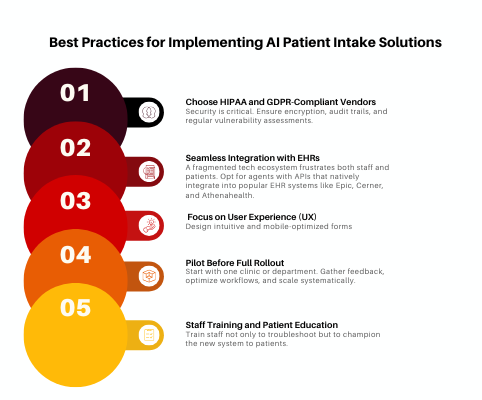
1. Choose HIPAA and GDPR-Compliant Vendors
Security is critical. Ensure encryption, audit trails, and regular vulnerability assessments.
2. Seamless Integration with EHRs
A fragmented tech ecosystem frustrates both staff and patients. Opt for agents with APIs that natively integrate into popular EHR systems like Epic, Cerner, and Athenahealth.
3. Focus on User Experience (UX)
Design intuitive and mobile-optimized forms.
91% of patients prefer filling out medical forms digitally if the experience is smooth.
4. Pilot Before Full Rollout
Start with one clinic or department. Gather feedback, optimize workflows, and scale systematically.
5. Staff Training and Patient Education
Train staff not only to troubleshoot but to champion the new system to patients.
Real-World Impact: A Case Study
At Boston Children’s Hospital, implementing an AI-based virtual intake system reduced form completion times by 70%, leading to improved clinical efficiency and a 22% increase in patient throughput (Source: Boston Children’s Hospital News).
Conclusion
The AI patient intake agent is becoming the new backbone of efficient, patient-centric healthcare systems. It minimizes administrative waste, accelerates revenue, and most importantly, puts patients at the center of the care experience.
As healthcare continues its march toward digital transformation, those who embrace AI-driven intake solutions will be better positioned for operational excellence and sustainable growth.
About RhinoAgents.com
At RhinoAgents, we create AI-driven agents tailored to modern healthcare needs.
Our AI Patient Intake Agents are built with secure APIs, customizable workflows, and seamless integrations to automate patient onboarding from start to finish.

