


Every day, thousands of visitors walk through hospital doors — family members, vendors, delivery staff, contractors, volunteers. Most hospitals greet them with a paper log, a front-desk staff member under pressure, and an access control system that hasn’t meaningfully changed in decades.
That’s a security gap, a compliance liability, and an operational inefficiency — all at once.
AI Hospital Visitor Management Agents are replacing this outdated model with intelligent, automated systems that verify identities, control access, monitor in real time, support infection prevention, and generate the compliance documentation hospitals need — without adding headcount.
This guide covers exactly how they work, what they deliver, the trends driving adoption in 2025, and how to deploy one in your facility.
The Problem with Traditional Visitor Management
Before understanding the solution, it’s worth being specific about what’s broken.
A Ponemon Institute study found that 62% of healthcare organizations experienced data breaches due to unauthorized access or negligent insiders. Paper sign-in logs don’t prevent this — they barely document it. Any determined individual can write a false name and walk through unchallenged.
Beyond security, the operational costs are significant:
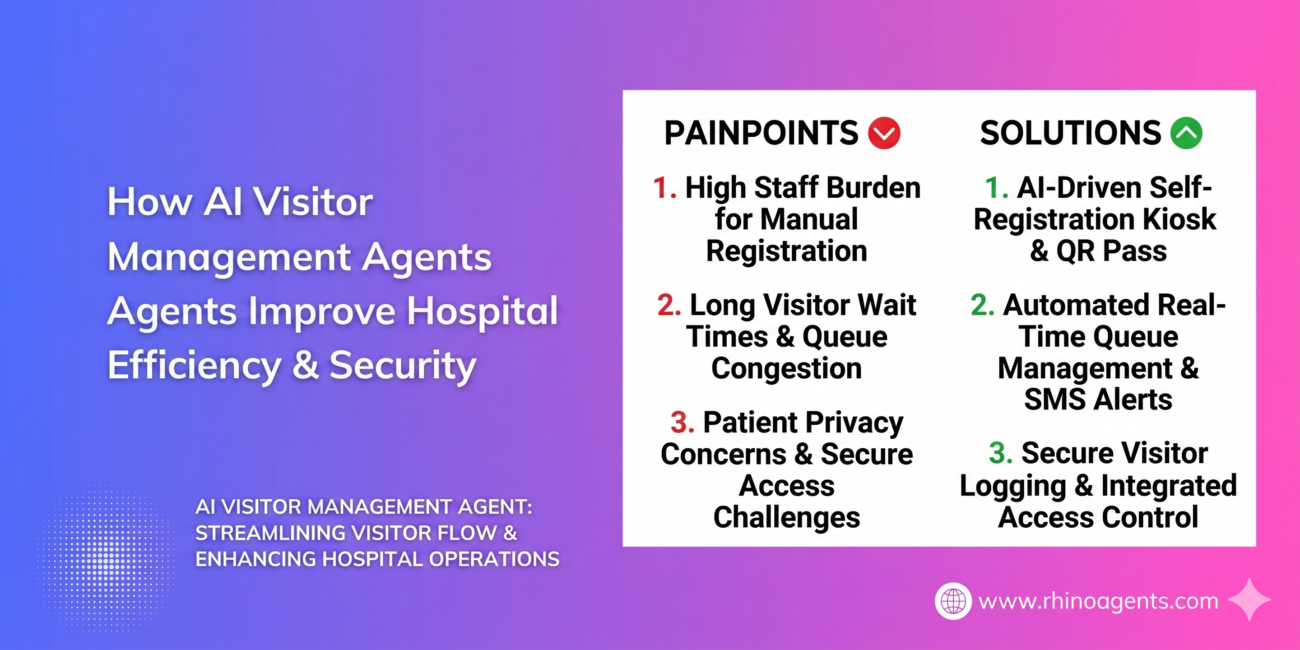
- Front-desk congestion during peak visiting hours creates long queues and frustrated visitors
- Manual data entry is error-prone and produces records that are difficult to audit
- No real-time visibility means security teams can’t know who is in the building at any given moment
- Infection control gaps — during COVID-19 and beyond — require visitor health screening that manual processes can’t reliably deliver
- Paper-based systems cost hospitals thousands annually in staff time, printing, and storage
McKinsey estimates that up to 36% of administrative tasks in healthcare can be automated. Visitor management is one of the clearest candidates.
What Is an AI Hospital Visitor Management Agent?
An AI Hospital Visitor Management Agent is an intelligent system that automates the full visitor lifecycle — from pre-registration and identity verification through access control, real-time monitoring, and post-visit reporting.
It combines:
- Computer vision and facial recognition — for contactless, accurate identity verification
- Digital ID validation — government ID scanning with real-time authentication
- IoT and RFID integration — for location tracking and zone-based access control
- Natural language AI — to handle visitor questions, provide directions, and manage pre-registration workflows
- Real-time analytics — to monitor occupancy, flag anomalies, and generate compliance reports
RhinoAgents’ AI agents for healthcare are built to handle exactly these workflows — configurable through prompts, integrable with hospital systems, and deployable without a development team.
How AI Visitor Management Agents Work: 10 Core Capabilities
1. Enhanced Patient Safety Through Controlled Access
AI-based systems perform multi-level verification at entry — face scans, OTP confirmation, government ID validation, and biometric logs — ensuring only authorized individuals access sensitive areas. Access rules can be defined by department, time of day, visitor role, and patient relationship.
This level of control is not achievable with manual front-desk processes, where staff must rely on judgment calls under pressure. Healthcare AI agents enforce these policies consistently — every visitor, every time, without exception.
Stat: Over 62% of healthcare organizations have experienced breaches tied to unauthorized physical or digital access (Ponemon Institute).
2. Elimination of Front-Desk Congestion
Self-service kiosks and digital check-in apps handle the high-volume, repetitive aspects of visitor intake — freeing front-desk staff for genuinely complex interactions. Visitors who pre-registered complete check-in in under 60 seconds. Even walk-in visitors move through the process faster than a manual queue.
An AI chatbot for healthcare can handle inbound visitor queries before arrival — visiting hours, parking, ward locations, visitor policy — reducing the volume of questions that reach front-desk staff entirely.
Stat: McKinsey estimates up to 36% of healthcare administrative tasks can be automated, with visitor management among the highest-impact targets.
3. Faster, Smarter Check-Ins
Visitors check in via facial recognition, QR code, or mobile pre-registration — no paperwork, no queues, no manual data entry. For returning visitors, the system recognizes them and completes verification automatically.
HIMSS research shows digital check-ins reduce waiting times by over 60%, improving both visitor satisfaction and operational throughput during peak periods.
Voice AI agents for hospitals complement this by calling visitors before their arrival — confirming appointment details, providing access instructions, and pre-loading their profile in the system so check-in is instant when they arrive.
4. Real-Time Visitor Monitoring and Security Alerts
At any moment, hospital security can see exactly who is in the building, which zones they’ve accessed, and how long they’ve been on-site. When a visitor overstays their allowed window or attempts to access a restricted area, the system triggers an immediate alert to security staff.
This visibility is also critical for emergency preparedness — evacuation accountability, lockdown protocols, and incident investigation all depend on accurate, real-time occupancy data that paper logs simply cannot provide.
A report by Accenture found that healthcare executives increasingly prioritize real-time location systems for both security and operational efficiency.
5. Infection Prevention and Health Screening
AI visitor management systems enforce health screening at the point of entry — symptom questionnaires, temperature checks, mask compliance verification — ensuring that your infection control policies are applied consistently, not just when staff remember to ask.
Critically, if contact tracing is required, the system instantly generates a complete record of everyone who visited a specific patient or area during a defined time window. This capability — which would take hours to reconstruct from paper logs — is available in seconds.
An AI chatbot can handle pre-arrival health screening digitally, before the visitor even reaches the facility — flagging high-risk cases and notifying infection control teams before they walk through the door.
6. Pre-Registration and Appointment Linking
Hospitals can offer pre-registration via mobile app or web form, allowing visitors to complete identity verification, confirm patient relationship, and review visiting policies in advance. The system allocates a digital badge, notifies the receiving ward, and links the visit to the patient’s appointment or admission record.
Zebra Technologies research shows 77% of patients prefer a digital experience before arrival — pre-registration directly meets this expectation while reducing arrival-time friction for everyone.
Voice AI agents for hospitals can automate visit confirmation calls entirely — reminding visitors of their approved window, providing parking and access instructions, and handling rescheduling requests without staff involvement.
7. Role-Based Access with Custom Rules
Different visitor types require different access rules. A vendor delivering to the loading dock needs different permissions than an ICU family member or a medical student on rounds. AI visitor management systems support complex, multi-role access configurations — by department, time window, escort requirement, and zone.
Rules for sensitive areas like maternity, psychiatric units, or ICU can be configured to require additional verification steps, supervisor approval, or time-limited badges that expire automatically.
RhinoAgents’ prompt-based configuration means these rules are set in plain language — no IT ticket, no development cycle.
8. Actionable Analytics and Reporting
The system continuously tracks peak visiting hours, average dwell times, visitor volume by department, and repeat visitor patterns. Hospital administrators get automated reports for operational planning, policy evaluation, and resource allocation.
Deloitte emphasizes that data-driven decision-making in healthcare boosts both efficiency and care quality. Visitor flow data directly informs staffing decisions, cleaning schedules, and capacity planning in ways that paper logs never could.
9. Integration with Hospital Systems
A modern AI visitor management agent integrates with:
- Hospital Information Systems (HIS) — to link visits to patient records
- Electronic Medical Records (EMR) — to verify patient admission status and visiting permissions
- Security and Surveillance Systems — for unified monitoring and incident response
- Building Automation — controlling elevators, doors, and access locks based on visitor credentials
When a patient is discharged, the system automatically deactivates visitor access permissions for that patient — no manual update required. Voice AI agents can notify pending visitors of the discharge automatically, saving ward staff from fielding those calls.
10. Cost Reduction and Sustainability
Going paperless eliminates the cost of paper registers, printing, manual digitization, and storage. A hospital with 100,000 annual visitors saves over 200,000 sheets of paper annually — and the associated staff time for data entry and retrieval.
Digital records also mean instant audit readiness. When a Joint Commission inspection or HIPAA audit requires visitor access logs, they’re available in seconds rather than hours of manual record retrieval.
Latest Trends in AI Visitor Management (2025)
Trend 1: Contactless Everything
Post-pandemic expectations have made contactless check-in the baseline, not the premium. Facial recognition, QR codes, and mobile-first experiences are now table stakes for any credible visitor management system.
Trend 2: Integration with Patient Experience Platforms
Leading hospitals are connecting visitor management data with patient experience platforms — using visit frequency and timing data to understand care network support, flag isolated patients, and personalize family communication.
Trend 3: AI-Powered Visitor Communication
Beyond check-in, AI agents are now handling the full visitor communication journey — pre-visit instructions, real-time wayfinding, post-visit feedback collection, and policy updates. This is where AI chatbots and voice agents are adding the most visible value to the visitor experience.
Trend 4: Vendor and Contractor Management
Hospitals are expanding AI visitor management beyond patient visitors to cover the full range of non-clinical entrants — vendors, maintenance contractors, regulatory inspectors, and medical device representatives — each with their own credentialing requirements and access rules.
Trend 5: Real-Time Occupancy for Space Planning
As hospitals optimize space utilization post-COVID, real-time visitor occupancy data is feeding directly into facilities management systems — informing cleaning cycles, HVAC adjustments, and capital planning for waiting area capacity.
Real Results: What AI Visitor Management Delivers
| Metric | Traditional System | With AI Agent |
|---|---|---|
| Check-in time (returning visitor) | 3–5 minutes | Under 60 seconds |
| Check-in time (new visitor) | 5–10 minutes | 2–3 minutes |
| Unauthorized access incidents | Difficult to prevent | Real-time alerts and prevention |
| Contact tracing time | Hours (manual) | Seconds (automated) |
| Compliance report generation | Manual, hours | Automated, instant |
| Paper/printing cost | Ongoing | Eliminated |
| Visitor data accuracy | Error-prone | Consistent and verified |
| Front-desk visitor query volume | High | Significantly reduced |
How to Set Up an AI Hospital Visitor Management Agent: Step-by-Step
Step 1: Map Your Entry Points and Visitor Types
Identify all entry points, the visitor categories that use each (family, vendors, contractors, volunteers), and the access rules that should apply. This mapping becomes the foundation for your agent’s configuration.
Step 2: Connect Your Hospital Systems
Integrate the agent with your HIS, EMR, and security systems. RhinoAgents supports standard API connections and can also work with legacy systems via middleware connectors.
Step 3: Configure Access Rules by Role
Using RhinoAgents’ prompt-based builder, define access policies for each visitor type. For example: “ICU visitors must be on the pre-approved list, limited to two at a time, between 10am and 8pm. A badge is issued for a maximum of 2 hours.” These rules are set in plain language — no coding required.
Step 4: Deploy Pre-Registration and Patient-Facing Channels
Activate the AI chatbot on your website and patient portal for pre-registration and visitor queries. Configure the voice AI agent for outbound visit confirmation and reminder calls.
Step 5: Install Kiosks or Enable Mobile Check-In
Deploy self-service kiosks at entry points for walk-in visitors. Enable QR-based mobile check-in for pre-registered visitors. Configure facial recognition where your facility’s policy and infrastructure support it.
Step 6: Go Live, Monitor, and Optimize
Start with one entry point or one visitor category. Review throughput, alert patterns, and visitor feedback at 2 and 4 weeks. Adjust rules, timing, and communication cadences based on observed behavior. Expand to additional entry points and visitor types as confidence grows.
Key Considerations Before Deployment
HIPAA and Privacy Compliance: Visitor data — especially when linked to patient records — must be handled in compliance with HIPAA. RhinoAgents operates with enterprise-grade encryption, access controls, and audit logging.
Staff Communication: Front-desk staff need to understand the new workflow — what the AI agent handles automatically and what requires human intervention. Plan a brief onboarding session before go-live.
Visitor Communication: Inform patients and their families about the new check-in process in advance — via patient portals, appointment confirmation messages, and signage at entry points.
Edge Cases: Define clear escalation paths for situations the AI can’t handle — visitors without valid ID, emergencies, or access disputes. The agent handles the majority; staff handle the exceptions.
Conclusion
The paper sign-in sheet had a 50-year run. It’s done.
AI Hospital Visitor Management Agents deliver what traditional systems never could: real-time security, automated compliance, infection control enforcement, and a visitor experience that reflects the quality of care your hospital provides.
From controlling access and eliminating front-desk queues to generating instant compliance reports and supporting infection prevention, the impact is immediate and measurable.
With AI agents for healthcare, AI chatbots, and voice AI agents for hospitals working together, your facility can manage every visitor touchpoint — from pre-registration to post-visit feedback — automatically, accurately, and at scale.
About RhinoAgents
RhinoAgents builds intelligent AI agents for healthcare operations — designed to integrate with your existing hospital systems and deliver measurable results without lengthy implementation cycles.
Our AI Hospital Visitor Management Agent automates check-ins, enforces access control, tracks visitor data, supports infection prevention, and generates compliance documentation — all through a no-code, prompt-configurable platform.
Why RhinoAgents:
- No-code setup — configure and launch without engineering resources
- Prompt-based customization — define visitor rules and workflows in plain language
- Full API and system integration — connect to HIS, EMR, security, and building automation
- HIPAA-compliant architecture — enterprise security and audit logging built in
- Complete visitor journey coverage — from pre-arrival chatbot to voice confirmation calls to on-site AI agents
Whether your hospital handles 100 or 10,000 visitors a day, RhinoAgents gives you the infrastructure to manage them intelligently. Explore RhinoAgents for Healthcare →

