


The calls that go to voicemail at the worst possible time
Every coaching institute has a season when the phones don’t stop. Board results are out. A scholarship test is two weeks away. A new JEE or NEET batch has just been announced. Parents and students who have been thinking about coaching for months suddenly act on it, and they act by calling.
This is also when your admissions desk is least able to pick up. Counselors are already in meetings with walk-in families, the lines are busy, and calls roll to voicemail. Some callers leave a message. Most do not. They dial the next institute on their list, and the next one answers.
That is the problem a voice AI admissions counselor is designed to solve. In this post, we’ll look at why phone inquiries are so valuable in coaching, what happens when they’re missed, how a ready-to-use voice agent handles the full call, and how to deploy one. The agent described here is drawn from our voice AI agents for coaching institutes page.
Why the phone still matters in coaching admissions
It is tempting to assume that admissions have moved entirely to forms, ads, and chat. In coaching, the phone remains central, for three reasons.
Parents prefer to talk. Choosing a coaching institute is a high-stakes decision, often involving fees, a multi-year commitment, and a child’s career. Many parents want to hear a real voice, ask follow-up questions, and judge how the institute responds before they commit.
Calls arrive with intent. Someone who picks up the phone is further along than someone who downloads a brochure. They have usually already done their research and want specific answers about batch timings, fees, scholarships, or syllabus.
Calls cluster around deadlines. Results week, scholarship-test registration, and batch launches create spikes that no admissions team is staffed for.
The value of each of those calls is high. The odds of your desk answering all of them at the right moment are low.
What a missed call really costs
The cost of a missed admissions call is easy to underestimate because you never see it. Four things happen quietly.
- The lead is gone. A caller who reaches voicemail rarely calls back. They try another institute, and the first one to answer often wins the conversation.
- Long queues push callers away. Even answered calls suffer when callers are placed on hold for several minutes while the desk works through earlier ones.
- Counselors spend their day on repeat questions. What is the fee? When does the batch start? Is there a scholarship? Each answer is simple, but together they consume the hours counselors should spend with serious prospects.
- After-hours inquiries vanish. Parents often call in the evening and on weekends, after they get home from work. If no one answers, the inquiry never enters your CRM at all.
The cumulative effect is that your best marketing months produce fewer enrollments than they should, not because your coaching is weak, but because the front desk can’t keep up.
Before and after: a JEE crash-course inquiry
A single call shows the difference clearly.
Before. It is the week board results are announced, and a student named Amit calls an institute at 7 p.m. to ask about the JEE crash-course batch. The desk is occupied, and the call goes to voicemail. Amit does not leave a message. He calls another institute, where a counselor picks up, explains the batch, and invites him to a scholarship test. He registers there.
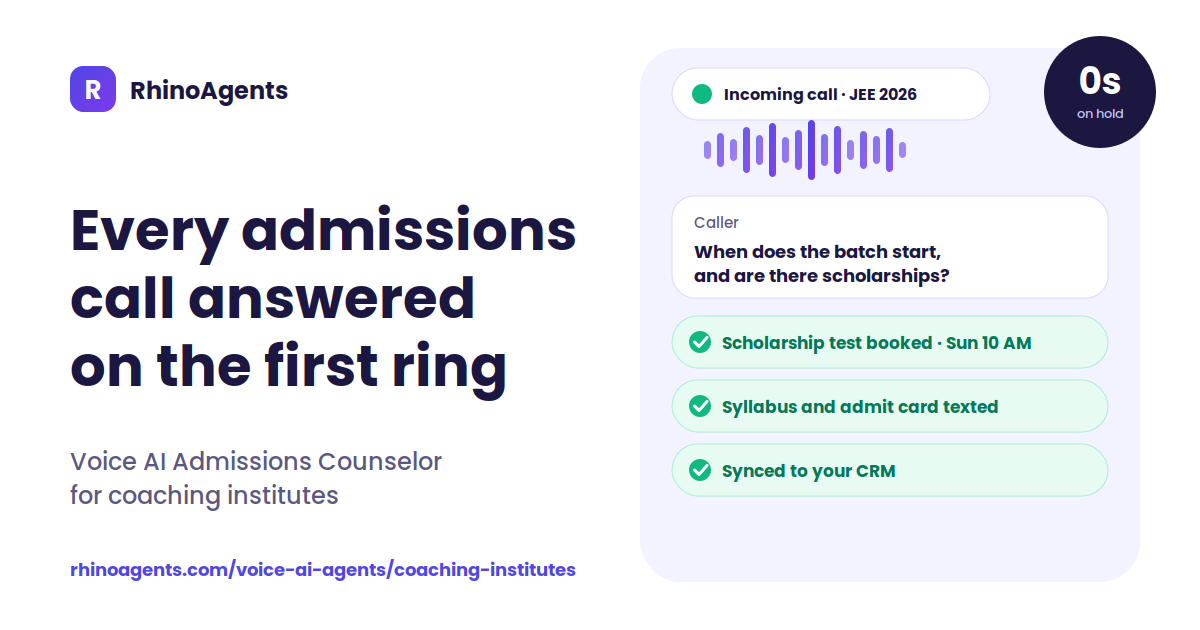
After. Amit’s call is answered on the first ring by a voice AI counselor. He asks when the JEE crash-course batch starts, what it costs, and whether scholarships are available. The counselor explains that the batch starts next Monday, outlines the fee, and mentions that scholarships of up to 50% are offered based on the scholarship test. It asks whether Amit would like to register for the test on Sunday. He says yes. The counselor registers him, texts him the syllabus and admit card, and offers to send a link for a partial deposit to hold a batch seat. Amit pays it that evening. The conversation is logged in the CRM, and a senior counselor can follow up the next morning with full context.
Same caller, same institute. The only change was that someone answered.
What a voice AI admissions counselor does
A voice AI counselor is a ready-to-use AI employee that answers inquiry calls and handles the early admissions conversation from start to finish. It speaks naturally, follows your admissions rules, and works with your CRM and class schedules. Here are its core jobs.
Lead qualification
The agent asks which exam the student is preparing for, such as JEE, NEET, UPSC, CA, or an overseas test, along with their current class, score history, and goals. It then writes a structured record directly into your CRM, so counselors never start from a blank page.
Course and batch FAQs
Batch timings, teachers, study materials, facilities, class sizes, and past selection records are all questions the agent answers instantly from the brochures and fee sheets you upload. It does not improvise on fees or promises.
Demo and scholarship-test bookings
The agent checks availability, matches the student’s schedule, registers them for an online or offline demo class or scholarship test, and texts a confirmation. For more on this workflow, see our page on voice AI for demo bookings.
Fee and installment questions
Parents want to know about installment options, discounts, and scholarship rules before committing. The agent explains them clearly and consistently, and can text a secure payment link during the call so that a batch deposit happens while interest is high. Payment links work through Stripe.
Installment reminders
As due dates approach, the agent can call or message parents with a polite reminder and a direct payment link. That removes an awkward task from your staff and keeps collections on schedule.
Parent transfer and escalation
Some calls need a person: a parent asking for a custom discount, a complaint, or a student who needs a diagnostic learning review. The agent recognizes these, collects the details, and transfers the call to a senior counselor with the full conversation attached.
What the conversation sounds like
Here is a simplified version of a typical inbound call.
Caller: Hi, I want to ask about the JEE 2026 crash-course batch. When does it start, and what is the fee? Also, are there scholarships?
AI counselor: Hi! Happy to help. The JEE 2026 crash-course batch starts next Monday. I can share the full fee structure by text. We also offer scholarships of up to 50%, based on the results of our upcoming scholarship test. Would you like me to book your slot for the test this Sunday?
Caller: Yes, please. What is the syllabus?
AI counselor: You’re registered for Sunday at 10:00 AM. The test covers Class 11 and 12 Physics, Chemistry, and Mathematics. I’m texting you the syllabus and your admit card now. Would you like a link to place a partial deposit and hold your batch seat?
(This example is illustrative. Your counselor answers from your own batches, fees, and test schedules.)
Outbound calling: the other half of admissions
Inbound calls are only part of the opportunity. A great deal of enrollment comes from following up with people who showed interest but did not commit: students who downloaded a mock paper, parents who attended a webinar, or families who inquired last season and went quiet.
A voice agent can call these lists on your behalf. For example, it can:
- Contact registered inquiries before a scholarship test to confirm attendance and answer last-minute questions.
- Re-engage lapsed inquiries with an upcoming batch or test.
- Follow up with brochure downloaders, answer concerns, and nudge them toward a demo class.
- Place a quick check-in call before a demo class to confirm the student is coming.
Our voice page shows live campaigns of exactly this kind, such as scholarship-test recall calls and lapsed-admissions re-engagement, running alongside incoming calls. For more on this approach, see our overview of voice AI for lead nurturing and our page on candidate outreach.
Speaking the family’s language
Coaching institutes often serve students and parents who are most comfortable in different languages. A parent may prefer Hindi, Telugu, Marathi, Tamil, or Bengali, while the student speaks English.
The voice counselor detects the caller’s language and switches during the conversation. Our page lists support for more than 15 languages, including English, Hindi, and Spanish, with a fallback language you choose. That means a parent calling in Hindi hears a patient, natural reply in Hindi rather than being asked to press a button or wait for a staff member who speaks it.
You can also choose the counselor’s voice, tone, and speaking speed, whether you want an empathetic and friendly manner, an encouraging one, or a more formal one.
Routing: AI for peaks and off-hours, your desk for the rest
A voice agent does not have to replace your front desk. You decide how calls are split.
- Evenings, weekends, and holidays: the AI answers every call.
- Peak season: the AI picks up whenever your lines are busy, so no caller reaches voicemail.
- Standard business hours: calls can go to your reception desk, with the AI as backup.
- Sensitive calls: custom discount requests, complaints, and learning-support reviews are routed to senior counselors.
This arrangement keeps the human touch where it matters while ensuring that no inquiry goes unanswered.
Connecting to your CRM and class systems
The agent is only useful if what it learns reaches your team. The voice page describes native syncing with CRMs such as LeadSquared, HubSpot, Salesforce, and Zoho, along with Moodle for demo and test registrations. You can also use Google Sheets or a custom webhook if your admissions data lives elsewhere.
Because the agent reads batch availability from your own systems, its answers stay current. When you update a batch in your LMS or CRM, the counselor knows about it on the next call. If you want to see how this connects to the full enrollment process, our page on voice AI for student enrollments and our overview of voice AI for education go further. For a view of how the same idea works in chat, read about our AI agents for coaching institutes.
What results can look like
Outcomes depend on your volume, market, and processes, but here is what the coaching-institute page reports from institutes using the voice counselor, as shown on that page:
- Instant response to inbound calls, compared with an average hold time of nearly four minutes at a traditional desk
- 91% demo-class attendance, compared with 62% when there is no follow-up reminder
- Roughly 310 student inquiries qualified per week, compared with about 84 handled by a traditional desk
- Lower weekly admin overhead per center
The same page features a JEE/NEET prep institute that reported its admissions yield rising 3.2x, a civil services academy that registered 410 students while responding to leads in under a minute, and a commerce and CA academy that raised demo attendance to 91% with voice check-in reminders. Treat these as examples of what is possible rather than a guarantee. Your own results will depend on your starting point.
What to measure
If you deploy a voice counselor, track these from the first week:
- Answer rate and wait time. The share of calls answered on the first ring, and the time callers wait.
- After-hours capture. How many inquiries you now record outside office hours.
- Lead-to-demo and lead-to-test rate. The share of callers who book a demo class or scholarship test.
- Demo and test attendance. Where reminder calls and texts show their effect.
- Deposit and enrollment rate. How many calls end with a paid seat or a booked follow-up.
- Counselor time on routine questions. A direct measure of capacity freed.
Watching these together shows you where each caller moves forward and where you still lose them.
A simple rollout plan
You can deploy a first version quickly. Our voice page describes setup in about ten minutes, and many institutes spend a day refining it.
- Choose your focus. JEE/NEET, UPSC, CA/commerce, or international tests such as SAT, GRE, and IELTS.
- Select the use cases. Intake and qualification, demo booking, fee FAQs, scholarship-test booking, parent routing, and installment reminders.
- Connect your systems. CRM, LMS, payment links, and your phone number.
- Upload your knowledge. Fee structures, installment schedules, scholarship criteria, brochures, and scripts.
- Set voice, tone, and languages. Pick the counselor’s voice, manner, and the languages your families use.
- Define handoff rules. Decide which requests transfer to a senior counselor.
- Test with mock calls, then route one line or one time window to the agent first and expand from there.
If your team prefers help with configuration, our team also offers done-for-you setup.
Frequently asked questions
What is a voice AI admissions counselor?
It is a ready-to-use AI employee that answers inquiry calls for your coaching institute, qualifies students, answers course and fee questions, books demo classes and scholarship tests, and texts payment links, around the clock.
Can it book demo classes and scholarship tests automatically?
Yes. It reads availability from your systems, matches the student’s schedule, registers them, and texts the confirmation, syllabus, and admit card.
How does it handle fee and deposit questions?
It explains installment options, discounts, and scholarship rules from the documents you provide, and can text a secure Stripe link so a family can place a deposit and hold a batch seat.
Does it speak the languages our families use?
Yes. It supports more than 15 languages, including English, Hindi, Spanish, Telugu, Marathi, Tamil, and Bengali, and switches automatically based on what the caller speaks.
Can we use it only for evenings, weekends, and busy periods?
Yes. You can route calls by schedule, so the AI answers outside business hours or whenever your lines are busy, while your desk handles the rest.
Does it replace our counselors?
No. It handles first response, routine questions, scheduling, and follow-up. Counselors spend their time with qualified families and complex conversations, such as custom discounts and complaints.
Will it work with our CRM?
Yes. It syncs with LeadSquared, HubSpot, Salesforce, Zoho, and others, and writes structured lead records after each call.
Is student and parent data protected?
RhinoAgents uses encryption for student leads and follows SOC 2 and GDPR practices.
Keep your batches full
Every call during results week is a family making a major decision and reaching out to you first. Whether that call turns into an enrollment often comes down to one question: did someone pick up? A voice AI admissions counselor makes sure the answer is always yes, whether it is 7 p.m. on a busy results day or 10 a.m. on a quiet Sunday.
Explore the full details on our voice AI agents for coaching institutes page, or book a demo to hear a counselor handle a call using your own batches and fees.

