


The enrollment you lost on a Sunday evening
A parent is comparing coaching institutes for their child’s JEE preparation. On Sunday evening, they message three of them on WhatsApp: When does the next batch start? What is the fee? Can my son attend a trial class first?
Two institutes reply on Monday. One replies in under a minute with the batch dates, the fee structure, and two trial-class slots for the coming week. You can guess which one gets the trial booking, and probably the admission.
This is the quiet math behind most coaching-institute enrollment. Institutes spend heavily on ads, brochures, and word of mouth to generate inquiries, then lose a large share of them to two problems that have nothing to do with teaching quality: slow replies and trial-class no-shows. Both are operational, and both are fixable.
In this post, we’ll look at where the enrollment funnel leaks, how a ready-to-use AI agent on WhatsApp closes those gaps, and how to deploy one for your institute. The agents described here come from our AI agents for coaching institutes page.
The two leaks that cost coaching institutes the most
Leak 1: The inquiry nobody answers in time
Parents research courses in the evening and on weekends, often late at night after the child is asleep. That is exactly when your admissions desk is closed. Staff also spend much of their working day answering the same questions: What is the fee? When does the next batch start? What is the timing? While they do, new inquiries wait in the queue.
The result is predictable. A parent writes on Sunday, gets a reply on Monday, and has already booked a trial class somewhere else.
Leak 2: The trial class that nobody attends
A trial class is the most important conversion step in coaching. A student who sits in one class and likes the teacher is far more likely to enroll than one who only read a brochure. But booking a trial and attending one are different things.
Students forget. Parents get busy. The joining link is buried in a message thread. Calling each family to remind them is slow, and when staff are already overloaded, the reminders simply don’t happen. The seat stays empty, the teacher teaches to a half-full room, and the admissions team never learns whether the student was genuinely uninterested or simply forgot.
These two leaks sit at the top and middle of the funnel, so every enrollment you win later depends on fixing them first.
Before and after: a Sunday-evening inquiry
Before. At 8:15 p.m. on Sunday, a parent messages your institute’s WhatsApp number about the JEE batch. No one is on duty. The message waits. On Monday at 10:30 a.m., a staff member replies with the fee and asks the parent to call the office. The parent is at work and misses the call. By Tuesday, the staff member has sent a trial-class link, but the parent has already visited another institute’s demo on Monday evening. Even for the inquiries that do convert, a Monday reply plus a missed call turns a one-day decision into a one-week delay.
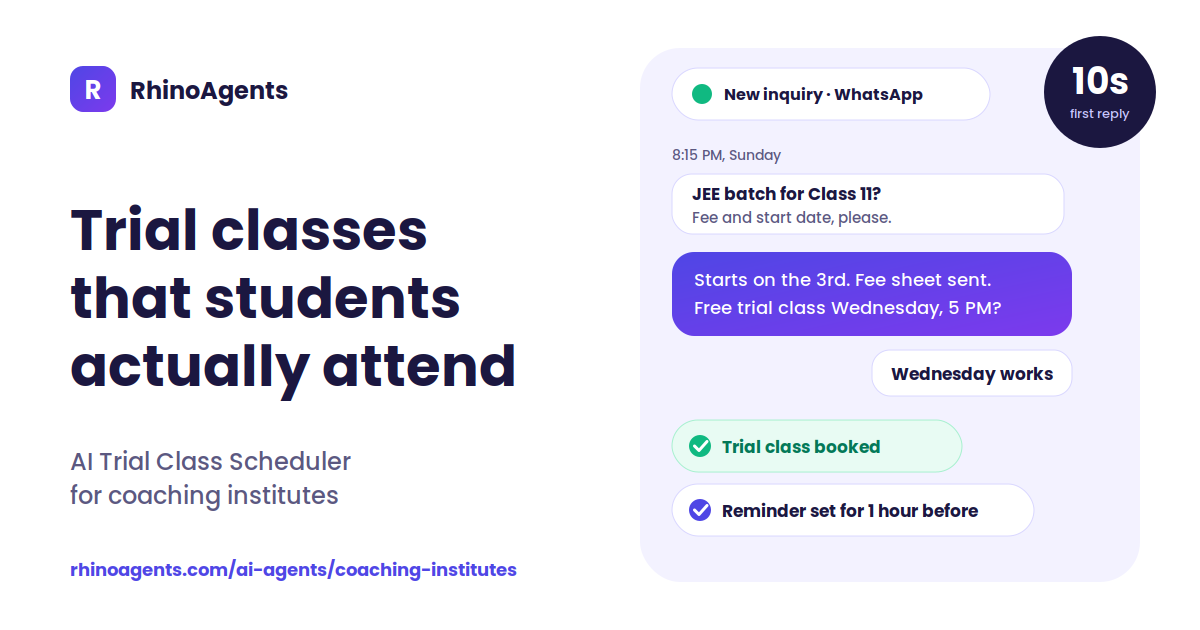
After. At 8:15 p.m., the parent’s message is answered within seconds by an AI Course FAQ and Trial Class agent on your WhatsApp number. It asks which class the student is in and which exam they are preparing for, then shares the right batch’s start date, timings, and fee structure. It offers two available trial slots with named teachers. The parent picks Wednesday at 5 p.m. The agent confirms the booking, sends the joining details, and schedules a reminder for the morning of the class and another an hour before it. On Wednesday, the student attends. A counselor, who now sees a warm, briefed lead in the CRM, follows up with the family that evening.
Same inquiry, same institute. The difference was the first ten seconds and the follow-through.
What an AI agent actually does for a coaching institute
An AI agent is more than a chatbot with canned replies. It understands context, reasons about a goal, and completes tasks across your tools. In the coaching setting, a single agent can answer a syllabus question, offer a trial class, check teacher availability, and book the student, all in one conversation.
On our education page, this works as a simple loop:
- Perceive. The agent receives an inquiry through your website, WhatsApp, or email.
- Reason. It understands the student’s grade, subject interest, and the specific questions being asked.
- Retrieve. It pulls course details, fee structures, and timetables from your own documents and systems.
- Act. It answers, books a trial class, or sends an enrollment link.
- Learn. It highlights which questions come up most often, so you can improve brochures and course pages.
Because the agent works from the brochures, fee sheets, and timetables you upload, its answers match what your institute actually offers. It doesn’t guess, and it doesn’t make up fees.
The agents that cover the full funnel
You can deploy a single agent or combine several. For coaching institutes, these are the ones that matter most.
Trial Class Scheduler
This agent engages prospective students, answers basic questions, and books them into available trial-class slots automatically. It checks teacher availability through your calendar, so it never double-books a seat. It connects to Google Calendar so bookings appear where your team already looks.
Course FAQ Bot
This agent learns your full syllabus, fee structure, and schedule, and answers detailed inquiries around the clock on your website and WhatsApp. It is the one that removes the burden of routine questions from your admissions desk. Institutes using agents like this typically see most routine queries handled automatically, which frees staff to focus on counseling and closing admissions.
Enrollment Assistant
Once a family is ready, this agent walks them through registration, collects the necessary details, and shares payment links. It makes the step from “interested” to “enrolled” a short conversation instead of a paper trail.
Fee Reminder Agent
Calling parents about overdue tuition is uncomfortable and can strain the relationship. This agent monitors your fee system and sends polite reminders with secure payment links before and after due dates, keeping the tone professional and the process consistent.
Parent Communication Bot and Student Progress Tracker
Parents who feel out of the loop are more likely to withdraw their child. These agents answer questions about holidays, cancellations, and teacher availability, and send performance updates and test scores by WhatsApp or email, which cuts incoming phone calls and keeps families informed.
The education page lists eight agents in total, including a Homework Help Bot and an Alumni Engagement Agent. Most institutes start with the first two and add the rest as they see results.
What the conversation looks like
Here is a simplified example from a coaching institute’s WhatsApp number on a Sunday evening.
Parent: Hi, I want to know about the JEE batch for Class 11. What is the fee and when does it start?
AI: Hello! Happy to help. Our Class 11 JEE batch starts on the 3rd, with weekday evening classes. I’ve attached the fee structure and the syllabus overview. Is your child currently studying in Class 10 or already in Class 11?
Parent: Just finished Class 10.
AI: Great, this batch is designed for exactly that. Would you like your child to attend a free trial class before deciding? I have Wednesday at 5:00 PM and Friday at 6:00 PM available.
Parent: Wednesday works.
AI: Booked. I’ve sent the joining details, and I’ll send a reminder on Wednesday morning and one hour before class. If anything changes, just reply here and I’ll reschedule.
The whole exchange takes about two minutes, and no staff member had to be awake for it. (Figures and dates in this example are illustrative. Your agent answers from your own brochures and timetables.)
Fixing no-shows: reminders that actually happen
No-shows are rarely a sign of low interest. They are usually a sign of missing follow-up. An agent addresses this in three ways.
Timely reminders. The agent sends a WhatsApp reminder with the joining link before each trial class, and a second one shortly before it starts, so the class is on the family’s radar at the right moment.
Easy rescheduling. If the student can’t make it, they reply to the same chat and pick another slot. There is no phone tag, so a cancellation becomes a rebooking instead of a lost lead.
Follow-up after the class. The agent checks in after the trial, answers new questions, and sends the enrollment link, or hands the family to a counselor with the full conversation attached.
Our education page cites 3x more trial-class bookings for institutes that deploy these agents. The result you see will depend on your volume and market, but the mechanism is consistent: faster answers and automatic reminders turn more inquiries into attended classes.
The rest of the pipeline: leads, marketing, and retention
Trial classes are the centerpiece, but the same agent set tackles the surrounding problems.
Messy lead tracking. Inquiries arrive from Instagram, WhatsApp, and your website, then scatter across phones and spreadsheets. An agent captures leads from every channel, qualifies them, and logs them in your CRM, such as HubSpot. For more on this stage, see our overview of AI lead generation.
Generic marketing blasts. Sending the same promotion to Class 10 and Class 12 families drives opt-outs. Because the agent knows each student’s grade and past inquiries, it can send relevant course suggestions to the right families. This pairs well with your wider marketing efforts.
Student onboarding. After enrollment, an agent can guide families through the first-week steps, much like our onboarding agents do for new employees.
If you’re looking at the broader category, our page on AI agents for education covers schools, training providers, and bootcamps as well.
What to measure
An agent changes which numbers matter. Track these from the first week:
- First response time. This should drop from hours to seconds, and it is usually the first metric to improve.
- Inquiry-to-trial rate. The share of inquiries who book a trial class.
- Trial attendance rate. The share who actually attend. This is where reminders show their value.
- Trial-to-enrollment rate. The share of attendees who join a batch.
- Share of queries resolved without staff. A direct measure of the workload lifted from your admissions desk.
- Fee collection timeliness. How quickly overdue payments are cleared once automated reminders start.
When you look at these together, you can see exactly where each family enters and leaves the funnel.
A simple way to deploy your first agent
You don’t need an IT team or a long project. Many institutes deploy their first agent in under an hour.
- Describe what you need in plain language. For example: “Answer parent queries about our JEE batches on WhatsApp, check teacher availability, and book free trial classes.”
- Pick the agent type. Course FAQ Bot, Trial Class Scheduler, Fee Reminder, or a combination.
- Connect your tools. WhatsApp, Google Calendar, your CRM, and your fee system.
- Upload your knowledge. Brochures, fee structures, and timetables, in whatever format you already have them.
- Test, then go live. Message the agent yourself, check the answers, and then connect it to your website or WhatsApp number.
Keep a human escalation path throughout. For discount requests, complaints, or questions about a student’s learning needs, the agent should hand over to a counselor with the full conversation so the family never has to repeat themselves.
Will it replace our counselors or teachers?
No, and this is the question we hear most. The agent handles the first response, scheduling, reminders, and routine follow-up. Counselors spend their time with warm, qualified families, which is where their judgment matters. Teachers focus on teaching. The institute simply stops losing students to delays that no one on the team chose.
Frequently asked questions
What AI agents work best for coaching institutes?
Most institutes start with a Course FAQ Bot to handle routine inquiries and a Trial Class Scheduler to increase bookings, then add a Fee Reminder Agent to automate collections.
Can the agent work on WhatsApp?
Yes. It connects natively to WhatsApp Business, so parents and students can talk to it on the platform they already use every day. You can learn more on our page about AI agents on WhatsApp.
Does it connect to our calendar and CRM?
Yes. It works with Google Calendar, Zoom, LeadSquared, HubSpot, and other common tools through one-click integrations, so bookings and leads sync automatically.
Do we need a developer to set it up?
No. You describe what the agent should do in plain language, upload your course documents, connect your channels, and go live.
How does it help our admissions staff?
By answering the large share of routine questions about batch timings, fees, and syllabus, it frees staff for counseling and closing admissions.
Is student and parent data secure?
RhinoAgents uses encryption in transit and at rest, and follows GDPR and SOC 2 practices, so family information stays protected.
How long does it take to go live?
Most institutes deploy their first agent in under 60 minutes.
Turn Sunday-evening inquiries into attended trial classes
Every inquiry is a family who raised their hand while their interest was high. Whether it converts usually depends on who answers first and whether the trial class actually happens. An AI agent on WhatsApp makes sure both are covered, at 8 p.m. on a Sunday as much as at 10 a.m. on a weekday.
Explore the full set of AI agents for coaching institutes, or book a demo to see a Trial Class Scheduler working with your own batches and timetables.

