


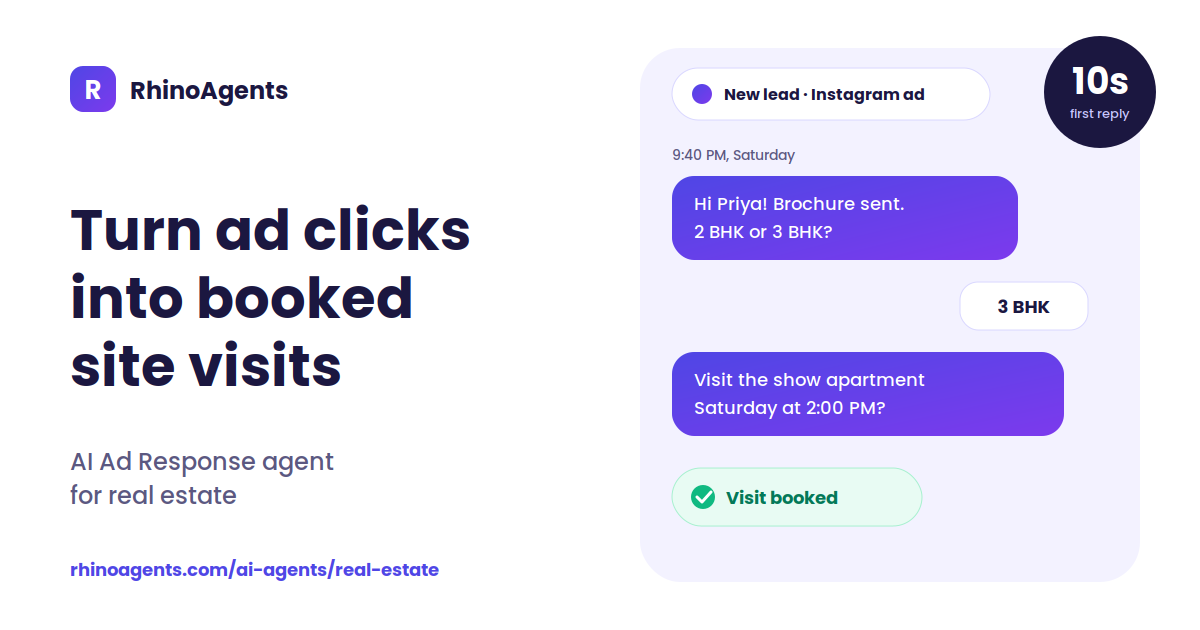
The click is the cheapest part of the sale
A real estate marketing team can do everything right. The creative is strong, the targeting is tight, the launch campaign is live, and the clicks are coming in. Then something quietly goes wrong. A buyer fills in a form at 9:40 on a Saturday night, and nobody replies until Monday afternoon. By then the buyer has spoken to two other developers, saved three listings, and forgotten the form entirely.
This is the most expensive leak in property marketing, and it hides in plain sight. Your dashboard shows cost per click and cost per lead, and both look healthy. What it doesn’t show is the gap between a lead arriving and a human (or anything else) responding. That gap is where ad spend turns into wasted spend.
In this post we’ll look at why ad leads go cold so quickly, what an AI Ad Response agent does about it, and how developers, brokerages, and marketing teams can deploy one that engages every lead within seconds, qualifies them, and books the site visit. It’s one of the eight ready-to-use agents on our AI agents for real estate page.
Why ad leads go cold faster than any other lead
Leads from ads behave differently from referrals or walk-ins. Three things make them fragile.
Intent is at its peak for a few minutes. Someone who taps a property ad on their phone is looking at listings right now. Their interest is at its highest the moment they submit the form, and it decays quickly as they scroll to the next thing. A widely cited rule of thumb in sales is that conversion probability drops sharply once a lead waits more than five minutes for a reply. The exact number varies by market, but the direction never does.
Ad leads are comparison shoppers. The same buyer is often clicking on ads from several projects at once. Whoever replies first with useful information, such as a brochure, a price range, or a floor plan, becomes the project the buyer mentally shortlists.
Ad traffic arrives on the marketing team’s schedule, not the sales team’s. Campaigns run at night, on weekends, and during festive-season pushes. Your sales team works defined hours. The leads don’t.
Put those together and you get a predictable pattern: the more you spend on ads, the more leads you pay for that nobody answers in time.
Six places your ad spend leaks
There are six common leaks between a click and a site visit. Most real estate teams have at least four of them.
1. The response delay
The form is submitted, and the lead enters a queue. It might be picked up in an hour, or at the start of the next working day. Meanwhile a competitor with an instant reply has already sent a brochure.
2. The generic first message
Even when a team responds quickly, the first message is often a template: “Thanks for your interest, our executive will call you.” It tells the buyer nothing and gives them no reason to stay engaged.
3. The unqualified lead pile
Ad campaigns bring in everyone: genuine buyers, window-shoppers, wrong budgets, wrong cities, and the occasional wrong number. Sales agents spend hours calling through them, and the genuinely hot buyers wait in the same queue.
4. The after-hours void
Property browsing peaks in the evenings and on weekends. If nothing responds during those hours, a large share of your leads effectively arrive into silence.
5. The scheduling back-and-forth
Even a warm lead can drift away when booking a visit takes five messages and two missed calls. Every extra step costs you a few buyers.
6. The forgotten follow-up
Leads who aren’t ready to book today still matter. Without consistent nurturing, they quietly disappear into the database.
None of these is a people problem. Sales teams are busy and doing their best. They are structural gaps that a human team cannot cover around the clock at the speed buyers expect.
Before and after: a Saturday-night launch
It helps to see the same campaign twice.
Before. A developer launches a new residential phase with a weekend Facebook and Instagram campaign. By Saturday night, 140 leads have come in. The sales team is offline until Monday at 10 a.m. On Monday, two executives start calling down the list. Roughly a third of the numbers don’t pick up, another chunk are outside the budget range, and some buyers say they’ve already booked a visit elsewhere. Of the 140 leads, perhaps eight make it to a site visit. The cost per visit is high, and the marketing team is asked why lead quality is poor.
After. The same campaign runs, but an AI Ad Response agent is connected to the lead forms. Within seconds of each submission, the buyer receives a personalized message on WhatsApp: a thank-you, the project name they enquired about, a short brochure, and a question about their preferred configuration. The agent then asks about budget and timeline, answers questions about amenities and possession dates, and offers two or three site-visit slots. By Monday morning, the sales team opens their CRM to find leads already sorted: those who booked a visit, those who are warm but undecided, and those who didn’t fit. The executives spend their week on showings and closures.
The leads were the same. The ad spend was the same. What changed was the first ten seconds.
What an AI Ad Response agent actually does
An Ad Response agent is a ready-to-use AI employee that sits directly behind your ad lead forms. As described on our real estate page, it captures lead submissions from Facebook, Instagram, and Google ads within seconds and engages the buyer immediately. Here is what happens in a typical flow.
Step 1: Capture
When a lead submits a form on Facebook, Instagram, or Google Ads, the agent receives the details instantly. It knows which campaign, project, and ad the lead came from, so the first message can be specific rather than generic.
Step 2: Instant first response
The agent replies in around ten seconds on the channel the buyer is most likely to use, usually WhatsApp. The message acknowledges the exact project, shares the relevant brochure or pricing summary, and opens a conversation instead of ending one.
Step 3: Qualify in conversation
Rather than sending a long form, the agent asks natural questions: budget range, preferred configuration, buying timeline, self-use or investment. If you want a deeper look at this stage, our guide to AI lead qualification covers how it works.
Step 4: Answer questions
Buyers rarely go straight to booking. They ask about carpet area, possession dates, payment plans, and nearby amenities. The agent answers from the brochures, price sheets, and FAQs you’ve uploaded, so it speaks accurately about your project.
Step 5: Book the site visit
When a buyer shows interest, the agent offers real slots from your calendar, confirms the booking, and sends the location pin and a reminder. It works with Google Calendar and Calendly, so bookings land where your sales team already looks.
Step 6: Hand off to your team
The complete conversation is logged to your CRM, such as HubSpot or Salesforce, with the buyer’s budget, preferences, and booking status. Your sales executive sees a briefed, qualified lead rather than a cold name and number.
What the conversation looks like
Here is a simplified example of a first exchange, starting about ten seconds after a buyer submits an Instagram ad form.
AI: Hi Priya! Thanks for your interest in Skyline Residences. I’ve sent you the brochure here. Are you looking for a 2 BHK or a 3 BHK?
Buyer: 3 BHK.
AI: Great choice. To show you the right options, what budget range are you considering?
Buyer: Around 1.2 to 1.5 million.
AI: That works well with our 3 BHK units on floors 8 to 14. Are you buying for yourself or as an investment, and when are you hoping to move?
Buyer: For ourselves, within the next six months.
AI: Perfect. Would you like to see the show apartment? I have openings on Saturday at 2:00 PM and 4:30 PM.
In under two minutes, the buyer has received the brochure, confirmed their configuration and budget, shared their timeline, and been offered a visit. No human had to be awake for any of it.
Where the Ad Response agent fits with your other agents
The Ad Response agent is the front door. It works best alongside the other real estate agents on the platform.
- Lead Qualifier goes deeper on budget, financing, and configuration once the first conversation is underway.
- Property Assistant handles detailed questions about amenities, floor plans, and possession timelines.
- Booking and Scheduling Bot manages rescheduling, reminders, and directions for site visits.
- Outbound Follow-up re-engages leads who didn’t book, with property recommendations and price updates over WhatsApp.
- Inbound Voice Reception picks up when a buyer prefers to call instead of message.
You can start with the Ad Response agent alone and add the others as you see results. Because they share the same knowledge base, a buyer moving from the first message to a booking to a follow-up experiences one consistent conversation.
The stack it connects to
An ad response agent is only useful if it connects to the tools your team already uses. RhinoAgents offers one-click connections to the systems most real estate teams rely on:
- Lead sources: Facebook, Instagram, and Google Ads, plus a webhook for portals and landing-page forms
- Messaging: WhatsApp Business and email
- CRM: HubSpot, Zoho, and Salesforce (see our overview of AI agents for CRM)
- Calendars: Google Calendar and Calendly
- Inventory and pricing: Google Sheets or your master inventory file
Nothing needs to be replaced. The agent works with what you have.
Metrics marketing teams should track
An AI agent changes which numbers matter. Rather than judging campaigns by lead volume, track the metrics that show whether clicks are becoming visits.
- Time to first response. This should drop from hours to seconds, and it is the first number to improve.
- Lead-to-conversation rate. The share of leads who reply at least once. Instant, relevant replies lift this.
- Qualification rate. The share of leads whose budget, timeline, and preferences are captured.
- Lead-to-site-visit rate. The share of leads who book and attend a visit. This is the metric that connects marketing to sales.
- Cost per site visit and cost per acquisition. The real test of whether your ad spend is working.
- No-show rate. Automated confirmations and reminders should bring this down.
When marketing and sales both look at lead-to-visit rate instead of lead volume, the “lead quality” argument largely goes away.
What results can look like
Outcomes will vary by project, market, and campaign, but here are the figures real estate developers and agencies report after deploying agents on RhinoAgents, as shown on our real estate page:
- 10 seconds average first response time
- 3x more site visits booked
- 65% lower cost per acquisition
- 40 hours saved per week on manual messaging and data entry
One developer, Prestige Builders, set up a lead qualifier agent for a new residential launch and reported that over 78% of incoming leads were qualified and booked for tours automatically, with the sales team closing three times as many units in the first month. Your own numbers will depend on your inventory, pricing, and ad quality, but the pattern is consistent: faster, more relevant first contact leads to more visits.
Who benefits most
- Real estate developers running project launches, where a burst of ad leads arrives in a short window.
- Brokerages and agencies that want every agent to have 24/7 booking support.
- Marketing teams who need to prove return on ad spend and are tired of leads going to waste.
- Sales teams who would rather spend their time on showings and closings than on cold-calling a raw list.
A simple rollout plan
You don’t need a long project to get started. Most teams deploy their first agent in under an hour, and this is a sensible order to follow:
- Pick one campaign. Start with your highest-volume ad channel or your next launch.
- Describe what the agent should do. For example: “Respond to every new Facebook and Instagram lead on WhatsApp within 10 seconds. Share the brochure, ask about configuration, budget, and timeline, and book a site visit on Google Calendar.”
- Upload your knowledge. Brochures, price sheets, floor plans, and FAQs, so the agent answers accurately.
- Connect your tools. Lead forms, WhatsApp, CRM, and calendar.
- Test with your own team. Submit a few test leads and read the conversations.
- Go live on one campaign, review the conversations after the first week, and refine the prompts.
- Expand. Add follow-up, voice, and booking agents as the numbers justify it.
Throughout, keep a human escalation path. For complex negotiations, financing questions, or unhappy buyers, the agent should hand over to a senior team member with the full conversation attached.
Frequently asked questions
What is an AI Ad Response agent for real estate?
It is a ready-to-use AI employee that captures leads from Facebook, Instagram, and Google ads, replies within seconds, qualifies the buyer through conversation, and books a site visit, all without a human having to respond first.
How fast does it respond to a new lead?
Our real estate page reports an average first response time of around 10 seconds across WhatsApp, web, and portals, at any hour.
Does it replace my sales team?
No. It handles the repetitive, time-sensitive first stage: instant response, qualification, and scheduling. Your sales team focuses on site visits, negotiations, and closing. Developers report their teams having roughly 2.5 times more capacity once qualification and follow-up are automated.
Will it work with my CRM?
Yes. It connects to HubSpot, Zoho, Salesforce, and other tools, and logs every conversation, qualification detail, and booking status automatically.
Can it handle buyers in different languages?
Yes. You can specify languages in your instructions, such as English and Spanish, and the agent will respond accordingly. RhinoAgents supports more than 50 languages.
Is buyer data secure?
RhinoAgents uses encryption in transit and at rest, is GDPR and SOC 2 compliant, and does not use buyer personal data for training without consent.
How long does it take to go live?
Most agencies and developers deploy their first real estate agent in under 60 minutes.
Turn your next campaign into booked visits
Every ad click is a buyer who raised their hand. The only question is whether someone answers while their interest is still high. An AI Ad Response agent makes sure the answer is always yes, at 9:40 on a Saturday night as much as at 10 a.m. on a Monday.
Explore the full set of AI agents for real estate, or book a demo to see an Ad Response agent working on your own campaign.

